Law Firm Backlinks – Using Your Content To Help

Law firm backlinks are one of those seemingly mysterious parts of legal SEO, but they don’t have to be. Of all the optimization strategies that help boost search engine rankings, acquiring credible backlinks has proven to be one of the most effective and enduring. Backlinks are evidence that someone else has reviewed the content and finds it to be an authoritative source. The more quality backlinks pointing toward a piece of content, the more trustworthy search engines deem the content to be and the higher it will rank.

Getting law firm backlinks requires a combination of specialized legal knowledge, top-notch qualifications, and information that is comprehensive, accurate, reliable, and can connect with a particular audience. 

  1. What Backlinks Mean to Search Engines
  2. Not All Backlinks Have the Same Authority
  3. Quality Content is the Best Way to Attract Authentic Backlinks for Lawyers
  4. How to Get Started with a Credible Law Firm Backlink Strategy
Backlinking for law firms.
Well-written and researched content can elevate your law firm’s backlink strategy.

Backlinks are like independent votes of confidence verifying the quality of content for search engines. They can also help determine content relevancy. When other relevant websites include a link back to content on a law firm’s website, it tells Google that the content is both reliable and helpful. Like votes, the more backlinks law firm content has, the more likely it will win at ranking in search results.

SEO expert Backlinko recently conducted a study of close to 12 million Google search results to determine what factors were most closely correlated with landing in the top spot on page one of the search results. 

The study found that the #1 search result had an average of 3.8 times more backlinks than the results appearing in positions 2 through 10. The study also found the number of different domains linking to a page (as opposed to the same domain linking to a page several times) had a positive correlation with ranking. 

Link building is the process of actively trying to obtain backlinks. Link building is not just about racking up as many backlinks as possible because links open pathways for search engines, and that may not always be appropriate or desired. 

Making determinations of authority helps Google select the content that it believes will be of the most help to a user. Link authority is the amount of ranking weight a link carries. The more link authority a backlink has, the higher the quality and the more ranking weight it will be given. 

The following considerations help determine the authoritativeness of a backlink:

  • Authority of the page containing the link
  • Number of other links on the page containing the link
  • Location of the link on the page 
  • Whether the link is follow or no-follow

Links from pages recognized as authoritative are given higher link authority. Links from pages with lots of other links will not get as much authority as links from pages with fewer other links. Links that are located within text are given more authority than links appearing in footnotes. 

No-follow links contain coding that tells search engines not to consider them for ranking purposes. No-follow links developed as a way to keep backlinks from passing authority to low-quality websites. 

Google also requires the use of no-follow links in certain situations to avoid violating anti-spam policies. Because of the heavy reliance on backlinks as an indication of content quality, Google wants backlinks to be acquired from other websites because the content being linked to is really that good.

According to Google Search Essentials, acquiring backlinks in an attempt to manipulate search rankings is considered ‘link spam’. The following are some of Google’s examples of what it considers to be spammy link-building: 

  • Exchanging money for links or posts with links
  • Exchanging goods or services for links
  • Excessive link exchanges
  • Low-quality directory or bookmark site links
  • Links in footers that are widely distributed

Does this mean law firm backlinks from legal directories or guest posts are prohibited link spam if they are not made no-follow? Not necessarily, but Google spam policies need to be taken into account when developing a law firm SEO backlink strategy. 

No-follow links don’t block the path of a user who clicks on the link. The communication is only to sea.’h engines. The most common strategic use of no-follow links is when there is a need to cite a source but no intention to have any search engine association with the content. 

Lest no-follow links should get a bad rap, digital marketing expert Semrush says no-follow links are an important part of SEO. Having a mixture of both follow and no-follow backlinks indicates backlink diversity. Backlink diversity is more suggestive of natural or organic backlink building and is favored by search engines. 

Google doesn’t like spam. The search engine doesn’t want to promote content that could harm or mislead people. Therefore, it uses both automated systems and manual reviews to detect and remove spammy content. During 2020, Google says its systems discovered 40 billion pages of spammy content every day

At the other end of the spectrum, Google has nothing but love for thoughtful, well-written, reliable content that is intended to help people rather than manipulate search engines. The better the content quality, the more likely another authoritative source will link to it, and that is backlink gold. 

Law firm websites with strong core practice pages supported by sub-practice pages and blog content can earn backlinks for lawyers by providing the kind of go-to references that others will rely on as trusted sources. Paying close attention to content quality is the key to building trust with search engines and people and establishing strong brand recognition.  

Law firm SEO backlink building is a long-term strategy because quality trumps quantity, and getting quality backlinks takes some work. The first place a law firm needs to start is with the content on its own website. 

Content prepared to be a handy resource or presented as a comprehensive guide is the type of content that gets more genuine backlinks. The following kinds of content can be very link-worthy on a law firm website:

  • Ultimate guides – comprehensive documents detailing a procedure, process, or area of law
  • List pages – giving steps in a process or a collection of relevant resources 
  • FAQ pages – providing quick answers to commonly asked questions
  • ‘Why’ and ‘what’ posts – these types of posts attract attention and tend to be backlink-friendly

Other strategies for gaining law firm backlinks, such as legal directory listings or guest posting, may still be of some benefit if done without offending Google’s spam policies. However, the main strategy for any law firm looking for long-term digital marketing success is to earn backlinks from other authoritative websites by consistently producing authoritative, reliable content that gives people the information they are looking for. 

Written By Mari Gaines – Legal Content Writer

How SEO for Personal Injury Lawyers is Evolving

Personal injury lawyers are working to be seen in a market with over 425,000 law firms nationwide. A well-optimized online presence is needed to ensure your law firm stays competitive in its field. Search engine optimization SEO for personal injury law firms can help place your firm as a top point of contact for people needing legal help.

The online marketing and SEO world changes all the time, so it is crucial you work with a company that focuses on the full picture and keeps up with changes and trends. At Blue Seven Content, our legal writers are constantly shifting to keep up with Google search updates, including their latest roll-out of SGE: Search Generative Experience. Read on to learn more about how SGE can change how prospective clients could see your law firm’s personal injury lawyer content and how our writers can maximize this experimental search experience.

  1. What Is Personal Injury SEO Content?
  2. Why Does SEO For Personal Injury Practice Area Pages Matter?
  3. What is SGE?
  4. How Does SGE Affect Personal Injury SEO?
  5. Optimizing SEO for Personal Injury Content
  6. Some Final Questions About Personal Injury SEO Changes
  7. Keep Your Personal Injury SEO Updated in This Evolving World
Personal injury lawyer SEO remains in a constant state of change.
SEO always changes, but don’t get stuck at 2023 changes when 2024 changes come knocking.

What Is Personal Injury SEO Content?

Personal injury SEO content involves effective search engine optimization strategies to make personal injury law firm websites appear at the top of search engines like Google. This is accomplished by incorporating relevant personal injury keywords into your personal injury SEO content pages, such as law firm social media posts, landing pages, personal injury blogs, and service pages. Together, these strategies can help your law firm website be visible on search engine results pages (SERPs) when a query is made by prospective leads using the specific phrases you ranked for.

Personal injury SEO is the process of improving your website ranking in search engines to increase the organic search traffic to your firm’s website. Blue Seven Content writers provide not only relevant keywords but high-quality content for the needs of your prospective leads. With the personal injury market being flooded and technology evolving continually, you need law firm content writers who are shifting equally with these changes.

Why Does SEO For Personal Injury Practice Area Pages Matter?

Due to the sensitive and urgent nature of personal injury cases it is vital that personal injury lawyers be easily accessible online. When your website appears on the first page of Google’s search results, your law firm is in the top 90% of web traffic. On the other hand, if your website does not appear on the first page, your law firm may be invisible to the majority of your potential leads. Read on to learn how Blue Seven Content can help you achieve this goal.

Begin With a Strong Foundation

Before focusing on how personal injury lawyer SEO is evolving, it is crucial to evaluate your online presence to best understand your audience. Blue Seven Content will thoroughly evaluate the design of your website, the content quality, mobile friendliness, current user experience, and how you currently rank in searches. This paves the way for changing your SEO strategy, tailoring personal injury lawyer SEO techniques to meet the unique needs of your prospective leads and the goals of your law firm.

Understand Your Target Audience 

It is important to understand who your target audience is. Knowing who your potential clients may be, the language they are using for searching, and what specifically they are searching for is a critical strategy for SEO success. Understanding these key points will shape how you create your content and which keywords you will select to ensure your online presence resonates with the very people you are aiming to serve.

Determining your target client means you must consider factors such as the specific circumstances leading to the need for personal injury services, location, gender, and age. Blue Seven Content will analyze the data from your social media platforms and web pages to evaluate the behaviors and interests of your audience. Remaining up-to-date on common personal injury cases and current trends can greatly refine your target audience.

Analyze Your Competitors 

While it is crucial to know your audience and how your own law firm page is performing, it is equally important to look at your local competition. Personal injury lawyer content SEO is highly competitive and worth the investment to utilize top-talent writers who specialize in SGE and SERP optimization for creating content that attracts personal injury clients to your website rather than the competitors.

Blue Seven Content will evaluate:

  • Blog content and articles
  • Practice area pages
  • FAQ pages
  • Social media
  • Lawyer profile pages
  • Videos 
  • On-site client testimonials
  • Off-site client reviews
  • Backlinks

Keyword Targeting and Research

With the rollout of SGE, keyword search relevance is even more important for personal injury SEO content. Identifying the phrases and words that potential leads use when they search Google is a priority for keyword research. “Car accident lawyer” or “Personal injury attorney” are traditional keywords that tend to be broad yet highly competitive. These keywords are critical since they align with the most commonly searched terms, but they are also incredibly competitive.

Our team of writers carefully crafts the keywords that match your practice area using specific words and phrases that will enhance your personal injury SEO content. These phrases are targeted towards specific locations and queries and are generally less competitive. By capturing a more niche audience, these search terms result in higher conversion rates and engagement.

What is SGE?

SGE, search generative experience, is a program that uses AI-based technologies, including machine learning, deep learning, and natural language processing. Search engines utilize these technologies to understand how a user searches queries, processes relevant content, and formulates an appropriate response.

Google provides users with a quick overview of a user’s query without getting too complicated or detailed. This can easily alter what the user sees when searching for specific topics.

Additionally, as an experimental program, Google’s new search options are not perfect and can easily generate misinformation for users. Disclaimers are posted saying, “Generative AI is experimental. Info quality may vary” or “This information does not constitute medical advice or diagnosis.”

How Does SGE Affect Personal Injury SEO?

Generative AI can have pros and cons on SEO for personal injury law firms. Here are both the benefits and disadvantages of SGE:

Organic Traffic of SEO

Organic traffic could be reduced through the use of search generative experience. However, it could also generate leads with a more likely chance of converting.

The cons of SGE on traffic can come when users seek most of their needed information from AI-created summaries, which prevents them from clicking through to pertinent websites such as yours. For instance, if the response created by SGE is overly detailed, the user may choose not to click on the webpage that created the original information the AI was referencing. Though Google still cites them as the original sources, the high ranking value may decrease for “what is” queries.

SGE may not be all that bad, though. The leads driven to your website by SGE could be of higher quality. While traffic may decrease for basic queries, many people still require research that is more in-depth than what is generated by AI. This means that users who do visit your page will be well-informed and prepared to convert or engage in some way. Fortunately, traditional search results will remain available underneath these results to users who have opted-in to SGE responses.

Optimizing SEO for Personal Injury Content

In-depth research by Blue Seven Content has found many ways to optimize for SERP and SGE queries. The first result of our research is that the most common and simple phrases used in SEO writing may not be the way to go for ranking in search engines. Using more detailed keywords will result in users more easily finding the pages they need rather than a plethora of unrelated content.

We have also found that SGE, like traditional searches, is focused on providing users with helpful and relevant content while making the experience easier and faster overall. 

Natural language is best recognized by SGE and SERP pages, which can only be done through the use of high-quality SEO writers. Blue Seven Content writers excel in their research and writing skills to provide personal injury law firms with the ultimate SEO pages. Without high-quality content that provides users with vital information, your firm will not be viewed as an authority in your field, causing potential leads to look to competitors.

Some Final Questions About Personal Injury SEO Changes

What are the specific challenges of using SGE for personal injury law content, and how can they be overcome?

The specific challenges of using SGE for personal injury law content include ensuring the content is detailed enough to meet the new search technologies’ requirements for depth and relevance while also being accessible to the average person. Overcoming these challenges involves creating high-quality, informative content that addresses the specific queries and needs of potential clients, using clear and concise language, and optimizing for both traditional SEO factors and the capabilities of SGE to recognize and rank valuable content. Now, do we know which factors SGE will use to “rank” pages? Not really. Nobody does yet, and as with traditional SEO, it will continuously change.

Will SGE become the main way people find law firms in the future?

While it’s not definitively stated that SGE will become the main way people find law firms in the future, the adoption of advanced search technologies like SGE indicates a significant shift in how search engines operate and how users interact with them. Given this trend, it’s reasonable to anticipate that search experiences utilizing SGE or similar technologies could play a major role in how potential clients discover law firms, emphasizing the importance of adapting SEO strategies to these evolving technologies.

Keep Your Personal Injury SEO Updated in This Evolving World

Staying ahead of the SEO curve is the only way to keep your law firm seen when the market is flooded with personal injury lawyers who are fighting to make it to the top of search engine rankings. Personal injury lawyers need to use a company that is an expert in SEO writing if they want to stand out in an overly crowded digital landscape. Our team of writers aims to establish your law firm as a personal injury law authority, attract more leads, and greatly enhance your visibility online.

If you want to take your personal injury website content to the next level, Blue Seven Content is ready to help. Our writers utilize comprehensive SEO tools that will be tailored to the unique needs of your personal injury law firm. Discover what our team can do for your personal injury lawyer content by visiting our website today and filling out our quick contact form.

Written By Dianna Mason – Legal Content Writer

Are You Looking for the Best Legal Content Writers? (Updated January 2026)

When building out your law firm SEO content, one of the first things you need is content that represents your firm. This content should cover a range of topics, from details about your practice areas to specifics about your law firm team. However, when you are already focused on your firm, and you have clients to think about, you may not don’t have the time to write dozens of pages for your website.

When you need to accurately represent your firm online, you need the best legal content writer on your side. The right legal content writers can take complex legal concepts, streamline them so that clients can easily understand without being misled, and encourage clients to work with your firm. Our team of legal content writers has the skills and resources to make this a reality for your law firm website.

  1. What Sets Blue Seven’s Legal Content Writers Apart?
  2. Types Of Legal Content You May Need
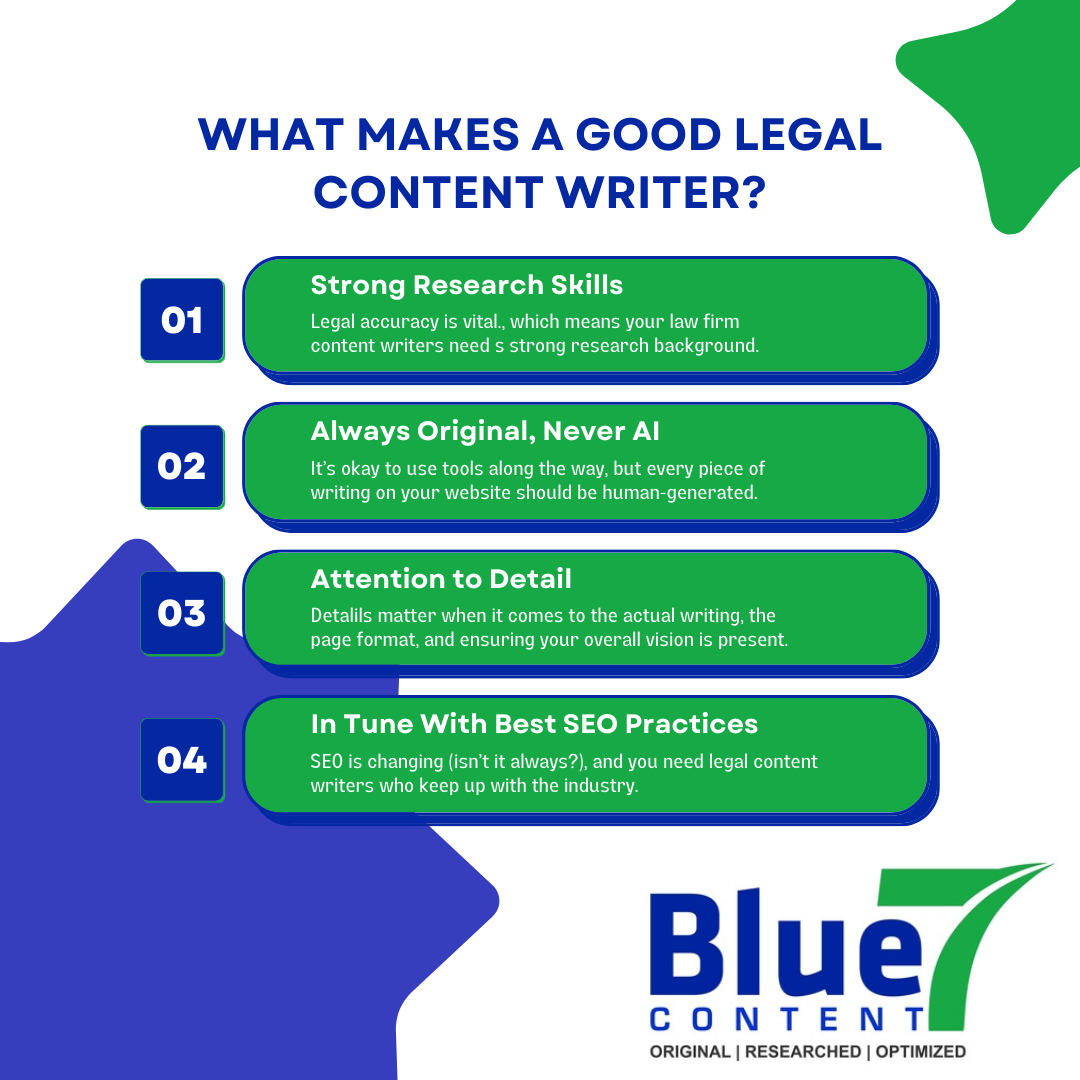
  3. What Makes a Good Legal Content Writer?
  4. Why High-Quality Legal Content Matters More Than Ever in 2025
  5. Do I Need an In-House Law Firm Content Team? 
  6. Reach Out for the Top Legal Content Writers Today 

From the first day in business, our motto has been “Original, Researched, Optimized,” and we’ve doubled down on being a human-first company.

Attorney Driven

From the top down, we’re just a legal crew. Co-founder Victoria Lozano is a practicing attorney in Chicago, and there are many talented current and retired attorneys onboard ready to help write and review content.

Human Crafted

Human connections are everything. We believe humans communicate with other humans better than AI can, which is especially important for the type of content you need. Your potential clients have real-life issues, and they want help from a real person.

Immediately Scalable Solutions

We work directly with marketing agencies. We can handle some of your content needs or all of them. Overflow issues? We can help. Tired of wrangling a writing team. We got you. We’re a fractional SEO content team with the experience to help you scale immediately without a quality decline. 

Communication Like We’re Your Team

You can reach us at any time. We’re not going to leave you hanging like many other content companies. If you have a question or need revisions, a member of our team (a real person) will help you nearly instantaneously. We believe in unreasonable hospitality. 

When building out a law firm website, you need more than a homepage that describes your firm, some pictures, and a contact form. You need content that shows your clients what they can expect if they choose to work with your law firm. 

This content can vary and may cover a range of topics, including pages specific to the practice areas you cover, from family law to personal injury to criminal law. Below is a sample of the types of legal content you may need and what we can provide: 

Note that not all of these types of content are necessarily focused exclusively on the law. We provide not just legal content for the clients but also content that highlights your team of attorneys and showcases what makes your firm different. We also certainly provide content for sources other than your website. We’re adaptable. Great writing and research skills are transferable.

You may have worked with content writers before who provided clean, readable content that served its purpose, but may not have provided the impact you expected. So, what makes a good legal content writer? 

Writing good legal content is not just about grammar and spelling. The right spell-check tools can make this part of the process easy. What makes a great writer is making the content as relevant, useful, and easy to read as possible for the client. Making sure that readers are able to understand the content without feeling confused or frustrated is also vital to converting them from readers to clients. 

To achieve this, our legal content writers have a number of resources and steps they take to ensure your legal content is as good as it can be. That includes the steps below, which our content writers strive to provide for each of our clients.

The best legal content writers are humans, not machines.

Strong Research Skills

State and federal laws are constantly changing and developing, meaning that staying on top of these changes can mean extra research. You may even want content that covers specific laws that are actively in development. That includes bills that are in the process of being passed, especially ones that may have a significant short-term impact on your potential clients. 

The best legal content writers are also some of the best researchers. They have the tools to access information that is accurate, up-to-date, and provided to the client in a way that is easy to understand.

Always Original, Never AI 

AI has come a long way. It can summarize articles, draft outlines, and assist with research, but when it comes to producing accurate, reliable, and truly effective legal content, it still falls short. Especially in 2026, when Google’s AI Mode is reshaping how search results appear, law firms can’t afford to publish content that’s generic, outdated, or wrong.

At Blue Seven Content, we don’t reject AI entirely. We use it thoughtfully to support efficiency, not replace human expertise, and it doesn’t even draft our work. We understand that legal content needs more than keywords and formatting. It needs nuance, compliance awareness, and trust-building language that only a human writer can deliver.

Here’s why AI can’t carry the weight alone:

  • Fact reliability is inconsistent. AI systems can hallucinate facts, cite non-existent laws, or pull outdated information.
  • Tone and empathy matter. Legal content isn’t just informative. It’s persuasive and sensitive. AI struggles with that human touch.
  • Originality is essential. Much of what AI produces is derivative. Google’s systems are trained to detect and devalue unoriginal content.

When it’s your reputation on the line, there’s no substitute for well-researched, custom-written content. That’s what we deliver to you, every time. At Blue Seven Content, we think we’re the best option for your legal content writing because we have a strict policy around our AI usage.

Attention to Detail 

If you have a house style, you want your content to follow those guidelines. That includes everything from specific phrases and practice areas you avoid to the way you format your law firm name. These little details go a long way toward creating a first impression of your law firm. 

Because putting your best foot forward is so important, having a legal content writer who understands this and pays attention to these details is vital. While any legal content writer can produce pages for your website, a good legal content writer will ensure that the specifics that make your firm stand out are present. 

That includes knowing details about your firm’s achievements. For example, you may have specific awards from your community that you want to highlight. A good law firm content writer will ensure those things are included on your site.

In Tune With Current Best SEO/GEO Practices 

While presenting an accurate picture of your firm is key to helping your audience grow, the best legal content writer will also keep the algorithm in mind as well. To get the attention and traffic you need for your website, your legal content writer will also need to be aware of search engine optimization (SEO) best practices. Consequently, good SEO content focused on the reader also does well in generative engine search.

These best practices include proper headings, keyword optimization, and localization that can help Google understand what your page is about and what locations you serve. Legal content writing is a balancing act between writing for your clients and for the search engine, and the best content writers find a balance between both.

As legal marketing continues to evolve, so does the way potential clients find and evaluate law firms. While traditional advertising, like billboards and radio spots, still has its place, most legal consumers today start or end their search online. With Google now integrating AI-generated summaries into search results, standing out requires more than just having a website. Your content needs to be clear, credible, and persuasive.

Low-quality content, whether generated by AI or written without care, can damage your firm’s reputation. If your site is confusing, vague, or inaccurate, potential clients may leave without taking action. Some may even question your professionalism based on the content they find.

This shift is especially important for law firms that want to improve their visibility in search results or gain traction in competitive markets. Having a website is no longer enough. Your content should:

  • Answer real client questions in a clear and accurate way
  • Reflect your firm’s values and strengths
  • Show both clients and search engines that you are a trusted authority

At Blue Seven Content, our legal content writers are best positioned to focus on creating work that does more than fill space. We produce content that earns trust, improves visibility, and helps law firms grow their online presence in 2025 and beyond.

Do I Need an In-House Law Firm Content Team? 

Having a law firm content writer who understands your firm’s needs can be useful and can provide you with ongoing legal content for your website. However, you may be concerned about having an in-house content team, and you may even be concerned that you do not have the budget for so much content. Fortunately, you do not have to worry about hiring new sources of writing when you work with our team. 

Our team of legal content writers can provide content for your team at varying tiers of quantity. For example, you may want to simply expand your number of landing pages as a one-time effort. In other cases, you may want regular blog posts that help support your current layout. In other cases, you may have no content at all and need to fully build your site’s content. 

Even without an in-house content team, this is an achievable goal with the right law firm content writers. The right team can provide needed pages in various forms and can produce more as the need arises.

If you’re a marketing agency, whether you focus specifically on legal marketing or not, you may need help with your content needs. Many agencies have wonderful internal writing teams, but they can get overwhelmed quickly when there’s an influx of content needs.

At Blue Seven, we can partner directly with marketing agencies. We do it all the time and know that scaling law firm SEO content, whether as a law firm yourself or as a marketing agency, isn’t an easy task. But when you have a team of the best legal content writers ready to go, it’s not as hard as you think.

Building a strong online presence is not just about social media posts and the technical side of your website. Much of what Google looks at, and all of what your potential clients look at, is the content that is actually on the page of your website. Building out this content, from your homepage to your monthly blogs, is key to painting a picture of what your law firm can offer. 

At Blue Seven Content, we offer a broad range of content writing packages for law firms of many sizes. But what you can expect from all of those packages is high-quality legal content from some of the top content writers today. You can expect our team to provide the detail, focus, and quality you expect from us. 

Ready to discuss your options for building out your content? Our team is ready to talk about what our writers can provide for your law firm’s website and how we can help your law firm grow. To learn more about our services, connect with us by calling, emailing, or filling out our online contact form.

Updated by Allen Watson – CEO of Blue Seven Content

Crafting Meaningful Content For Lawyer Websites – What It Means In 2024

When it comes to digital marketing, it seems the only constant is how fast things change. In 2023, it seemed generative AI might revolutionize writing content for lawyer websites, but it turns out that AI cannot replace the need for significant human involvement in content creation to ensure accuracy, originality, and voice.

And there may also be legal ramifications associated with AI-generated content. Laws regulating the use of AI in content creation have not kept pace with the technology, and there are several issues – such as copyright infringement – that are just beginning to come under legal scrutiny. 

While generative AI may not be the best idea for creating content for law firm websites, Google has been testing its use to enhance the search experience of its users. Known as Search Generative Experience (SGE), the SGE feature is able to create personalized responses to detailed search inquiries, thereby reducing a user’s need to evaluate search results. 

The SGE feature is scheduled to go mainstream in 2024 and has many marketing professionals concerned about the potential affects the new feature could have on current SEO marketing strategies. This article talks about the upcoming changes, what they mean for law firm marketing, and how law firms can create content that will continue to rank well and generate website traffic in the coming year.

  1. Why AI Still Doesn’t Work (Well) for Creating Content for Lawyer Websites
  2. How SGE Will Affect Search Results
  3. Does SGE Spell the End of SEO?
  4. SEO Content Best Practices for Law Firms That Will Continue in 2024
  5. What Law Firms Can Do to Succeed with Content Marketing Efforts in 2024
  6. Get More Bang for Your Legal Marketing Buck in 2024 with Blue Seven Content
Content for lawyer websites in 2024.
Content for lawyer websites is going to have to look a bit different in 2024.

Why AI Still Doesn’t Work (Well) for Creating Content for Lawyer Websites

As generative AI continues to evolve and become even more refined, it might be tempting to see how well it can create website content for your law firm. Although we don’t use AI to assist with content creation at Blue Seven Content, we do acknowledge its usefulness for generating ideas and structuring outlines. 

But AI-generated law firm website content is far from ready to go without being reviewed and edited by a human. Information still needs to be verified and accurately sourced. The tone and focus of the writing may need to be adjusted if it is not consistent with how a law firm wants to brand itself. 

The following issues are some of the pitfalls that lawyers need to be aware of when using AI to generate content:

  • The information presented is not always accurate or up-to-date and must be fact-checked.
  • The output may be very similar to other content and hard for search engines to distinguish for ranking purposes.
  • The output is limited by the quality of data used to train the AI.
  • Strategic human prompting is necessary to get the intended results.

In 2024, search users will be looking for anything but generic when it comes to content. Users almost expect content to be specifically tailored as though responding only to their inquiry. In fact, SGE will be rewarding content that is more targeted and personalized by placing the best results right at the fingertips of users. 

While incorporating AI to help streamline operations and improve client experience is almost essential in the competitive legal services market, it cannot be trusted to produce authentic, original, accurate, targeted content with your law firm, your legal practice, and your desired clients firmly in mind. 

How SGE Will Affect Search Results

SGE takes Google searches to the next level using AI. Generative AI accesses deep learning algorithms called large language models (LLM) that enable it to understand more of the context of a given search and provide results that are more personalized and interactive. SGE is an attempt to make a computer seem more human. 

According to Google, SGE will enable users to:

  • Enter search queries that are more complex and specific
  • Read an AI-generated overview of the search results and click on links to the relevant sources
  • Access needed information right from the search results
  • Ask follow-up questions to refine a search without starting over

The SGE feature is currently available to Google Chrome users in the US who are at least 13 years old, visit the Search Labs tab, and enable the feature. Not all inquiries will generate SGE responses. SGE will not generate a response for explicit or dangerous topics or queries that indicate a vulnerable situation. SGE is currently intended to help users engage more deeply with longer-form informational content. For inquiries where an SGE response is appropriate, it will appear at the top of the search results. 

Does SGE Spell the End of SEO?

Well, no, but SGE may spell the end of SEO as we now know it. When a search query is entered, two search engines will provide results. The traditional search engine results pages (SERP) still appear, but they will appear below the AI-generated search results. What this means is a lot of organic search results that would have ranked well as the result of traditional SEO may now not be seen or be seen less often. 

The SGE results will display an AI-generated summary of information (snapshot) intended to answer a user’s search query. The information included in the snapshot is pulled from organic sources AI determines will be most helpful to the user. The user is able to click on links to the organic sources for further reference. Also featured is a carousel of three clickable cards where a user can link to additional sources that might be of interest. 

So, how can your law firm website content get selected as a source for the SGE snapshot or appear in the SGE card carousel? 

Those details are not yet precisely known, but an overview of SGE released by Google indicated that the AI search would be integrated with the ranking and quality systems developed and used by the core search function so content that ranks well in the traditional search results may have a strong possibility of also appearing in the SGE results. 

According to the SEO tool platform Semrush, the content displayed in SGE results does tend to share the following similar characteristics, which may shed some light on what kinds of content Google’s AI considers to be reliable, trusted sources.

  • Expert opinion or analysis
  • Full sections and blocks of text suggesting an affinity for lists, bullet points, or other structured text
  • Content displaying topical authority
  • New or novel information

An additional marketing challenge law firms may face as SGE becomes widely integrated is getting prospective clients to click through to their websites. If the SGE snapshot answers a user’s question completely, there may be no incentive to go further than the search results page. This type of zero-click search experience has been increasing as Google has added more search enhancements to the SERP, such as knowledge panels and local packs. It is anticipated that SGE will contribute to declining click-through rates.  

SEO Content Best Practices for Law Firms That Will Continue in 2024

Despite the growing influence of AI on the digital marketing landscape, certain optimization strategies will remain among the best ways for law firms to achieve higher search rankings in 2024 and are certainly consistent with what is now known about SGE.   

Establish Topical Authority

Content that has topical authority provides comprehensive information on a particular topic. Google algorithms prioritize content that demonstrates authority. Indications of authority are expertise, experience, authoritativeness, and trustworthiness (E-E-A-T).  

An SEO strategy that helps content for lawyer websites establish authority is called a topic cluster. A topic cluster begins with a core pillar page and links to related sub-topic pages. A pillar page provides a broad general overview of the topic, and the sub-topic pages go into greater detail on the related topics. 

Topic clusters provide a structure that makes it easier for search engines to navigate the content and improve internal linking so users can find relevant information faster. A well-written pillar page may also be seen as an authoritative resource, making it more likely to generate backlinks and improve link authority. 

Update or Refresh Old Content

Google still loves fresh content. SEO expert Neil Patel recommends evaluating older content for accuracy and relevancy at least once a year. Updating content can provide the following benefits that impact SEO and user experience:

  • Gives content an updated publication date, letting Google know it is current 
  • Newer content is more likely to rank and motivate user click-through
  • Provides an opportunity to correct grammatical and spelling errors 
  • Improves content accuracy and relevancy
  • Can replace broken links or add links to higher-quality resources
  • Re-optimize keywords or phrases for better performance

Refreshing older content for lawyer websites benefits not only the updated content but also gives a rankings boost to the website publishing the content. The more frequently content is updated, the more often Google will crawl the website for new information.

Focus on User Experience

All of Google’s changes are made with the objective of improving the experience of its users. User experience involves how quickly content can be accessed, its visual appeal, the accuracy and depth of the information presented, and its readability. 

Google is looking for content created to help people rather than produce marketing results. The trick is to create content that is foremost valuable to users and also attractive to search engines.

Content that is well-organized provides comprehensive, up-to-date information, is well-researched using credible sources, and is written in a friendly, relatable manner is the kind of content Google is looking to present to users. 

Tailor Content to Match Search Intent

Search intent is what actually motivates a user’s search. Google can evaluate how well content matches a user’s intent based on how a user interacts with the content. Does a user get the information they are looking for from the content, or do they quickly leave and click on other search results? Content that is relevant to a user’s search will rank higher than content that misses the mark. 

A way to gain a better understanding of user intent is to do a search on keywords before writing and then reviewing the content that is ranking well. The information in content ranking well for particular keywords can be used as a guide for creating content that provides the answers a user is actually looking for. 

What Law Firms Can Do to Succeed with Content Marketing Efforts in 2024

As more becomes known about how SGE prioritizes information, marketing strategies will continue to adapt in order to optimize the opportunities for recognition in SGE results. Law firm website content writing may need to evolve from a focus on anticipated keywords to addressing more comprehensive and detailed search queries as more information is learned about AI preferences. 

Content marketing may be evolving, but some practices remain effective even with the addition of AI-generated search results. The following content marketing strategies are still recommended and will continue to be productive in 2024:

  • Update old content
  • Post content frequently and consistently
  • Use multiple content distribution channels
  • Make content more engaging/interesting by sharing success stories, new or little-known information, and unique viewpoints
  • Optimize for local SEO
  • Post only authentic, original content that is well-optimized, researched, and sourced

When it comes to writing content for lawyer websites, Blue Seven Content has you covered. We may not yet know exactly what AI will be looking for, but we’ve got a pretty good idea of what will always work. It is our business to create quality content that answers the questions your new clients are asking. We aim to position the law firms we work with as trusted authorities and thought leaders serving their communities with integrity and compassion.

Our authentic, original content is written entirely by a team of human writing professionals and thoroughly edited for composition and accuracy. If you are looking to make 2024 a great year for your law firm, Blue Seven Content can help get more of the right clients walking through your doors. Call us at 843-580-3158 or visit our website to learn more about our content creation services. 

Written by Mari Gaines, JD – Legal Content Writer

White Label Law Firm SEO Content – What It Means

Law firm marketing in the digital age is all about getting the attention of potential clients. How a law firm is able to distinguish itself and its services from other law firms with similar practices is the difference between receiving a steady stream of prospective clients and wondering where the next client will come from.

Well-written SEO content is a vital component in any law firm marketing strategy. Good content is what helps a law firm attract and maintain quality clients. Bad content causes potential clients to click away – if they even see the content in the first place. 

The content that goes on a law firm website can’t be an afterthought. Writing quality law firm SEO content is a skill. It has to be thoughtfully tailored to achieve a specific purpose. Content must be interesting, informative, accurate, persuasive, and written with search results in mind. It should be created so it performs consistently over time and produces measurable results.

Pursuing white-label law firm SEO content is a way for law firms and legal marketing agencies to obtain the consistent production of expertly crafted original content written to client-specific preferences. 

  1. What White Labeling Means
  2. Is SEO Content Still That Important for Law Firm Marketing?
  3. Law Firm Content Must Rank High in SERP to Get Results
  4. Why White Label Law Firm SEO Content?
  5. How To Choose a White Label Content Provider
  6. Why Blue Seven Content for Your Law Firm White Label Services?
  7. Grow Your Legal Practice with Blue Seven Law Firm SEO Content
Blue Seven Content provides white label law firm SEO content reviewed by practicing attorneys.
Blue Seven Content provides quality, well-researched law firm content.

What White Labeling Means

White-labeling is a type of business outsourcing. Outsourcing is a way for businesses to save time and money and still be able to offer high-quality products or services. White-label providers create products or services that other companies can purchase and then brand as their own. 

White-label legal content writers are ghostwriters for hire. They have a working knowledge of the subject matter and the research capabilities to create accurate and authoritative content.

The writers receive information about what to write and often who it is to be written for and then produce content that will be owned by and branded as the law firm client. 

White Labeling Does Not Mean Generic Reproduced Content

White labeling can describe a generic product that is branded and sold by different companies. However, it cannot describe law firm content because duplicate or very similar content found on different sites is not SEO-friendly. Therefore, each piece of white-label law firm SEO content must be distinctly crafted to the specifications and business practices of individual law firms. 

Is SEO Content Still That Important for Law Firm Marketing?

Well-written SEO content is as critical as ever for successful law firm marketing. Content that is easy to read, informative, accurate, and optimized to reach the right type of client is still a key component in a law firm’s overall marketing strategy. 

Most people with legal issues are going to begin to search for answers online. According to a recent survey conducted by legal marketing services provider Attorney Sluice, 70% of the persons surveyed said if they needed to find an answer to a legal question, they would first search for the answer online. 

About 45% of those surveyed said they would start their search to hire an attorney online either by using a search engine or visiting a social media platform. When asked about the significance of placement in search results, 34% believed the best lawyers were those ranking the highest. Another 12% believed higher search result rankings meant more legal experience. 

Law firms wanting to have their content appear before persons with legal questions or needing legal services have to publish content that is going to rank as high as possible in response to targeted search queries. Content that is poorly written or not optimized properly will likely not be seen by those it’s trying to reach, thus wasting a law firm’s valuable time and marketing dollars. 

Law Firm Content Must Rank High in SERP to Get Results

Being highly ranked on page one of the relevant search results is the desired position for any law firm content targeting a specific search inquiry. The content must compete with and outrank a lot of similar content in order to achieve a top position. Consequently, close attention must be paid to the specific details that can affect ranking when creating content. 

According to the SEO tool suite platform Semrush, the page landing in the number one spot in Google search results has an almost 28% chance of a click-through. The click-through rate drops by about half for the number 2 spot and falls all the way to 2% for content in the number 10 spot. Content that appears on page 2 of the search results or beyond has very little chance of ever being read. 

Well-optimized content lets a search engine know that it best meets the needs of a search inquiry by including quality factors that set it apart from competing content. Following are some content creation tips that indicate content quality and can boost search engine placement.

  • Content should thoroughly cover a topic so it doesn’t leave a reader needing to look elsewhere for additional information.
  • Tell Google the content is reliable by demonstrating E-E-A-T (experience, expertise, authoritativeness, and trustworthiness).
  • Make the content unique by incorporating original ideas or examples.
  • Make sure time-sensitive content is updated to keep it relevant to current searches. 
  • Try to write content at about an 8th-grade reading level so it is easy to understand.

SEO marketing expert Backlinko recently analyzed close to 12 million Google search results to identify factors that correlate with first-page search result rankings. The key findings included the following factors relating to content:

  • Better link authority (the measure of how many other websites link to your content) means higher ranking.
  • Content that covers a topic in-depth ‘significantly outperforms’ superficial or incomplete content.
  • The average Google first page search result contains just under 1,500 words.
  • Websites that people stay on longer (because of great content!) tend to rank higher.

Why White Label Law Firm SEO Content?

If law firms want to achieve their marketing goals, they need to publish a lot of quality content on a consistent basis. Trying to produce a large volume of content can be time-consuming, costly, and detract from core law firm business operations. 

In addition to lots of it, the content needs to have all the pieces so that it ranks well, engages readers, builds trust, enhances brand awareness, drives traffic to a website, and ultimately results in law firm clients. That means the content must incorporate current SEO best practices and be written in such a way that it pulls the reader in and convinces them they have found the solution to their legal problem. 

Whether a law firm does its own marketing or uses a legal marketing agency, white-label law firm SEO content writers are specialists who can produce engaging, well-researched, original content in high quantities while maintaining consistent quality.  

Law Firms  

Digital marketing has become very specialized. To be good at it takes consistent practice and staying on top of an ever-changing digital landscape. It can be a full-time job all on its own. Yet, in addition to practicing law, lawyers also handle marketing in the majority of US law firms. Only about 33% pay internal staff or an outside agency to handle legal marketing. 

So, what is the problem with lawyers creating their own content? Well, there can be several problems for the lawyer looking to improve a law firm’s ROI. 

  • Content creation takes time away from practicing law
  • Content may not be promoting the law firm brand
  • Content may not be adequately optimized for search engines
  • Content may not be written to prompt readers into action
  • Content may not connect with the right readers
  • Content may not be produced consistently

The bottom line is that it is typically more cost-effective and gets a law firm better marketing results to purchase tailor-made content from writers who regularly create SEO content for law firms.

Legal marketing agencies offer a suite of services to help law firms with marketing. Content marketing is often among them. Initially, marketing agencies may produce content in-house, but as a business grows and demands for content increase, it may make sense to cut agency overhead and use a reliable white-label provider for content creation. 

Legal marketing agencies may have the technical prowess to produce fabulous content, but they may be able to scale their businesses more efficiently to meet the demands of clients by outsourcing content production to white-label writers. 

How To Choose a White Label Content Provider

A white-label content provider is going to create content that a law firm will be using to represent its business to potential clients. There has to be a fit between provider and client so the content is consistent with how a law firm desires to brand itself. 

Some basic criteria that can help determine the best fit when selecting a white-label content service include:

  • Qualifications/Experience – Visit the website and social media platforms of a white-label content provider. Do you like the content posted by the provider? Are you confident in the abilities of the writers? Do they offer the services you need?
  • Customization – A good white-label service provider will create content to meet specific client preferences, whether they be stylistic, brand specific, or in order to optimize the content for a particular purpose. 
  • Quality Control – Content is intended to build trust between a law firm and potential clients. Readers expect it to be factually and legally accurate without grammatical errors. How is the content edited? What assurances exist confirming the quality of the product?
  • Accessibility – How available is someone to answer questions, respond to feedback, and address concerns? What is the level of commitment to client satisfaction?
  • Transparency – Does the white-label service provider say what they do and do what they say? Are they clear about services and pricing?  Are you confident the company operates with the utmost integrity? Will your privacy be respected?

Just as a law firm’s content needs to build trust between the firm and its clients, there needs to be trust between a law firm and its white-label service provider to achieve the best marketing results. 

Law Firm White-Label FAQs

How does white-label SEO content specifically address the unique ethical considerations in legal marketing?

White-label SEO content for law firms should be designed with an understanding of legal marketing’s ethical considerations, ensuring content complies with regulations and standards specific to the legal industry. This approach includes creating content that is accurate, informative, and respectful of confidentiality and advertising rules, addressing the unique ethical concerns that law firms face in their marketing efforts.

What are the specific steps a law firm should take to integrate white-label SEO content into their existing marketing strategy?

To integrate white-label SEO content into their marketing strategy, law firms should first identify their target audience and key practice areas, then select a reputable white-label content provider for law firms

that understands legal industry nuances. The next steps involve collaborating with the provider to create a content plan that aligns with the firm’s marketing goals, ensuring the content reflects the firm’s brand voice and ethics, and finally, integrating this content across their digital platforms for a cohesive online presence.

Can white-label content be customized to reflect a law firm’s specific brand voice, and if so, how is this achieved?

Yes, white-label content can be customized to reflect a law firm’s specific brand voice. This is typically achieved through a collaborative process where the law firm communicates its branding guidelines, tone, and target audience to the content provider. The provider then tailors the content to align with these specifications, ensuring it resonates with the firm’s brand identity and appeals to its desired clientele.

Why Blue Seven Content for Your Law Firm White Label Services?

Blue Seven Content writers are a dedicated group of professionals who love creating quality content. Our writers are carefully selected and receive ongoing training to keep their skills on the cutting edge of SEO content creation. The content we produce is well-researched, original, accurate, and designed to engage targeted readers. 

All Blue Seven writers have secondary education. Some have legal experience and education. They all have diverse backgrounds and life experiences, giving them the ability to meet the expectations of even the most discriminating clients.  

Providing a quality product that gets results for a client is the goal of Blue Seven Content. We are a very detail-conscious bunch and hold ourselves to high standards of performance. Each of our creations must pass through a multi-layered editing process before ever reaching a client’s inbox. 

We are discreet about the law firms and legal marketing agencies we provide white-label services for. Our clients appreciate our discretion, and we are happy to respect their privacy.

We value our clients. On those rare occasions when a problem does arise, Blue Seven Founders Allen Watson and Victoria Lozano are quick to respond and work to resolve any differences to the satisfaction of the client. 

Law firms need to publish a steady stream of great content to attract new clients and retain existing ones. At Blue Seven Content, we can provide law firms and legal marketing agencies with amazing content guaranteed to be authentic and 100% written by human wordsmiths. 

Whether it’s practice area pages, niche landing pages, FAQs, or blogs, you can expect high-quality, fairly priced content customized to suit your business needs. Your law firm SEO content solution is only a message away. Reach out. We will be glad to show you what we can do. 

Written By Mari Gaines, JD – Legal Content Writer

6 Ways to Quickly Create Law Firm FAQ Topics

A FAQ section for your website is a great way to create new conversions and leads by improving your SEO, but you need to have the right law firm FAQ topics. When prospective clients visit your page, they will undoubtedly have questions regarding what they can expect when working with you, the services you offer, your attorneys, and how you work. Many of these questions can be covered under the law firm FAQ sections rather than clients having to search multiple places. 

Adding a law firm FAQ section on your practice area pages provides a more user-friendly experience for clients. A FAQ section can provide your clients valuable information while saving your law firm resources and time by answering these common questions less often. Below, we discuss how to get started with a FAQ section and how it can benefit your law firm.

Craft quality, well-researched FAQ page to help your reader better understand the issues.
FAQs are a great way to improve the reader experience on your law firm’s website.

Benefits of Creating a FAQ for Your Law Firm’s Website

The benefits of your law firm having a legal FAQ section are numerous. Here are just a few of those benefits.

Saves Your Law Firm Money and Time

Your law firm is likely to receive the same questions from prospective clients consistently. If these questions are easily accessible in your law firm website’s FAQ, your staff will save time by not having to respond to these questions.

Improves User Experience 

Visitors are looking for easy access to legal information, and you provide that for potential clients when giving them a FAQ section. You can provide a positive experience leading to established trust with potential clients by saving them time and effort when interacting with your website.

FAQ sections on landing pages and blog posts should be easy to navigate and well-organized. You should use logical structure, clear headings, and bullet points to help visitors easily locate any information they seek.

Builds Your Law Firm Website’s Trustworthiness and Credibility 

Creating a FAQ can contribute to your law firm’s trustworthiness and credibility. A FAQ section demonstrates your firm’s knowledge and legal expertise in their practice area by providing clients with comprehensive and accurate answers to their legal questions. 

Such information leaves potential clients feeling more comfortable with choosing to work with you. Your law firm will have a solid reputation for trustworthiness and credibility when you share some free legal knowledge to prove your attorneys are highly capable. 

Creating an Effective Law Firm FAQ

Here are the six steps to quickly creating your law firm’s FAQ.

1. Identify Your Law Firm’s Most Common Questions

Sit with your staff and discuss the questions your clients ask you most frequently. You likely have a good list of questions you should include. But if not, ask your staff to write them down as they come up and update your FAQ with repeat questions.

One tactic may be to research some pinpoint keyword questions that have been typed most often into Google that are relevant to your practice area and add those to your FAQ.

2. Organize Questions by Topic 

After establishing the list of questions you want to include, you should organize them by practice area or topic. Doing so makes it easier for potential clients to find the information they are searching for while helping you create a more visually appealing FAQ.

3. Use Easily Understandable Language 

The best law firm website content has language that clients can understand. You want the answers to your FAQ to be easily understood by using plain language and avoiding complex legal jargon. It is best to assume that the majority of visitors to your website are not familiar with legal terminology, so keeping it simple will give you the best results.

4. Frequent Updates

You will want to keep your FAQ section updated by adding new questions and by updating any existing answers. Updating your content on a regular basis will help with overall SEO, and potential clients will appreciate that you have provided them with the most up-to-date information.

5. Make Your FAQ Easily Accessible 

The location of your FAQ is just as important as the questions you answer. Pick a prominent location on your law firm’s website to add your FAQ. We suggest you link the FAQ in the main navigation bar so that it is visible from every page.

6. Provide Accurate Information

When answering any FAQ questions, you need to be sure your answers are accurate and up-to-date with current practices and laws in your area.

Writing Engaging FAQs for Law Firm Websites 

You want your FAQs to be engaging for those who are reading them. The following are some tips you can follow to create an FAQ that will capture the interest of your audience.

You are trying to answer questions for your clients, and when you use confusing legal jargon, you might further confuse them. It is critical to remember that many visitors to your website have no background in law and appreciate the time you take to use plain language when answering questions. 

Answer in a Conversational Tone

When answering your FAQs, you should speak directly to your potential clients rather than writing as though it is a legal paper. Your content will be more engaging and relatable when you use a conversational tone, and it helps you avoid looking haughty.

Use Examples and Visuals 

You should consider the addition of relevant media, such as infographics and videos, to help strengthen the answers you provide. This type of information can be helpful in answering the more complex questions your clients may ask. Adding case studies or real-life examples can help boost your law firm’s credibility and make your legal content more engaging for your clients.

Answer Proactively 

You should think proactively by considering what follow-up questions your potential clients may ask. By thinking proactively, you can answer anticipated questions, further saving your law firm time and energy by addressing client questions in advance.

Use Professional SEO Content in Your Law Firm FAQs to Boost Conversions 

By creating the ultimate FAQ page, you can easily boost the conversion rate of your law firm’s website. By following the above tips, you can attract more traffic both organically and by Google ranking when creating a law firm FAQ. Contact Blue Seven Content to discuss your law firm’s web content needs today. Complete our secured contact form or call us to get started.

Written by Dianna Mason – Legal Content Writer

3 Things You Must Know Before You Write Great Legal Content

Having great legal content must be a big part of a law firm’s overall marketing strategy. It must be educational and entertaining enough to hold the attention of the audience it is intended to reach. The end objective of legal content is to provide enough value to readers so that they are persuaded to take the next step toward becoming clients.

Beyond a basic ability to write, there are three skill areas that must be combined in just the right proportions to create legal content that will get the results a law firm is looking for.

Much of legal content is directed toward helping people understand their rights and obligations in various legal situations. It just makes sense that if you are going to be good at explaining something to someone else you have got to have a decent understanding of it yourself.

Attorneys who write their own legal content are obviously going to be very proficient in their knowledge of what they are writing about. They may even be a little too proficient to the extent they are focused primarily on the subject matter of their content – perhaps to the exclusion of the necessary marketing components.

Understanding how to research legal subjects is a huge benefit for legal content writers.

I find it quite helpful for writing legal content that I have a JD and did practice law for a short period many years ago. However, a JD is not necessary to become a good legal content writer. What is necessary is a sincere interest in the law and legal matters, a willingness to learn, and the ability to research and write about a topic.

2. Digital Marketing

Business advertising has moved to the internet in a big way. Advertising on the internet requires some skills that more traditional methods of advertising do not require.

  • You have to know who your audience is – who do you want to read your content?
  • You have to figure out how to get your content in front of your audience.
  • You have to know how to increase the likelihood that your content will get the attention of the people you want to read it.
  • You have to be able to hold readers’ attention long enough to get them to take the action you want them to take.

What this means is that you have to understand the concept of search engine optimization (SEO) and using keywords and key phrases. You have to know which keywords to use, when to use them, and when not to use them.

You have to know what it means to target a particular audience and to write your content so it speaks to those people.

You have to engage your reader visually. Content must be presented in a way that is visually appealing to a reader. It must be organized so that it is capable of providing basic information from a quick skim.

3. Copywriting

Copywriting is “selling with words.” Copywriting is the ability to persuade the reader to do something. In the case of legal content, the copy must be written so that when the reader gets to the end of the article they are willing to call the phone number or click through to a law firm contact page and schedule a consultation.

Copywriters are interesting people. It’s not just writing, it’s writing with a purpose.

Copywriting emphasizes being able to connect with your reader and make them feel something. People who need to hire a lawyer or law firm have a problem they need help with. Good legal content connects with people who have a specific legal problem and then shows them the solution and why a particular law firm is the most capable of providing that solution.

Putting the Pieces Together

The main goal of legal content is to sell a lawyer or law firm to a prospective client. Legal content needs to hook readers who are looking to solve a particular legal problem and then build a bridge back to the law firm that can help them.

Research shows that people make most decisions based on emotion and then justify those decisions intellectually. So while having the technical aspects of legal content correct is very important, being able to write so that you capture something intangible within people is the difference that makes the difference.

There is extreme competition among law firms offering similar services to rank high in search results and get the attention of the people needing their services. If you want to be in the game, you have got to know what you are doing with your advertising.

At Blue Seven Content, we come from varied backgrounds. Some of us have worked in the legal profession. Some of us are really into technology. Some of us have marketing experience. But what we all have in common is a passion for creating great legal content that keeps our clients happy and our services in demand.

If you want legal content that both convinces and persuades, Blue Seven can help you with any of the following:

Find out how you can improve your law firm marketing with strategic, well-written legal content by contacting us here for a free planning session or calling 843-580-3158.

Written by Mari Gaines, JD – Legal Content Writer

Creating Original Content for Law Firm Blog Posts

Creating original law firm blogs isn’t easy, especially when it comes to figuring out what to write.

At Blue Seven Content, we’re proud of the team we’ve amassed. Our writers come from varied backgrounds, and our writer meetings are always interesting. One thing that more than one of our writers has brought up is the ability to keep the content we create original.

Let’s face it – originality can be a problem when it comes to law firm content. How many times have you needed to write a law firm blog post on a certain topic only to find that 50 other law firms have written about the same thing?

I’m willing to bet you’ve experienced that. I’m also willing to bet that many of those 50 pages say damn near the same things. It may not be direct plagiarism, but it’s likely pretty close.

Here, we want to briefly discuss how we handle this problem here at Blue Seven Content (spoiler – sometimes you can’t avoid writing about the same topics as other firms, but you can control the quality of your writing).

Trying to Stay Original With Law Firm Blogs (It’s Hard to Do)

When I (founder Allen) was a kid, I had a poster in my room. It was a poster full of cats that looked like Dalmatians with one actual Dalmatian. On the bottom of the poster, it said, “In a world full of copycats, be an original.”

The poster from Allen’s room

I forgot about that poster until I had a recent conversation with one of our writers. She wanted to talk about how to differentiate our content from other content already in the web universe. Let’s face it – how many ways can you write about “Steps to Take After a Car Accident”? Worse, how many ways can you write about “Reasons Insurance Carriers May Deny a Claim”?

I used to relish writing these pages, particularly when I first started creating law firm content. Well, that was 10,000 pages ago. Now, I groan when I see a request like that. I’ll write them, but I won’t necessarily enjoy it. I know what the law firms want when they request these pages. They want the same thing that “Johnny Cash Law” down the street has (but, “please make it different…thanks”).

How We Keep Content Original and Interesting

I’ve tried to stretch my creative fingers when writing generic blog posts. I’ve often thought I’m more clever than I really am when writing. In the past, I’ve written some fiction stories in my free time, mainly because I need to activate that portion of my brain sometimes. I spent my grad school years as a research assistant, so I learned about the need to break away from dull writing every now and then.

Unfortunatley, my attempts at creativity have been met with pushback. I’ve even had a client tell me that “We loved what you wrote here, but we think we need to tone it back a bit and stick with the basic steps.”

Right…boring. I know.

But I oblige because I do need to get paid.

The only real way to differentiate some of these pages from other law firms’ pages is to do an excellent job geo-targeting your keywords and creating well-written, readable sentences and paragraphs. Make sure you have a good UX. Grin and bear it.

At Blue Seven Content, we generally let our writers have free reign over the blog posts that we provide law firms. Unless a client has a particular request about what they want, we scour each clients’ geographic area to see if there are any news stories related to their practice area. If there are, we’ve hit gold. We can use a recent local event, discuss it, and then round it back to the law firm. Completely original, and we can let our fingers craft an interesting story.

If there are no new stories that we can use, we take a good look at the law firm’s website to see what blogs have already been written. If we see that the firm could benefit from a new page, say something like “Why are There so Many Defective Products in the US?” then we go with it. Even though other law firms may have similar content, we have specific goals in mind when we write these pages.

We want to make every page we write “Original, Researched, and Optimized.” We take pride in the fact that our writers are REALLY good at what they do. We don’t have amateurs here. Nobody is moonlighting for hokey websites making “Top 10 Celebrity Dog” posts. We take this seriously. When we turn a blog post or practice area page over to a law firm, we know that it’s well-written, completely original, and researched. We use top-notch sources to gather statistics and data.

Oh, and the best part is this – law firms get their content properly formatted and ready to be put onto the site. We use proper headings (H1s, H2s, H3s), short sentences and paragraphs, bullets, internal and external links, etc.

Reach out to Blue Seven for Your Law Firm Content Needs

We know how to handle the content for your law firm’s website. We work with dozens of law firms and marketing agencies throughout the US, and we are ready to get started on your website today.

If you’re ready for some help with original law firm blogs for your website, our team is here. We specialize in all of the following:

You can contact us for a free consultation by clicking here or calling us at 843-580-3158. Our team is ready to talk to you today.

Written by Allen Watson – CEO and Co-Founder of Blue Seven Content

Using Census Data to Bolster Your Law Firm’s Presence

Population data for law firms. It matters.

Law firms are successful because of their clients. Gaining clients often depends on your website, particularly your landing pages, your law firm practice area pages, and your blog posts. However, in order to truly target the desired clients in your law firm’s location, you need to dig into specific types of demographic and socioeconomic data. I want to talk about how you can use Census data to really understand your prospective clients so you can take your practice area pages, blog posts, and your firm to a deeper level.

From Education to Law, Data is Crucial For Your Law Firm Marketing Strategy

For the most part, the law firms that I work with have regular, everyday people as their clients. That’s a good thing. The general public needs good attorneys. The vast majority of people in this country don’t have much legal expertise, which can hurt them when it comes to standing up to insurance carriers and other attorneys. Because your prospective clients are not other legal professionals, your webpage needs to reflect this reality. Yes, your page must look professional, but that does not mean it should be overwhelming, especially when it comes to your content.

I was a teacher in my previous life, and that taught me a valuable thing – that you have to be able to communicate your ideas to the desired audience. My audience, at the time, was a bunch of raging, spaced-out kids. Now my audience is you, attorneys, paralegals, and legal assistants.

Your audience, however, is those who need your legal services.

Local Data Can Enhance Your Law Firm’s Reach

One of the first things that I had to do when I was becoming a teacher was learn the specific demographic and socioeconomic data for our county, district, and school. Trust me when I say that demographics and socioeconomics play a huge role in how we educate students, and this data varies from school to school.

The same concept needs to be used for your law firm. For each area you are located in or want to target, you need to know certain data. For your target area, you should research and understand the population’s:

  • Racial and ethnic makeup
  • Mean and median income
  • Employment status
  • Types of occupations
  • Poverty level
  • Educational attainment
  • Languages spoken at home
  • Marital status
Screenshot of intro Census data for Myrtle Beach, SC

While all of this can seem daunting, this task is not going to be horribly difficult. That’s because the US Census Bureau gathers all of this data for you. The Census Bureau is a terrific, non-partisan gatherer of data for every region in the US. They break this data down nationally, by state, and at the local level. This is a tremendous tool for your firm that I don’t think enough lawyers take advantage of. Let’s face it – most of us live in a bubble of people similar to us. The same race, the same economic level, and the same educational level. This can be dangerous for any business, including law firms.

With this data, you can tailor your practice area pages and blog posts. Suppose you notice that in one area of your firm’s area that most of the population has high school diplomas or GEDs. Maybe this is an industrial, blue-collar area. For your target practice area pages and blogs for this region, you may want to stick with information related to why they need an attorney for their problem, the types of compensation they could receive (personal injury), the possible penalties of a crime (criminal defense), and how much an attorney will cost them.   

However, maybe you notice that in one part of your firm’s coverage area that the population has a high percentage of higher educational attainment, perhaps close to a university. For that area, you may be able to target some blog posts and practice area pages or sub-pages that delve deeper into the laws and even theories behind some of the laws. Of course, they need to know the basic information as well, but you see what I’m saying here – know your audience and craft an appropriate strategy to target them.

Aside from marketing purposes, the demographic and socioeconomic data for your law firm’s area is important information for everyone in your firm to know. You want to be a part of the community, which means you need to KNOW the community.

We Will Gather This Data For Your Law Firm

You are attorneys, paralegals, and legal assistants. I know that you can research data. I also know that you are busy. That is why Blue Seven Content is willing to help. All of our writers are also researchers. We have diverse backgrounds in various fields, and we can help you gather this data for your law firm’s location. If you want us to, we can gather and provide the types of law firm population data we mentioned above. We will also provide our analysis of how you may be able to use this data to reach your desired client.

The data that we gather for your law firm can be used to alter your current practice area pages and blogs as well as your future law firm content. This includes your:

All we need to know from you is what areas you want us to target. You may only operate in one area, but we know that many law firms cover multiple geographic areas that all differ significantly. Each location report that we compose costs $800 (discounted rates for areas in the same general geographic region). Please reach out to us for a free consultation by clicking here or calling us at 843-580-3158.

Written by Allen Watson – CEO and Co-Founder of Blue Seven Content

Why We Focus Only On Written Content For Law Firms

When I talk to people about Blue Seven Content, they inevitably ask me – How can you build a business around only providing content and not actual website development for law firms?

The answer to that is – There’s a demand for it (since this was written in Dec 2021, we’ve realized that there is a significant demand).

It’s been a while since I’ve finished my economics classes in grad school, but I still remember supply and demand. If there’s a demand for something, supply it.

I take this a bit farther and say that – If there is a demand for something, become the best supplier out there. That’s what Blue Seven Content is here to do.

Blue Seven Content is a premium content supplier for law firms

Blue Seven Content isn’t launching because we hope that there’s a market for high-quality content for law firms. We know the market exists. There are many firms, both new and seasoned, that need well-written and researched practice area pages, blog posts, landing pages, and more, though they don’t necessarily need all the bells and whistles that come with a marketing agency.

Why should these law firms pay for things they don’t need, like graphic designs, full-stack development, and continual SEO analysis? In many cases, law firms have someone on-staff who builds or maintains their websites. In other cases, they have already paid someone to build their site only to realize that the person or company they hired really doesn’t provide good content. Why would a law firm want to be stuck in a monthly contract for…crappy blog posts?

You need someone who understands your practice area

Building websites is one thing, but actually putting together good content for your practice area pages and blog posts is another ballgame altogether. You don’t want someone who rarely, if ever, writes website content for law firms trying to give you content meant to draw in clients. The last thing you need is someone who just finished writing “Top Ten Reasons Boy Bands of the 90s Failed” or “Where Justin Bieber is Spending New Years” to write your page focused on car accident victims in your area. The two aren’t the same, but many marketing firms hire anyone who can string sentences together.

At Blue Seven Content, you have a team of writers who are well-educated and all academic writers in their own right. We have all either worked directly for law firms or written extensively for them. Some of us came from law firm marketing agencies, though we work directly with many firms as well. We know how to do this.

Blue Seven Content is ready to help you

At Blue Seven Content, we are a small team that chooses who we work with very carefully. We actively turn down clients so we can focus on our valued partners. We are here to help you with:

Please reach out to us for a free consultation by clicking here or calling us at 843-580-3158. Our founder, Allen Watson, will be happy to talk about your needs.

Written by Allen Watson – CEO and Co-Founder of Blue Seven Content