10 Tips for Writing Personal Injury SEO Content That Converts to Clicks and Clients

Writing personal injury content may be easier said than done. You want your content to drive your readers to choose your law firm over others. Yet, you may need help figuring out where to start. And the longer you wait to create high-quality SEO content, the more likely it becomes that prospects will find the legal services they need elsewhere. 

You spend your money getting readers to your website. Now what? If your content is less than stellar, your potential client becomes someone else’s potential client with the click of a back button.

When it comes to personal injury lawyer SEO content, do not leave anything to chance. Learn the ins and outs of content that will help you engage, inform, and inspire your readers. Once you do, you can create content that turns your readers into clients.

  1. Why Does SEO for Personal Injury Lawyers Matter?
  2. Personal Injury SEO Content Tips
  3. Get Help Writing Personal Injury SEO Content For Your Law Firm or Legal Marketing Agency
personal injury SEO content converts to clicks and clients

Why Does SEO for Personal Injury Lawyers Matter?

According to research, Google processes more than 40,000 search queries every second. This works out to about 3.5 billion searches every day and 1.2 trillion searches annually around the world. With search engine optimization, you can make it easy for readers to find your content since it may appear at or near the top of Google searches. 

Google has a formula for how its search works. Based on this, it considers the meaning, relevance, quality, usability, and context of all content. If your personal injury SEO content hits the mark in these five areas, Google may see it as credible. At this point, when readers search Google for pertinent terms and phrases included in your content, it may be one of the top results they see. This means readers are more prone to click on and read your content over your rivals’. When they read your content, they may discover the value your law firm offers. This may lead readers to search other areas of your site for content and reach out to your firm for more information about your legal services.

Writing personal injury content that ranks highly on Google can impact your firm long into the future. If readers continuously return to your site, it may be easy for others to find you on Google. This increases the likelihood that readers will choose your firm over its competitors. On top of that, you may boost your conversions and sales.

Personal Injury SEO Content Tips

Producing top-notch SEO content for personal injury law firms may seem difficult at first. Fortunately, we are here to help you get the best results out of your content. Here are five tips you can use to create content that transforms your readers into clients:

1. Identify Your Audience

To make content your readers need, you have to figure out who you want to read it in the first place. Consider who will read your content and why they should look at it. From here, you can figure out what terms and phrases to include in your content. This can help you produce content that resonates with your target reader. 

2. Avoid Jargon

Even though SEO content for personal injury law firms is evolving, there is at least one constant: Jargon will do you no favors. You may understand legal terms and phrases, but your readers might not. As you produce your content, keep the reader’s point of view front and center. If there are terms and phrases that a reader may not understand, define or rephrase them. Otherwise, if a reader does not understand what you are saying, they may be confused about your content. This may drive them to look elsewhere for legal services. 

3. Avoid Fluff

Just because you want to craft meaningful content for your lawyer website does not mean you need to be long-winded about it. In terms of SEO, short and direct content is typically better than long and descriptive. Your content should make it clear what your law firm offers and what you are all about. When someone reads your content, they should not have to search far and wide for the information they need. If you are worried your content is loaded with fluff, help is available. For example, you can partner with a legal content marketing agency that can produce SEO-friendly content that is concise and digestible. This agency may help you revamp your existing content and produce new content that is free of fluff and delivers outstanding results. 

4. Be Intentional

You may be tempted to use AI legal content marketing, but doing so may hurt your law firm now and in the future. Artificial intelligence gives you a quick solution to produce content. Alternatively, the content is not personalized. In the big picture, it may not differentiate your law firm from others. If you produce SEO content on your own, you can tailor it to your firm. You can create content that is well-structured and easy to understand. Plus, you can write about any legal topics that are relevant to your readers. This flexibility creates endless possibilities. It allows you to deliver content that your readers can enjoy and helps your firm rise above its rivals. 

5. Update Your Content

If you are not careful, bad law firm website content may damage your brand reputation. For instance, you may have published a law firm blog post that includes statistics and research that are now out of date. Even worse, the post may contain information about statutes and laws that are no longer in effect. Prioritize your website content and make sure it is up to date. Generally, it may be a good idea to audit your site’s content every few months. Some pages may need to be updated more frequently than others. A legal content marketing agency can work with you to make a plan to keep your content up to date. 

6. Convey Empathy

A person who has suffered a personal injury has experienced a significant negative event in their life. Their normal has been turned upside down. They may be going through a wide range of emotions. They may be overwhelmed and need some reassurance that everything is going to be okay. 

Personal injury SEO content has to let the reader know that their plight is understood, their welfare is important, and there is help to get them through this ordeal. Law firms can draw on past experiences with personal injury clients for examples of what people may be going through following a personal injury accident. 

Content that conveys to the reader that someone cares about them and what they have been through makes them feel valued and increases their trust in the information (and the law firm providing it).

7. Incorporate References that Demonstrate Familiarity with the Local Area

Including references to local culture and other points of common interest or experience will demonstrate similarities and help establish common ground with the reader. People are more likely to trust other people that they have things in common with. Let the reader know you are a part of and care about the local community. 

Incorporating local references into writing personal injury SEO content also helps search engines identify content that is highly relevant in terms of proximity to the searcher. For law firms with localized practices, this means the people reading the content are more likely to live or work in the same local area.

8. Make Sure Your Writing is Unique

When creating content, don’t just reiterate what every other personal injury law firm is writing about ‘distracted driving accidents’ or whatever else. Beware of using common phraseology too often. There can be a lot of similar language used when writing about laws and legal concepts. 

Plagiarism can often occur unintentionally due to limited ways to describe similar topics and the sheer volume of content being produced. There is mixed authority on how much plagiarism is acceptable or should be tolerated. Generally, a plagiarism percentage under 10% is considered safe, but the goal should be as low as possible. An online plagiarism-checking tool such as Grammarly can be of assistance. 

Plagiarism is a big problem when AI is used for generating content. Text analysis expert Copyleaks conducted a recent study of AI-generated content produced on a number of different topics and found that 60% of the content, overall, contained some form of plagiarism. Almost 43% of the legal content contained plagiarism, with close to 12% having identical text. 

Writing personal injury SEO content that is unique and original may take a little more time and attention. However, the rewards will be worth the extra effort. Not only do search engines prefer something new and different, but readers will find the content more engaging and be more likely to reach out. 

9. Be Realistic About the Outcomes Clients Can Expect

Law firms trying to generate personal injury leads need to be careful when expressing what they may be able to do for a client. It is an ethical violation for attorneys to promise or guarantee they can obtain a particular result. 

Rules of professional conduct prohibit lawyers from making claims about their services that could be misleading to potential clients. Particularly problematic are statements claiming to be better than other attorneys, such as ‘we are the experts’ or ‘work with the best law firm in town’.  

Even a representation such as ‘our firm can get you all the money you deserve’ could be misleading in that a person may believe an attorney can do more than is actually possible. 

Content may contain factual statements about qualifications, prior case results, and testimonials from clients about actual experiences. Readers are then left to draw their own conclusions without being inappropriately influenced about the outcome of the legal services a personal injury law firm can provide. 

Make sure your choice for writing personal injury SEO content understands what’s needed to get the job done right and up to your state bar’s standards.

10. Incorporate Personal Experience 

If appropriate, sharing personal experiences can enhance the authenticity of content and make it more relatable for readers. Readers are more likely to connect with information describing actual experience – especially if it is similar to their own. 

When someone else has experienced something similar to what we are looking for information about we tend to give more credibility to what they have to say. Google has realized the value to users of content describing personal experience, which is why ‘experience’ was added as one of its content quality ranking factors in 2022. 

Google is especially concerned about experience when it comes to personal injury legal content because it could influence a person’s financial and individual well-being. Content quality ratings undergo additional scrutiny when the topic contains information that could affect ‘your money, your life’ (YMYL).

Law firms that can ethically incorporate personal experience into their content are more likely to connect with readers on a personal level and get more personal injury clicks.

There really is no easy way around it. Law firms wanting to convert more personal injury leads into clicks and clients must commit to producing content that is reader-focused, relatable, unique, and trustworthy.   

Get Help Writing Personal Injury SEO Content For Your Law Firm or Legal Marketing Agency

Search engine optimization can make or break your law firm’s website, and these 10 tips should be considered when writing personal injury SEO content. If done correctly, the content can help lay the foundation that begins an attorney-client relationship. Regardless, you do not have to tackle SEO on your own. At Blue Seven Content, we have a wealth of experience with legal content marketing. Our team includes law firm writers who can help you craft content that drives traffic and helps your web pages rank high on Google. To learn more about our SEO content services, contact us today. 

Written By Dan Kobialka and Mari Gaines – Legal Content Writers

It’s Always Been a Long-Term Game, Calm Down

“Instant results! Law firm SEO for immediate client acquisition!”

It’s obnoxious, sometimes, reading through your LinkedIn, Facebook, Instagram, or TwiX feeds.

The now-AI bros (it’s always the bros) are exactly who they’ve always been – the guarantors of instant results that leave you feeling cheap, used, and taken advantage of.

It’s always the bros.

You want long-term law firm website growth?

Then, you need a long-term law firm SEO content plan.

And you need law firm content that’s well-written by a person or team who does this regularly. Find your long-term team, make your long-term plan, and secure long-term growth.

Long-term FTW.

Stick with a long-term content strategy for your law firm.

A Long-Term Plan Means Long-Term: Don’t Get Scared After Two Months

No SEO professional will be able to give you an exact time frame for how long it’ll take for your SEO plan to start working. However, any reputable SEO professional should tell you it’ll likely take some time.

Even if you are barely scraping the surface of your SEO knowledge, then you’ve likely seen that you need a long-term strategy. It’s the truth. Despite what you may see on LinkedIn or on other social media platforms, insert results really aren’t a thing, but long-term organic growth through a strategic content plan is absolutely doable.

Not one month or two.

Make a plan that spans a year (to start with).

Make a plan that has quarter-specific goals that you and your team review.

Make a plan that gives you a solid year of STICKING TO THE PLAN.

On the flip side, you wouldn’t believe how many times we’ve seen law firms get great results from their SEO content after a year or so and then decide to stop producing content altogether once they get the results. It doesn’t take long to neglect a website before negative results happen. It doesn’t necessarily mean that you did anything wrong with your website in the meantime. It just means that others are continually adjusting and adapting their own websites, adding new content, and adjusting existing content.

Don’t stop once you get results. Keep going, even if you adjust your strategy.

Long-term content strategies should be the game plan regardless of practice area type. Blue Seven Content regularly helps develop strong, well-written, and researched:

Our team certainly handles more than just the “big” practice areas. We regularly write content for insurance defense firms, patent and trademark lawyers, employment lawyers, and more.

What Types of Content Make a Good Long-Term Law Firm Content Plan?

Your content strategy should be multifaceted. As far as marketing goes, you should tackle brand building from every avenue possible. This is much more than just SEO. However, since we just do content, we want to focus on the types of pages that can come together to create a healthy long-term SEO content strategy.

At the heart of your law firm’s website are the practice area pages. You might see these referred to as service area pages, but these are essentially your firm’s product descriptions. Your practice area pages tell your audience what you do. They give you a chance to convince a reader that you are the law firm best suited for their needs.

Practice area pages can encompass more than just one page for every area you practice. The reality is that you will likely need geographic-specific practice area pages focused on every location where you practice law. At least, pages for every location you want to get clients from.

For example, if you practice personal injury law in San Diego, your main target city for each page will be San Diego. However, as you grow your practice and expand your long-term law firm SEO plan, you may want to secure more clients from the surrounding areas. So, instead of having only a car accident page tuned towards your San Diego audience, you may also want to have a car accident page for Coronado, Chula Vista, La Mesa, and other nearby cities.

This applies to most law firms. It’s very rare for a firm to only take clients from one specific area.

There are likely some questions that you get over and over again. There are also some questions that individuals who need your services ask often, if not in person, then online, as they go through their journey of finding an attorney. Your law firm frequently asked question (FAQ) pages can help address these commonly asked questions, not only for the convenience of your audience but also for the happiness of Google and other search engines.

Blogging isn’t dead. Well, smart blogging isn’t dead. We’re no longer blogging just to blog in the SEO world. At least, most of us aren’t. However, law firm blogs can still provide more than just a source of Evergreen content for your website. They can help you address more granular issues related to your practice areas. The blog space on your law firm can help contribute to your overall SEO plan while also allowing you to reach out to the community, discuss current events, address local or national news, and more.

Your law firm content plan should include beefing up your “About Us” pages and any individual attorney biographical pages. Some of the most popular pages on any website are the pages that show the personal side of your firm. Looking for legal experience is scary, and people want to work with attorneys they can trust. Building out these sections of your website helps establish that trust with someone who is close to making their decision.

How Do You Develop Your Law Firm’s Long-Term Content Plan?

When developing your long-term law firm content strategy, think big picture.

Is your firm entering a new market?

Are you aiming to increase revenue by 50%?

Are you just starting out?

While creating content on a campaign-to-campaign basis or jumping into PPC may help achieve smaller short-term goals, a comprehensive long-term plan is crucial for reaching significant organic, long-term objectives.

Consider these key questions as you plan:

  • What are the firm’s long-term SMART goals? (Specific, Measurable, Achievable, Realistic, Timely)
  • Who are the law firm’s target potential clients? (e.g., car accident victims, slip and fall cases, violent crime defense)
  • Is there old content that needs refreshing? (e.g., outdated statistics, broken links)
  • Are there upcoming opportunities for blog posts or press releases? (e.g., recognition by Super Lawyers, relevant news events)
  • What makes this law firm unique?
  • Who will manage the content?
  • How often should content be published?

For example, suppose a small to mid-size personal injury firm wants to attract more car accident cases and reduce medical malpractice claims. A focused content plan might involve:

  • Targeting local car accident victims
  • Posting well-researched blogs about car accidents twice a week, including topics such as:
    • Recent car accidents
    • What to do in a car accident
    • What to expect from car insurance companies
    • Types of car accidents
  • Updating the website’s homepage to emphasize car accident claims by:
    • Adding relevant images of car accidents
    • Revising content to minimize focus on medical malpractice
    • Including statistics about local car accidents
    • Adding a “What to Do After an Automobile Accident” page
  • Posting and sharing the blogs across various social media platforms

Every long-term content strategy requires careful planning, and it’ll look different for each law firm. Once implemented, your law firm can expect several advantages, including increased visibility, improved client trust, and sustained growth – OVER TIME.

Law Firm Spanish Content and Translations – Bolster Your Long-Term Plans Based on Demographics

Serve your audience.

That means serving ALL of the people in your area. For areas with a heavy Spanish-speaking population, you NEED Spanish content on your website.

No, not just a cursory line or two on the homepage or a “We Habla Spanish” on the bottom left-hand corner of your page.

You need to SHOW your Spanish-speaking audience that they can trust you. Your existing law firm SEO web pages can be translated into Spanish by a professional. No, using Google Translate or ChatGPT is not your golden ticket.

That’s insulting to your audience.

Treat your Spanish-speaking readers with the respect they deserve. Translate your website pages and create brand-new Spanish content that reaches them directly.

It’s not rocket science – it’s knowing how to respect people.

Blue Seven Content – We Don’t Let Clients Down

It’s a long-term game, and we’re in it for the long haul. Our team has been doing this for a while now, and we’re continually refining our processes to improve. We communicate. We’ll never leave you in the dark, and we have a content guarantee.

When you’re ready to get your long-term law firm content strategy going (or if you want to bolster what you’re already doing), give us a call or fill out our form here. We’re ready to help.

Written By Allen Watson – CEO and Co-Founder of Blue Seven Content

Well-Researched Content From Blue Seven for Your Law Firm’s Continued Success, From SEO to SGE

We started with law firms. Our founders began their writing careers (after switching from education) by writing SEO content for multiple industries but specifically focusing on law firms. After starting this company, they changed the industry process for writing competent law firm content.

Legal marketing is an insanely competitive field. But we aren’t trying to compete. In fact, there aren’t many people or agencies that can compete with us. At least, not with the level of talent we have combined with our price point.

But how do we do it?

Law firms seeking to gain a competitive edge in their geographic market have to create knowledgeable content and craft a credible reputation. This can take time, but well-researched law firm SEO content that focuses on the reader can position your firm as an authority for your particular practice area(s).

Well researched law firm SEO and SGE content.

Speaking to the Choir, But Just In Case – The Search World Has Changed

How’s your head?

We ask because we’ve had a fairly regular dose of morning Tylenol for the last year or so as our new overlords artificial intelligence has crept into every aspect of the marketing sphere (well, every sphere, actually – just the other day, we swore we saw a commercial for a smart toilet).

But, the shift changed a while ago for the legal marketing industry. We’re still feeling the initial start of what artificial intelligence may do, but the shift towards digital has been rapid, sped up even more by the COVID-19 pandemic. Data shows that 74% of companies have moved most of their services online. Again, speaking to the choir.

However, as more and more companies and more and more law firms realize the importance of their online presence, competition becomes intense.

You know it’s serious when the town’s PI/Divorce/OccassionallyCriminalDefense lawyer, who’s been in the same janky building for 37.5 years, has a website marketing his services (his name isn’t Saul).

However, and we are just going to speak anecdotally for a moment, whatever we call the current era we are in, it’s been a mucked-up, bassackwards, rollercoaster. ChatGPT rushed a miracle (lol) to the market, and everyone’s been playing catch-up, unfortunately leaving somewhat reliable SEO tactics in shambles.

However, we took some time to reflect last year (one hour) and decided to stay the course. We got into this business as writers. We hired more writers. So, we want to write, and we want to write well.

We didn’t lose any clients because of AI, but we DO know some agencies that made the shift. Most have shifted back to human writers. Two of our former colleagues have disappeared (not in a mafia way).

It’s well-researched pages for the win, duh.

Well-Researched Law Firm SEO Pages Are Still Golden

I encourage you to check out our legal writer training process. We’re able to create the best content for your law firm’s presence because of their talent.

Our writers and our process are the key to helping your law firm or marketing agency acquire new clients. A strong digital presence comes first from strong writing.

Good writing that’s well-researched and truly makes a point to communicate directly with the audience is the heart of what we do. It’s what we love.

Data from Googly shows what we already know – a ton of people (96% of law firm prospective clients look online for advice, and 74% of those people will visit a law firm’s website to take the next steps.

Competing means thinking about more than SEO, obviously, but your content can be a springboard to so many other marketing channels within your firm – SEO, SGE, social media, off-site brand awareness, physical marketing, and more.

If you have a good law firm SEO page, you have everything you need to pull it apart to use elsewhere. And that’s what we’re trying to shift to – more than SEO.

We know we can write, but we also know that our writing can grow your law firm’s brand and complement every marketing channel. Law firms should position themselves as a source of credibility and authority, not just online but within their community. However, your website is your storefront. Your content should be well-researched and help solidify your law firm’s credibility by becoming a reputable, trusted information resource. Turn writing law firm content into a priority.

Information from Customer Experience shows that 61% of online prospects are more likely to become clients with a law firm that approaches content in a unique way. Data also shows us that it could take five to seven online impressions before a consumer remembers your brand.

Your content can do a few things here – it can both address the immediacy of your potential client’s concerns while also crafting a lasting story to enhance your law firm’s brand.

High-quality, well-researched pages build brand awareness, strengthen your readers’ trust, and encourage more clicks to that contact page.

Good Writing First – Search Second

Blue Seven Content finds good writers first. That’s the priority.

Good writing is intuitive, and not everybody has that. That’s OK. Not everybody knows how to use a ham radio or how to grow strawberries, either. Not everybody has to be an expert in everything.

Typing does not equal writing. Putting together sentences that make sense does not equal writing.

Putting together words, sentences, and paragraphs that transform a law firm from a cheesy, AI, rote, basic content repository to a website the whole family trusts is a skill. It’s a talent we bring to every client.

We’ve been doing this for years now. Maybe you’ve heard of us, or maybe you’re out on the prowl for a new content provider. The good news is that we can partner directly with you OR your legal marketing agency.

When you call us, you’re going to talk to one (or both) of our founders. We are all personally involved in your content. When you need to get a hold of us, you can.

Oh, and we also have a content guarantee. If we don’t hit the mark you expected with your page, we’ll do it again. We don’t charge for revisions if we make a mistake, miss the mark, or just bungle a page.

We get it right, so you aren’t wasting money.

We’re ready to talk if you are. Writing law firm content is our thing. You can fill out our contact form (I promise, someone will see it) or call us at (843) 580-3158.

Written by Allen Watson – CEO and Founder of Blue Seven Content

How Do You Write Content For Construction Companies?

Knowing how to write construction SEO content can help your business reach the next level. If you own or operate a construction company, you want a steady stream of customers to keep your business growing. In many local areas, people looking for construction services have almost too many choices. How can one particular company stand out from competitors and get more potential customers to its website?

In the digital marketing era (everything seems to be digital marketing now), the solution is great content. People with construction-related issues or looking for construction services will use a search engine to try and get the information they are looking for. Well-written SEO content on construction websites will connect construction companies with the right customers.

Website Content that Will Help a Construction Company Attract More Business

People interested in the services of a construction company may begin the process by searching for information. A construction company website that has content providing the answers people are looking for is a giant step ahead of one that doesn’t. 

Content on a construction company website should anticipate the questions potential customers may want answers to and serve as a trusted go-to resource. Construction company and contractor website content should include the following kinds of information: 

  • Descriptions of the products and services the company offers (product and service pages)
  • Details about the experience and expertise of the people (about us pages)
  • Helpful or newsworthy industry-related information (blog articles)
  • Handy resources for quick consumption (FAQ pages, lists, tips and hacks)
  • Announcements for upcoming events or promotions (press releases)
  • Shared experiences of other customers (testimonials)

An experienced construction SEO writer can craft any type of content a construction company needs so that it promotes the company, is favored by search engines, and attracts and retains the attention of new or returning customers. 

Tips for Writing Construction Company Website Content

Content has to be well written and strategically optimized for search engines if it is to reach the intended audience. Google only wants to show searchers content that is helpful (relevant, engaging), reliable (up to date, accurate), and original (not duplicative, offers something new).

Following are some of the general things a construction SEO writer knows to do and not to do when creating content for construction websites.

Keep it Reader Friendly

Use clear, simple language.  Write in short, concise sentences. Stay on topic. Don’t make spelling or grammatical errors. 

Make it Easy to Consume

Walls of text tend to overwhelm. Keep paragraphs to 3, 4, or 5 lines of text. Use subheadings, bold text, and bullet points to highlight important information and make content easy to skim. Both search engines and readers appreciate this.

Know the Topic

Always make sure to present the most accurate, up-to-date information. Get information only from credible, authoritative sources. 

Link to Internal and External Sources

Linking content to other content on the same website (internal) is helpful to search engines and encourages readers to stay on a website longer by making it easy to find additional information. Linking to other authoritative websites (external) enhances the credibility of content and improves its authority and ranking potential with search engines.

Optimize for Search Engines (SEO)

Before Google can decide to show content to a searcher, it has to determine whether the content is the best response to the search query. It looks for certain indicators – such as keywords – that help the search engine determine the relevance and reliability of the content. Good content optimization vastly improves the chances it will reach and impact its intended audience. 

Always Create Original Content

Copying or closely duplicating other published content is not cool and may be plagiarism. Google is not a fan of duplicate content, and having it on a website can negatively affect ranking. Make content unique with elements such as data and statistics, personal experience, opinion, individual style, and case studies.

The Importance of Optimizing Construction Company Content for Local Search

Many construction companies serve particular geographic areas within their communities. Optimizing content with location information helps connect companies with customers in their area and will improve a company’s ranking in searches for ‘construction company near me’ or similar searches that are location-specific. 

Why Construction Companies Should Be Weary of Using Generative AI to Create Content

Like many industries, AI is making an impact on the construction industry. Generative AI, like ChatGPT, has taken the content creation world by storm since its introduction. Sure, it’s fast and cheap, but there are some drawbacks to having AI write construction SEO content for a website. 

AI-generated content is not reliable because it may not be accurate or up-to-date. AI is only as knowledgeable as the data it is trained on, and sometimes it makes things up. Any content created by AI must be thoroughly reviewed and edited (by a human) before being published. 

Content created by AI is not original since it can only pull information from existing content. It cannot speak from experience, offer insight, or draw conclusions. And AI content must always be checked for plagiarism

The more AI is used to generate content on a topic, the more the content produced will become generic and unable to differentiate a business or brand from its competitors. This is exactly the opposite of what a construction company wants from its content. 

Google is not going to reward watered-down, bland content either. As of April 19, 2024, Google finished rolling out its latest core update, promising a whopping 45% reduction of low-quality, unoriginal content in search results.  

Finally, there is the issue of customer expectations and full disclosure. If a construction company uses AI to generate content, should the company disclose that fact? Disclosure is not yet a legal requirement in most cases, but opinion is trending toward requiring disclosure. Companies that are not transparent about the use of AI to create content now may lose face if disclosure becomes law.   

Writing Construction Company Content Made Easy with Blue Seven Content

Writing good content is essential for construction companies that want to establish authority, gain strong brand recognition, and maintain a steady flow of customers. It takes practice to write SEO construction content that will consistently perform well in search results. Fortunately, construction companies don’t have to struggle when it comes to producing amazing content. 

Blue Seven Content writes SEO content for construction companies. Our content is well-researched, thoughtfully optimized, always original, and written (by humans) to meet the specific needs of each of our construction clients. Not sure about writing your own content? Contact Blue Seven Content to find out how our SEO construction writers can produce affordable solutions for your construction content needs. 

Written by Mari Gaines – Blue Seven Content Writer

March 2024 Google Updates – What It Means For The Blue Seven Approach

In early March 2024, Google began rolling out the latest updates in its ongoing mission to provide searchers with the most useful information and not the self-serving clickbait created primarily to achieve higher search result rankings. 

The updates focus on two main areas. Changes are being made to the core ranking systems to better distinguish and filter out unoriginal content. Spam policies are being improved in order to keep the lowest quality content out of Search.

For human content creators, the update is somewhat encouraging. It means human input and oversight are still highly valued contributions to content creation. And though Google does not have a problem with AI-generated content per se, it does have a problem with people trying to manipulate its systems with crappy content. 

March 2024 Google updates could affect law firm content.
Should you keep calm and stay the course if your content is genuinely helpful? Or panic and switch gears?

Google Search March 5, 2024 Updates

Generative AI has provided some new opportunities for spammers and some new challenges for Google to respond to. In 2022, Google began refining its ranking systems to better identify helpful content and provided guidance about the kind of content it was looking to reward. 

The March 2024 core update and new spam policies are just a continued refinement of Google’s systems in the attempt to deliver useful, high-quality content to searchers. 

1. Filtering Out Low Quality, Unoriginal Content from Search Results

Several times a year, Google makes fairly major changes to its algorithm and other systems used to identify and rank content. These changes are called core updates. Google has advised the March core update will involve several core systems and will be more complex than previous updates. 

At this point, Google will only say that the innovative signals and approaches that are being used to enhance the core systems mark an evolution in how the search engine will identify helpful content going forward.

A new FAQ page has been put together to help explain the changes. It doesn’t contain a lot of new information, but it does indicate Google will be focusing on content originality and trying to make sure users are left with the feeling they’ve had a satisfying experience

Because of the complexities involved, the rollout of the March core update is anticipated to take about a month. Google says to expect fluctuations in ranking during the integration process, but no action is required by those who have been producing helpful, reliable, people-first content. 

2. Identifying and Penalizing Websites Hosting Spammy Content

Google’s spam policies detail some of the types of content and practices that can result in lower rankings or in having content completely removed from Search. Google fights spam with both automated systems and manual human review and has indicated it will be using manual review to target sites violating the new policies. 

The March update added three new spam policies in response to growing trends Google was observing. 

  • Expired domain abuse
  • Scaled content abuse
  • Site reputation abuse

Expired Domain Abuse

Expired domain abuse is the practice of purchasing expired domains and leveraging their optimization advantage to promote content that may have nothing to do with the content produced by the previous owner. The practice can mislead users into thinking the new content is affiliated with the expired site. 

Scaled Content Abuse

Scaled content abuse occurs when large amounts of content are created with the intention of manipulating search results rather than providing useful information to searchers. Such content may but need not necessarily be created by AI. Of particular interest to Google is content that lures a searcher to click by promising an answer to a popular question and then fails to deliver the relevant information. 

Site Reputation Abuse

Site reputation abuse involves the publication of third-party content with little or no oversight by the hosting website, allowing the third-party content to piggyback on the host site’s better ranking signals. The third-party content may have little to do with the host site’s main purpose and offer minimal value to users. 

Google provides a few non-exclusive examples of what it will consider site reputation abuse as well as some examples of the type of third-party content that will not be considered spam. The more valuable the content is to site users and the more involvement by the hosting site, the less likely third-party content will be found to violate spam policies.   

Possibly because the practice of hosting third-party content is fairly widespread, Google will not begin enforcing the new policy until May 5, 2024, to give site owners an opportunity to make any necessary changes in order to comply. 

Google’s Stand on AI-Generated Content

Back in February of 2023, Google offered guidance about AI-generated content. The search engine clarified that it is looking for quality content no matter how the content is created. Original, people-first content demonstrating experience, expertise, authoritativeness, and trustworthiness (EEAT) will be rewarded by Google’s ranking system, whether written by people or machines. 

However, Google is well aware that machine-made content without human oversight can be unreliable and unoriginal. Updates continue to emphasize the need for significant human involvement to ensure AI-generated content is written to Google’s standards and does not violate any of the spam policies. 

What the Google Updates Mean for Low-Quality or Spammy Content

So, what is a website owner to do? Regarding the core update, acclaimed SEO expert Lily Ray recommends not overreacting to any early fluctuations in traffic as Google begins implementing the changes. Try to wait until everything has been rolled out because Google may need to course-correct mid-way through in order to initiate the changes it wants to make. 

For sites that may be or already have been penalized for violating the new spam policies, the best thing to do to try and save the site is to own the violation, figure out a new plan to try and get on Google’s good side again, and then apply for reconsideration. Second chances aren’t guaranteed so it’s best to be thoughtful and sincere in the reconsideration request. 

What the Google Updates Mean for High-Quality, Useful Content

The good news is that owners with helpful, reliable, people-first content on their sites should not have to do much of anything to make sure they are in compliance with Google’s updates. If the content on your site has always been high quality and useful, then you aren’t likely at risk of lower rankings or a spam violation. 

At Blue Seven Content, we aren’t worried about the content we produce for our clients. All of our content is generated by humans who are intimately familiar with producing the kind of content Google wants to reward. Because Blue Seven focuses on content quality, originality, and engagement, our approach never has to vary much, no matter what changes Google decides to make. 

Written by Mari Gaines, JD – Legal Content Writer

Law Firm Backlinks – Using Your Content To Help

Law firm backlinks are one of those seemingly mysterious parts of legal SEO, but they don’t have to be. Of all the optimization strategies that help boost search engine rankings, acquiring credible backlinks has proven to be one of the most effective and enduring. Backlinks are evidence that someone else has reviewed the content and finds it to be an authoritative source. The more quality backlinks pointing toward a piece of content, the more trustworthy search engines deem the content to be and the higher it will rank.

Getting law firm backlinks requires a combination of specialized legal knowledge, top-notch qualifications, and information that is comprehensive, accurate, reliable, and can connect with a particular audience. 

  1. What Backlinks Mean to Search Engines
  2. Not All Backlinks Have the Same Authority
  3. Quality Content is the Best Way to Attract Authentic Backlinks for Lawyers
  4. How to Get Started with a Credible Law Firm Backlink Strategy
Backlinking for law firms.
Well-written and researched content can elevate your law firm’s backlink strategy.

Backlinks are like independent votes of confidence verifying the quality of content for search engines. They can also help determine content relevancy. When other relevant websites include a link back to content on a law firm’s website, it tells Google that the content is both reliable and helpful. Like votes, the more backlinks law firm content has, the more likely it will win at ranking in search results.

SEO expert Backlinko recently conducted a study of close to 12 million Google search results to determine what factors were most closely correlated with landing in the top spot on page one of the search results. 

The study found that the #1 search result had an average of 3.8 times more backlinks than the results appearing in positions 2 through 10. The study also found the number of different domains linking to a page (as opposed to the same domain linking to a page several times) had a positive correlation with ranking. 

Link building is the process of actively trying to obtain backlinks. Link building is not just about racking up as many backlinks as possible because links open pathways for search engines, and that may not always be appropriate or desired. 

Making determinations of authority helps Google select the content that it believes will be of the most help to a user. Link authority is the amount of ranking weight a link carries. The more link authority a backlink has, the higher the quality and the more ranking weight it will be given. 

The following considerations help determine the authoritativeness of a backlink:

  • Authority of the page containing the link
  • Number of other links on the page containing the link
  • Location of the link on the page 
  • Whether the link is follow or no-follow

Links from pages recognized as authoritative are given higher link authority. Links from pages with lots of other links will not get as much authority as links from pages with fewer other links. Links that are located within text are given more authority than links appearing in footnotes. 

No-follow links contain coding that tells search engines not to consider them for ranking purposes. No-follow links developed as a way to keep backlinks from passing authority to low-quality websites. 

Google also requires the use of no-follow links in certain situations to avoid violating anti-spam policies. Because of the heavy reliance on backlinks as an indication of content quality, Google wants backlinks to be acquired from other websites because the content being linked to is really that good.

According to Google Search Essentials, acquiring backlinks in an attempt to manipulate search rankings is considered ‘link spam’. The following are some of Google’s examples of what it considers to be spammy link-building: 

  • Exchanging money for links or posts with links
  • Exchanging goods or services for links
  • Excessive link exchanges
  • Low-quality directory or bookmark site links
  • Links in footers that are widely distributed

Does this mean law firm backlinks from legal directories or guest posts are prohibited link spam if they are not made no-follow? Not necessarily, but Google spam policies need to be taken into account when developing a law firm SEO backlink strategy. 

No-follow links don’t block the path of a user who clicks on the link. The communication is only to sea.’h engines. The most common strategic use of no-follow links is when there is a need to cite a source but no intention to have any search engine association with the content. 

Lest no-follow links should get a bad rap, digital marketing expert Semrush says no-follow links are an important part of SEO. Having a mixture of both follow and no-follow backlinks indicates backlink diversity. Backlink diversity is more suggestive of natural or organic backlink building and is favored by search engines. 

Google doesn’t like spam. The search engine doesn’t want to promote content that could harm or mislead people. Therefore, it uses both automated systems and manual reviews to detect and remove spammy content. During 2020, Google says its systems discovered 40 billion pages of spammy content every day

At the other end of the spectrum, Google has nothing but love for thoughtful, well-written, reliable content that is intended to help people rather than manipulate search engines. The better the content quality, the more likely another authoritative source will link to it, and that is backlink gold. 

Law firm websites with strong core practice pages supported by sub-practice pages and blog content can earn backlinks for lawyers by providing the kind of go-to references that others will rely on as trusted sources. Paying close attention to content quality is the key to building trust with search engines and people and establishing strong brand recognition.  

Law firm SEO backlink building is a long-term strategy because quality trumps quantity, and getting quality backlinks takes some work. The first place a law firm needs to start is with the content on its own website. 

Content prepared to be a handy resource or presented as a comprehensive guide is the type of content that gets more genuine backlinks. The following kinds of content can be very link-worthy on a law firm website:

  • Ultimate guides – comprehensive documents detailing a procedure, process, or area of law
  • List pages – giving steps in a process or a collection of relevant resources 
  • FAQ pages – providing quick answers to commonly asked questions
  • ‘Why’ and ‘what’ posts – these types of posts attract attention and tend to be backlink-friendly

Other strategies for gaining law firm backlinks, such as legal directory listings or guest posting, may still be of some benefit if done without offending Google’s spam policies. However, the main strategy for any law firm looking for long-term digital marketing success is to earn backlinks from other authoritative websites by consistently producing authoritative, reliable content that gives people the information they are looking for. 

Written By Mari Gaines – Legal Content Writer

How SEO for Personal Injury Lawyers is Evolving

Personal injury lawyers are working to be seen in a market with over 425,000 law firms nationwide. A well-optimized online presence is needed to ensure your law firm stays competitive in its field. Search engine optimization SEO for personal injury law firms can help place your firm as a top point of contact for people needing legal help.

The online marketing and SEO world changes all the time, so it is crucial you work with a company that focuses on the full picture and keeps up with changes and trends. At Blue Seven Content, our legal writers are constantly shifting to keep up with Google search updates, including their latest roll-out of SGE: Search Generative Experience. Read on to learn more about how SGE can change how prospective clients could see your law firm’s personal injury lawyer content and how our writers can maximize this experimental search experience.

  1. What Is Personal Injury SEO Content?
  2. Why Does SEO For Personal Injury Practice Area Pages Matter?
  3. What is SGE?
  4. How Does SGE Affect Personal Injury SEO?
  5. Optimizing SEO for Personal Injury Content
  6. Some Final Questions About Personal Injury SEO Changes
  7. Keep Your Personal Injury SEO Updated in This Evolving World
Personal injury lawyer SEO remains in a constant state of change.
SEO always changes, but don’t get stuck at 2023 changes when 2024 changes come knocking.

What Is Personal Injury SEO Content?

Personal injury SEO content involves effective search engine optimization strategies to make personal injury law firm websites appear at the top of search engines like Google. This is accomplished by incorporating relevant personal injury keywords into your personal injury SEO content pages, such as law firm social media posts, landing pages, personal injury blogs, and service pages. Together, these strategies can help your law firm website be visible on search engine results pages (SERPs) when a query is made by prospective leads using the specific phrases you ranked for.

Personal injury SEO is the process of improving your website ranking in search engines to increase the organic search traffic to your firm’s website. Blue Seven Content writers provide not only relevant keywords but high-quality content for the needs of your prospective leads. With the personal injury market being flooded and technology evolving continually, you need law firm content writers who are shifting equally with these changes.

Why Does SEO For Personal Injury Practice Area Pages Matter?

Due to the sensitive and urgent nature of personal injury cases it is vital that personal injury lawyers be easily accessible online. When your website appears on the first page of Google’s search results, your law firm is in the top 90% of web traffic. On the other hand, if your website does not appear on the first page, your law firm may be invisible to the majority of your potential leads. Read on to learn how Blue Seven Content can help you achieve this goal.

Begin With a Strong Foundation

Before focusing on how personal injury lawyer SEO is evolving, it is crucial to evaluate your online presence to best understand your audience. Blue Seven Content will thoroughly evaluate the design of your website, the content quality, mobile friendliness, current user experience, and how you currently rank in searches. This paves the way for changing your SEO strategy, tailoring personal injury lawyer SEO techniques to meet the unique needs of your prospective leads and the goals of your law firm.

Understand Your Target Audience 

It is important to understand who your target audience is. Knowing who your potential clients may be, the language they are using for searching, and what specifically they are searching for is a critical strategy for SEO success. Understanding these key points will shape how you create your content and which keywords you will select to ensure your online presence resonates with the very people you are aiming to serve.

Determining your target client means you must consider factors such as the specific circumstances leading to the need for personal injury services, location, gender, and age. Blue Seven Content will analyze the data from your social media platforms and web pages to evaluate the behaviors and interests of your audience. Remaining up-to-date on common personal injury cases and current trends can greatly refine your target audience.

Analyze Your Competitors 

While it is crucial to know your audience and how your own law firm page is performing, it is equally important to look at your local competition. Personal injury lawyer content SEO is highly competitive and worth the investment to utilize top-talent writers who specialize in SGE and SERP optimization for creating content that attracts personal injury clients to your website rather than the competitors.

Blue Seven Content will evaluate:

  • Blog content and articles
  • Practice area pages
  • FAQ pages
  • Social media
  • Lawyer profile pages
  • Videos 
  • On-site client testimonials
  • Off-site client reviews
  • Backlinks

Keyword Targeting and Research

With the rollout of SGE, keyword search relevance is even more important for personal injury SEO content. Identifying the phrases and words that potential leads use when they search Google is a priority for keyword research. “Car accident lawyer” or “Personal injury attorney” are traditional keywords that tend to be broad yet highly competitive. These keywords are critical since they align with the most commonly searched terms, but they are also incredibly competitive.

Our team of writers carefully crafts the keywords that match your practice area using specific words and phrases that will enhance your personal injury SEO content. These phrases are targeted towards specific locations and queries and are generally less competitive. By capturing a more niche audience, these search terms result in higher conversion rates and engagement.

What is SGE?

SGE, search generative experience, is a program that uses AI-based technologies, including machine learning, deep learning, and natural language processing. Search engines utilize these technologies to understand how a user searches queries, processes relevant content, and formulates an appropriate response.

Google provides users with a quick overview of a user’s query without getting too complicated or detailed. This can easily alter what the user sees when searching for specific topics.

Additionally, as an experimental program, Google’s new search options are not perfect and can easily generate misinformation for users. Disclaimers are posted saying, “Generative AI is experimental. Info quality may vary” or “This information does not constitute medical advice or diagnosis.”

How Does SGE Affect Personal Injury SEO?

Generative AI can have pros and cons on SEO for personal injury law firms. Here are both the benefits and disadvantages of SGE:

Organic Traffic of SEO

Organic traffic could be reduced through the use of search generative experience. However, it could also generate leads with a more likely chance of converting.

The cons of SGE on traffic can come when users seek most of their needed information from AI-created summaries, which prevents them from clicking through to pertinent websites such as yours. For instance, if the response created by SGE is overly detailed, the user may choose not to click on the webpage that created the original information the AI was referencing. Though Google still cites them as the original sources, the high ranking value may decrease for “what is” queries.

SGE may not be all that bad, though. The leads driven to your website by SGE could be of higher quality. While traffic may decrease for basic queries, many people still require research that is more in-depth than what is generated by AI. This means that users who do visit your page will be well-informed and prepared to convert or engage in some way. Fortunately, traditional search results will remain available underneath these results to users who have opted-in to SGE responses.

Optimizing SEO for Personal Injury Content

In-depth research by Blue Seven Content has found many ways to optimize for SERP and SGE queries. The first result of our research is that the most common and simple phrases used in SEO writing may not be the way to go for ranking in search engines. Using more detailed keywords will result in users more easily finding the pages they need rather than a plethora of unrelated content.

We have also found that SGE, like traditional searches, is focused on providing users with helpful and relevant content while making the experience easier and faster overall. 

Natural language is best recognized by SGE and SERP pages, which can only be done through the use of high-quality SEO writers. Blue Seven Content writers excel in their research and writing skills to provide personal injury law firms with the ultimate SEO pages. Without high-quality content that provides users with vital information, your firm will not be viewed as an authority in your field, causing potential leads to look to competitors.

Some Final Questions About Personal Injury SEO Changes

What are the specific challenges of using SGE for personal injury law content, and how can they be overcome?

The specific challenges of using SGE for personal injury law content include ensuring the content is detailed enough to meet the new search technologies’ requirements for depth and relevance while also being accessible to the average person. Overcoming these challenges involves creating high-quality, informative content that addresses the specific queries and needs of potential clients, using clear and concise language, and optimizing for both traditional SEO factors and the capabilities of SGE to recognize and rank valuable content. Now, do we know which factors SGE will use to “rank” pages? Not really. Nobody does yet, and as with traditional SEO, it will continuously change.

Will SGE become the main way people find law firms in the future?

While it’s not definitively stated that SGE will become the main way people find law firms in the future, the adoption of advanced search technologies like SGE indicates a significant shift in how search engines operate and how users interact with them. Given this trend, it’s reasonable to anticipate that search experiences utilizing SGE or similar technologies could play a major role in how potential clients discover law firms, emphasizing the importance of adapting SEO strategies to these evolving technologies.

Keep Your Personal Injury SEO Updated in This Evolving World

Staying ahead of the SEO curve is the only way to keep your law firm seen when the market is flooded with personal injury lawyers who are fighting to make it to the top of search engine rankings. Personal injury lawyers need to use a company that is an expert in SEO writing if they want to stand out in an overly crowded digital landscape. Our team of writers aims to establish your law firm as a personal injury law authority, attract more leads, and greatly enhance your visibility online.

If you want to take your personal injury website content to the next level, Blue Seven Content is ready to help. Our writers utilize comprehensive SEO tools that will be tailored to the unique needs of your personal injury law firm. Discover what our team can do for your personal injury lawyer content by visiting our website today and filling out our quick contact form.

Written By Dianna Mason – Legal Content Writer

Lawyers Have To Certify Use Of Artificial Intelligence – Proposal From US Appeals Court (Updated)

The information contained in legal documents submitted to a court is expected to be accurate. The legal positions advocated are expected to be supported by existing law. This is not something that can be guaranteed when legal documents are generated by artificial intelligence, as has been demonstrated on several recent occasions. 

While there is no general rule regulating how attorneys can use AI to generate legal documents, courts are starting to specifically require documents have human input prior to submission. A federal circuit court of appeals is considering adopting a rule requiring lawyers to disclose the use of AI and certify they have checked the accuracy of any AI-generated material filed with the court. 

Will lawyer have to permanently certify their use of AI in court documents?
Some lawyers have made mistakes with AI – can we prevent these mistakes in the future?

Fifth Circuit Court of Appeals Proposed Amendment to Certificate of Compliance Requires Disclosing Use of AI

That generative AI could not be trusted to produce accurate legal information was first discovered last year when two New York lawyers used ChatGPT for legal research and submitted a legal brief that included fictitious case citations generated by the AI tool. 

Some other courts around the US have responded by banning the use of generative AI or requiring attorneys to disclose whether or not AI was used to draft documents. The highest court to address the issue of using AI to create documents is the Fifth Circuit Court of Appeals. 

In an attempt to ensure legal accuracy and verify human lawyers are the ones practicing law, the Fifth Circuit proposed an amendment to its Rule 32.3 regarding documents submitted to the court. 

The proposed change would require attorneys to certify either that they have used no generative AI to draft any document or, if generative AI was used, that all citations and legal analysis have been reviewed for accuracy and approved by a human. 

A material misrepresentation in the certification of compliance could result in the court striking the document and imposing sanctions on the person signing it. 

The written comment period ended on January 4, 2024, and a final decision on the adoption of the proposed rule is currently pending.

Simply put, AI-generated legal documents may contain false information that the technology just makes up. Why does this happen? It has to do with how AI models learn and process information and their tendency to predict outcomes based on patterns rather than factual accuracy. 

The propensity of generated AI to fabricate information is known as hallucinating. And it’s currently a problem without a solution. 

One of the latest instances of reliance on the unverified accuracy of AI-generated case law citations occurred in December 2023 when the attorney representing (Donald Trump’s former personal attorney) Michael Cohen, submitted phony case citations in a motion to the court. 

Cohen had used Google Bard to do legal research and claimed to be unaware that the case citations he provided to his lawyer could be inaccurate. Cohen’s lawyer apparently accepted the sources provided by his now-disbarred client without bothering to check their validity. 

How Disclosure Requirements Might Affect Attorney Use of AI

The recent incidence of attorneys trusting generative AI to their detriment suggests some lawyers may be using the technology without fully understanding its capabilities and limitations in a law practice. The negative publicity and the court requirements to disclose the use of AI and then vouch for it may deter some law firms from experimenting with content automation in their practices. 

AI is not going anywhere and will continue to develop and become more specialized for various uses – including the practice of law. Lawyers need to become familiar with how AI can best be used to increase the efficiencies of providing legal services while also understanding that AI is not a replacement for professional judgment and must always be reviewed for accuracy. 

The legal community, at least a portion of it, has voiced opposition to the 5th Circuit’s proposal.

Lawyers have expressed concerns, highlighting that existing professional conduct rules sufficiently cover obligations for accuracy in documents. The rise of AI in the legal profession has led to various court orders, some educating about AI, others outright prohibiting it, and most requiring disclosure of AI use.

Bar associations are also examining AI’s ethical implications, with the American Bar Association and state bars like California and Florida actively working on guidelines. The overall sentiment is that AI will significantly transform the legal industry, but there’s caution about explicit rules on AI use in legal practice​​.

A recent article on “Artificial Intelligence (AI) and the Practice of Law” by US District Judge Xavier Rodriguez offers some basic information about AI and how it can be used to benefit a law practice while pointing out some potential issues law firms need to be aware of if they choose to use the technology.

The article acknowledges that AI can be of great assistance to lawyers by performing time-consuming functions such as legal research, document review, and client communications. It may be useful to help with the creation of forms and legal documents. But, any AI output must always be reviewed for accuracy and edited using professional judgment. 

Revealing privileged information is an ethical issue that law firms using AI need to keep in mind. Client confidentiality may be compromised if protected client information is used as a prompt because of how AI may further use the private information. Before submitting client information to an AI platform, a law firm needs to be sure that the information will remain secure. 

As for legal documents filed with a court, Rule 11 of the Federal Rules of Civil Procedure already requires attorneys to certify to the court that a reasonable inquiry was made into the information contained in a submitted document, and based on the inquiry, it is believed the information is accurate and the legal contentions are supported by existing law.

Under the law as it presently exists, it would be rather dubious to argue a reasonable inquiry was conducted when documents that contain fake case citations are submitted to a court. 

The Fifth Circuit’s proposed amendment to its document certification rule doesn’t impose any additional obligations on attorneys who are already expected to present accurate information to a court – including the law cited in support of a legal position. 

Should the Fifth Circuit adopt the proposed amendment and other courts around the country follow suit, lawyers will merely be put on notice that AI is not a stand-in for professional judgment or ethical responsibilities, and attorneys will be held accountable for misuse of the technology.

Written By Mari Gaines, JD – Legal Content Writer

Law Firm Blogs – 3 Tips for Making Content Your Readers Need

Search the phrase “law firm blogs” in Google, and hundreds of millions of results will come up. Making your law firm blog content stand out among these results is important. If you plan accordingly, you can produce content that engages, inspires, informs, and educates your target audience. On top of that, your content is likely to generate web traffic, leads, and revenues. It can also help distinguish your firm as a thought leader. 

Of course, blogging for law firms is rarely simple. You have the option to go with AI legal content marketing, but ChatGPT and similar technologies offer no guarantees. Plus, if you want personalized law firm blog content, AI cannot deliver exactly what you want. 

Outside of AI, you can go it alone with your legal firm blogs. This requires time, energy, and resources you may have to take away from other areas of your operations. This can hamper your ability to serve your clients the way you want. 

Ultimately, hiring professionals is the best option for blogging for law firms. If you have an experienced law firm marketing agency team at your side, you are well-equipped to produce high-quality content that lines up with your firm’s expectations. Perhaps most importantly, you will have no trouble making the content your readers need exactly when they need it.

Focus on your reader. The rest will fall into place.

Tips to Make Law Firm Blogs Your Readers Need

1. Relate to the Reader

According to research, there are more than 600 million blogs across the internet. You can create a blog for your legal firm in just minutes and start producing posts right away. But just because you create content does not necessarily mean your readers will get value out of it. 

How well your content relates to your readership often dictates its success. For example, if you want law firm blog posts for car accident victims, you probably do not want to focus on premises liability lawsuits. Instead, you want timely, relevant, and accurate content that explains why readers should contact your firm if they need an auto accident firm. 

To make your blog post content relatable, consider your target audience and why website visitors will visit your site in the first place. From here, you can craft posts that explain why your visitors should care about your firm and all it offers. If your messages resonate with audience members, they will get value out of them. This means members of your audience will follow up with a phone call or email or respond to any other call-to-action you include in your posts. 

Displaying empathy makes a world of difference with blogging for law firms, too. If you know your audience members, you can empathize with them and their needs. You can produce content that shows readers you care and want to help them. This can help distinguish your firm and its blog posts from the competition. 

Along with these things, look for the best law firm content writers to produce your content. These writers will learn about your firm and its target audience. Next, they will provide content that hits the mark with your readers. They will also make sure your content establishes your firm as a trusted partner for legal services.

2. Go Beyond Artificial Intelligence

ChatGPT and similar artificial intelligence technologies are tools — not solutions. They can help with blogging for law firms. However, if you rely exclusively on these tools for blog posts, your audience will eventually notice. At this point, the content you produce may actually hurt your chances of building trust and growing your firm. 

There are many opportunities with AI tools in the legal sector. At the same time, generative artificial intelligence challenges are making it difficult for many firms to get the most value out of these tools. These challenges include:

  • Lack of Legal Data: Firms often place restrictions on the data used to train AI models. 
  • AI “Hallucinations”: Some AI models are known to “hallucinate,” i.e., generate misleading or incorrect results. 
  • Copyright Violations: There is a risk of producing law firm blog posts that violate copyright laws.  

Do not leave anything to chance with your blog posts for law firms. If you want to use AI, do so only for research and analysis. AI tools can help you identify opportunities to improve your existing blogs or generate ideas for new ones. Conversely, if you rely on them solely for blog content, the damage can be significant. If you are not careful, your AI-generated blog posts may compromise your firm’s reputation, lead to revenue losses, and cause other long-lasting harm. 

And remember, the goal of your content is to make it valuable to your readers. AI may help you produce content in just seconds, but it cannot personalize your blog posts to your target audience. To create blog posts that speak to your audience, hire professionals. 

For instance, you can partner with a law firm blog post marketing agency that understands how to quickly come up with FAQ topics. This agency has writers on staff who want to work in lockstep with you to achieve your content marketing and blog post goals. These writers will do everything within their power to produce the best content for your firm. They will make sure your content is relatable, easy to understand, and delivers your desired results. 

Your law firm blogs can serve as more than just website content — you can use sentences or sections from your posts on X (formerly Twitter), Meta, LinkedIn, and other social platforms. 

As an example, you write a blog post on law firms in the United States and include reasons why a reader should hire you over other options. In your post, you include the following sentence,

“According to the American Bar Association (ABA), there are 1.3 million lawyers in the United States.”

This nugget provides useful information, as it tells a reader just how many attorneys are accessible nationwide. It also opens the door to producing compelling social media content.

Here is an example of a social media snippet that encompasses this stat:

According to the American Bar Association (ABA), there are 1.3 million lawyers in the United States.

At [Your Law Firm], our attorneys stand out from the pack. Here are some of the reasons why: link to your blog post

Social media snippets are easy to find. Just think about your target audience as you re-read your blog posts. Then, you may find some sentences or sections containing meaningful content you can easily share on your social channels. Use this content as the basis for a social media post. 

As you share social media snippets, track your results. If you find your snippets drive engagement, continue to use them. On the other hand, if you see your nuggets are not working as well as you would like, now may be a good time to revamp your law firm’s blogging and social media strategy. 

If you want help with social media snippets and blog post content, you have options. One of the best routes involves hiring a law firm marketing agency. This gives you access to a team of content writers who know the ins and outs of social media and blogging. As these writers create your content, they will account for your social channels. When your blog posts are ready, they can publish them to your site — and use social media nuggets to promote your posts and your firm. 

Get Started with Blogging for Law Firms

Producing reader-friendly content is usually easier said than done. Multiple options are available to help you generate best-in-class law firm blog posts. But only one can help you achieve the optimal results. 

ChatGPT and other AI tools are fast and easily accessible but will not always produce accurate content for your law firm blogs. They cannot deliver personalized blog post content, either. 

Alternatively, you can generate blog posts on your own. This requires you to spend time writing and editing your posts and making sure they align with your firm’s mission, values, and goals. Yet, the time, energy, and resources you commit to creating blogs can cut into your day-to-day work. It may ultimately impact your customer satisfaction levels and bottom line, too. 

For law firm blogging, nothing beats the skills and expertise of a legal content writer. This is due to the fact that law content writers have a simple goal: to produce content that delivers value to your legal firm and its target audience. 

By working with a team of legal content writers, you can produce content that lines up with your readers’ expectations. You have the opportunity to share your ideas, opinions, and feedback about the legal blog posts you want. Or, you can let writers offer blog suggestions, recommendations, and tips. In either scenario, you are assured of getting top-notch content that provides value. You may even be able to get social media nuggets that go viral. 

At Blue Seven Content, we offer a wide range of legal content services to law firms across the country. We can provide you with a steady stream of law blog posts — with no AI necessary. To find out more, contact us online or call us at (843) 580-3158. 

Written By Dan Kobialka – Legal Content Writer

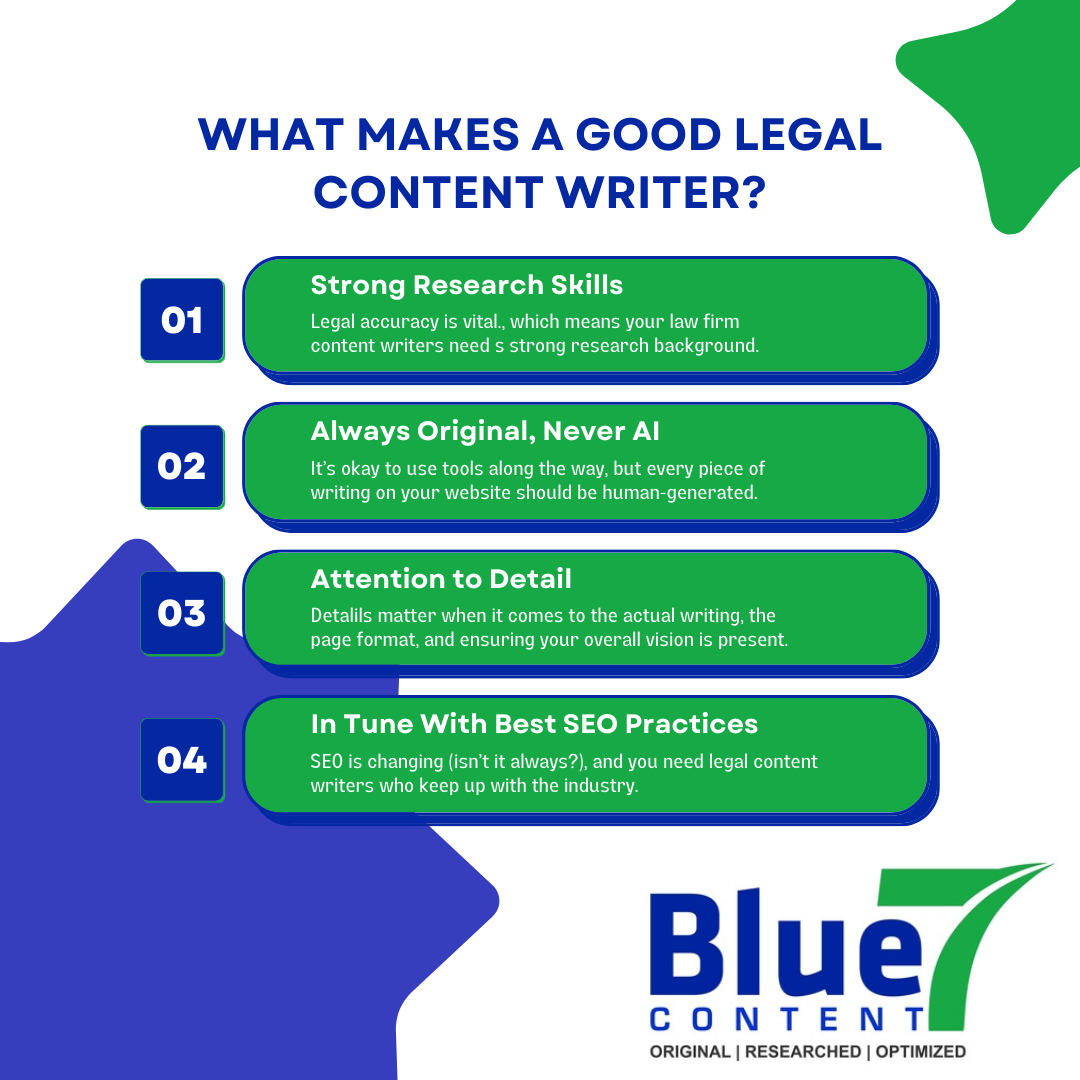
Are You Looking for the Best Legal Content Writers? (Updated January 2026)

When building out your law firm SEO content, one of the first things you need is content that represents your firm. This content should cover a range of topics, from details about your practice areas to specifics about your law firm team. However, when you are already focused on your firm, and you have clients to think about, you may not don’t have the time to write dozens of pages for your website.

When you need to accurately represent your firm online, you need the best legal content writer on your side. The right legal content writers can take complex legal concepts, streamline them so that clients can easily understand without being misled, and encourage clients to work with your firm. Our team of legal content writers has the skills and resources to make this a reality for your law firm website.

  1. What Sets Blue Seven’s Legal Content Writers Apart?
  2. Types Of Legal Content You May Need
  3. What Makes a Good Legal Content Writer?
  4. Why High-Quality Legal Content Matters More Than Ever in 2025
  5. Do I Need an In-House Law Firm Content Team? 
  6. Reach Out for the Top Legal Content Writers Today 

From the first day in business, our motto has been “Original, Researched, Optimized,” and we’ve doubled down on being a human-first company.

Attorney Driven

From the top down, we’re just a legal crew. Co-founder Victoria Lozano is a practicing attorney in Chicago, and there are many talented current and retired attorneys onboard ready to help write and review content.

Human Crafted

Human connections are everything. We believe humans communicate with other humans better than AI can, which is especially important for the type of content you need. Your potential clients have real-life issues, and they want help from a real person.

Immediately Scalable Solutions

We work directly with marketing agencies. We can handle some of your content needs or all of them. Overflow issues? We can help. Tired of wrangling a writing team. We got you. We’re a fractional SEO content team with the experience to help you scale immediately without a quality decline. 

Communication Like We’re Your Team

You can reach us at any time. We’re not going to leave you hanging like many other content companies. If you have a question or need revisions, a member of our team (a real person) will help you nearly instantaneously. We believe in unreasonable hospitality. 

When building out a law firm website, you need more than a homepage that describes your firm, some pictures, and a contact form. You need content that shows your clients what they can expect if they choose to work with your law firm. 

This content can vary and may cover a range of topics, including pages specific to the practice areas you cover, from family law to personal injury to criminal law. Below is a sample of the types of legal content you may need and what we can provide: 

Note that not all of these types of content are necessarily focused exclusively on the law. We provide not just legal content for the clients but also content that highlights your team of attorneys and showcases what makes your firm different. We also certainly provide content for sources other than your website. We’re adaptable. Great writing and research skills are transferable.

You may have worked with content writers before who provided clean, readable content that served its purpose, but may not have provided the impact you expected. So, what makes a good legal content writer? 

Writing good legal content is not just about grammar and spelling. The right spell-check tools can make this part of the process easy. What makes a great writer is making the content as relevant, useful, and easy to read as possible for the client. Making sure that readers are able to understand the content without feeling confused or frustrated is also vital to converting them from readers to clients. 

To achieve this, our legal content writers have a number of resources and steps they take to ensure your legal content is as good as it can be. That includes the steps below, which our content writers strive to provide for each of our clients.

The best legal content writers are humans, not machines.

Strong Research Skills

State and federal laws are constantly changing and developing, meaning that staying on top of these changes can mean extra research. You may even want content that covers specific laws that are actively in development. That includes bills that are in the process of being passed, especially ones that may have a significant short-term impact on your potential clients. 

The best legal content writers are also some of the best researchers. They have the tools to access information that is accurate, up-to-date, and provided to the client in a way that is easy to understand.

Always Original, Never AI 

AI has come a long way. It can summarize articles, draft outlines, and assist with research, but when it comes to producing accurate, reliable, and truly effective legal content, it still falls short. Especially in 2026, when Google’s AI Mode is reshaping how search results appear, law firms can’t afford to publish content that’s generic, outdated, or wrong.

At Blue Seven Content, we don’t reject AI entirely. We use it thoughtfully to support efficiency, not replace human expertise, and it doesn’t even draft our work. We understand that legal content needs more than keywords and formatting. It needs nuance, compliance awareness, and trust-building language that only a human writer can deliver.

Here’s why AI can’t carry the weight alone:

  • Fact reliability is inconsistent. AI systems can hallucinate facts, cite non-existent laws, or pull outdated information.
  • Tone and empathy matter. Legal content isn’t just informative. It’s persuasive and sensitive. AI struggles with that human touch.
  • Originality is essential. Much of what AI produces is derivative. Google’s systems are trained to detect and devalue unoriginal content.

When it’s your reputation on the line, there’s no substitute for well-researched, custom-written content. That’s what we deliver to you, every time. At Blue Seven Content, we think we’re the best option for your legal content writing because we have a strict policy around our AI usage.

Attention to Detail 

If you have a house style, you want your content to follow those guidelines. That includes everything from specific phrases and practice areas you avoid to the way you format your law firm name. These little details go a long way toward creating a first impression of your law firm. 

Because putting your best foot forward is so important, having a legal content writer who understands this and pays attention to these details is vital. While any legal content writer can produce pages for your website, a good legal content writer will ensure that the specifics that make your firm stand out are present. 

That includes knowing details about your firm’s achievements. For example, you may have specific awards from your community that you want to highlight. A good law firm content writer will ensure those things are included on your site.

In Tune With Current Best SEO/GEO Practices 

While presenting an accurate picture of your firm is key to helping your audience grow, the best legal content writer will also keep the algorithm in mind as well. To get the attention and traffic you need for your website, your legal content writer will also need to be aware of search engine optimization (SEO) best practices. Consequently, good SEO content focused on the reader also does well in generative engine search.

These best practices include proper headings, keyword optimization, and localization that can help Google understand what your page is about and what locations you serve. Legal content writing is a balancing act between writing for your clients and for the search engine, and the best content writers find a balance between both.

As legal marketing continues to evolve, so does the way potential clients find and evaluate law firms. While traditional advertising, like billboards and radio spots, still has its place, most legal consumers today start or end their search online. With Google now integrating AI-generated summaries into search results, standing out requires more than just having a website. Your content needs to be clear, credible, and persuasive.

Low-quality content, whether generated by AI or written without care, can damage your firm’s reputation. If your site is confusing, vague, or inaccurate, potential clients may leave without taking action. Some may even question your professionalism based on the content they find.

This shift is especially important for law firms that want to improve their visibility in search results or gain traction in competitive markets. Having a website is no longer enough. Your content should:

  • Answer real client questions in a clear and accurate way
  • Reflect your firm’s values and strengths
  • Show both clients and search engines that you are a trusted authority

At Blue Seven Content, our legal content writers are best positioned to focus on creating work that does more than fill space. We produce content that earns trust, improves visibility, and helps law firms grow their online presence in 2025 and beyond.

Do I Need an In-House Law Firm Content Team? 

Having a law firm content writer who understands your firm’s needs can be useful and can provide you with ongoing legal content for your website. However, you may be concerned about having an in-house content team, and you may even be concerned that you do not have the budget for so much content. Fortunately, you do not have to worry about hiring new sources of writing when you work with our team. 

Our team of legal content writers can provide content for your team at varying tiers of quantity. For example, you may want to simply expand your number of landing pages as a one-time effort. In other cases, you may want regular blog posts that help support your current layout. In other cases, you may have no content at all and need to fully build your site’s content. 

Even without an in-house content team, this is an achievable goal with the right law firm content writers. The right team can provide needed pages in various forms and can produce more as the need arises.

If you’re a marketing agency, whether you focus specifically on legal marketing or not, you may need help with your content needs. Many agencies have wonderful internal writing teams, but they can get overwhelmed quickly when there’s an influx of content needs.

At Blue Seven, we can partner directly with marketing agencies. We do it all the time and know that scaling law firm SEO content, whether as a law firm yourself or as a marketing agency, isn’t an easy task. But when you have a team of the best legal content writers ready to go, it’s not as hard as you think.

Building a strong online presence is not just about social media posts and the technical side of your website. Much of what Google looks at, and all of what your potential clients look at, is the content that is actually on the page of your website. Building out this content, from your homepage to your monthly blogs, is key to painting a picture of what your law firm can offer. 

At Blue Seven Content, we offer a broad range of content writing packages for law firms of many sizes. But what you can expect from all of those packages is high-quality legal content from some of the top content writers today. You can expect our team to provide the detail, focus, and quality you expect from us. 

Ready to discuss your options for building out your content? Our team is ready to talk about what our writers can provide for your law firm’s website and how we can help your law firm grow. To learn more about our services, connect with us by calling, emailing, or filling out our online contact form.

Updated by Allen Watson – CEO of Blue Seven Content