Writing a Personal Injury Practice Area Page For Your Law Firm – 10 Immediately Useful Tips for 2025

So, you’ve decided to write your personal injury lawyer SEO content by yourself. Whether you’re an attorney, paralegal, legal assistant, or some other poor soul sent off with instructions, we have you covered. In fact, when we (founders Victoria and Allen) started in this business, we had no clue how to do this either. We were the poor souls with virtually no instructions. 

At Blue Seven Content, we’ve got this figured out by now. Our team writes law firm practice area pages daily and we’ve figured out a good system. When you’re designing and writing these pages, you have to remember you’re writing for an audience of two – your prospective clients and the algorithm. No, you aren’t included. You aren’t the audience. I mention that now so that you simmer down on those overactive “attorney hands” that’ll want to nitpick every word on your pages. It’s not necessary or worth it. 

Let’s talk about how this is done.

Man in wheelchair at desk with paperwork for a personal injury claim.
We’re here to offer tips that can immediately enhance your personal injury SEO game.

1. Know Your Audience

Focus on your reader – the prospective clients. The trick with personal injury law is that anyone could need your services. This isn’t like a professional license defense law firm that would cater to one specific audience. No, your audience is practically everyone in your desired coverage area.

This means you need easily digestible content. No fancy legal language. Here are some points to help with this process:

  • 7th to 8th grade reading level. Your readers are often dealing with stress, pain, and confusion. They need clear, straightforward language, not legalese. 
  • Shorter sentences. Long, complex sentences can lose your audience. Keep things direct and to the point to ensure your message is understood quickly.
  • Shorter paragraphs. Walls of text can feel overwhelming. Stick to 2-3 sentences per paragraph to make scanning easier, especially for mobile users.
  • Utilize bullet points. When breaking down key information, such as legal rights, steps in a claim, or common mistakes, use bullet points to improve readability and comprehension. Think about how you read a page online, particularly if you’re reading from your phone. You skim until you see certain information.

Part of knowing your audience also means knowing the keywords. This page is more focused on crafting your personal injury SEO page after you’ve already narrowed down your keywords. You’ll use these keywords and their variations seamlessly throughout the page. By that, I mean that it won’t be obvious to the reader that you’re weaving keywords into the page. 

2. Your Introduction Paragraphs Matter

This isn’t Pinterest or a recipe website, so cut the shit. Your reader needs assistance from an attorney, not a backstory about their town or the origin of the name of their injuries. 

Just like we mentioned a moment ago, your introduction has two audiences. The reader needs a hook so they keep reading or, if you’re lucky, call you immediately. The algorithm is looking to your intro for a few different things that should be woven into the content seamlessly, so as to avoid confusing the reader. 

Now, if you speak to five SEO “experts,” they’re going to give you five different ways to write personal injury SEO page introductions. What we’re going to give you is a list of things we strongly encourage you to include and/or learn about as you start the page:

  • Your main keywords. You need to know this before you even start crafting your page. Whether you have a keyword research tool or you’re relying on an SEO team to give you topics, don’t start your page until you know the main keywords. Generally, the main keywords will be the same as your H1 (or page title). For example, it may be “Chicago personal injury attorney” or “Memphis commercial truck accident lawyer.”
  • The “parent page” to your current page. Without getting too granular here, every page on your website will have a relationship to another page. Your page may be a “child” page of another page (the “parent” page). It’s crucial to know where your page falls in the hierarchy of the website so you get the internal linking done properly. This is for the algorithm, friends. 
  • Correct anchor texting. Anchor text refers to the word or group of words you link your internal and external sources to (creating a hyperlink). Believe it or not, there’s a method to which words you use that can help the algorithm better understand what your page is about.
  • Avoiding external links (for now). We generally want to avoid adding external links (links that lead to a website other than yours) in the intro. While they may help with your page authoritativeness and help gain reader trust, save these for the meat of the page.

3. Why Should They Choose You

Unfortunately, just about every personal injury SEO page is the same. No flavor. Generic. Plain white chicken in the crock pot with a single potato and no spice. Now, some of that boils down to the fact that these pages all need to convey the same basic information. But how can you even stand out?

You. 

You and your team are the answer. Use a section of your personal injury SEO page to talk about you and your firm. What sets you apart from the firm next door? Tell the reader why you’re the personal injury firm that cares about them

We’re working with a client in the PNW who is expanding their personal injury practice. On their main PI page, the attorney posted their story about why personal injury law means so much to them. They’d experienced a serious injury and had been on the other side of the process. This lawyer’s story really highlighted why they cared and it helped gain readers’ trust. 

As we revamped this page, we kept the story in its entirety. It was powerful and we crafted the whole page around that theme. 

The point is that there should be some points that set you apart. Use a hundred to 150 words of your personal injury page to give your “selling points.” You can even do this in bullet point format. You can draw on client reviews (with approval from the clients) in this section as well. 

Plain personal injury pages are bad
The “spice” for your law firm’s personal injury SEO content is YOU. What sets you and your firm apart from the bajillion other plain recipes?

4. Cover the Costs 

One of the first questions a prospective personal injury client will have is something along the lines of, “How much will this cost me?” They want to know a few things that you can address upfront. First, is there an initial consultation fee? If you have free consultations, which I suspect you do as a personal injury lawyer, make it known.

As for the overall cost of the case, chances are, you handle these types of plans on a contingency fee basis. But guess what? Most people aren’t going to know what a contingency fee is.

Explain your pricing clearly and with compassion. By that, I mean you should meet the reader where they are. The reader or someone they know has just sustained an injury, and they need help. They may not have money and could, perhaps, be ashamed by that. Don’t make your reader feel more lost by throwing cold language around.

Empathy and compassion can shine through on these pages, especially when discussing costs. Reassure the reader that you’re there to help, and you want to make legal assistance affordable.

5. Covering Your Types of Cases

This is an area that can seem, to the outside reader, like a waste of words. If you knew me in real life, you’d know that I absolutely hate clogging up Law Firm SEO pages with unnecessary sections; however, sometimes, you really do need to play to the algorithm.

Your law firm’s basic personality pages, regardless of the location, will all likely have sections discussing the types of cases you handle. For example, while you may be a personal injury lawyer, you’re going to need pages for the main types of injury cases you’d like to obtain. For example, go on to any personal injury lawyer website, and you are going to see much more than just pages geared toward the keywords “personal injury lawyer.” You’ll see a list of the types of claims, usually each with its own page. An attorney will likely have a page for car accidents, truck accidents, dog bite claims, product liability cases, slip and fall incidents, premises liability claims, construction accident cases, and so on, and so on, and on.

But can’t you just write one personal injury page and mention all of those and skip all the others?

Nah, that’s not going to work. It certainly won’t work if you want to have any semblance of competitiveness in your particular coverage area.

Okay, all of that to say that you are going to have these “child pages” to your main personal injury page. On your main personal injury page, you’ll be able to link out to these other pages, and these child pages will all link back to your main personal injury page (well, the personal injury page in their location silo). This all helps create a wonderful internal linking strategy that is a major part of your overall SEO goals.

6. Show Them the Money

If you create a personal injury page without addressing potential damages, there’s a decent chance the reader will click the back button and go to the next law firm’s website. 

No, you can’t make any guarantees about how much a case could be worth. However, you should discuss the types of compensation, and you should discuss that each case is different. This section is a good place to stress the importance of having a personal injury lawyer and to gently persuade the reader to call for a free consultation.

Spend a few paragraphs or bullet points highlighting special and general damages (but call them economic and non-economic, or at least explain the legalese). Keep in mind that most personal injury victims likely don’t know the full extent of the types of compensation available. They may not know the true value of their claim, especially if they’re only thinking in terms of recouping an emergency room bill, when in reality they’ve had to miss work and are partially disabled. 

Clarify potential compensation as a way of encouraging the reader to contact you for help. This can be a powerful section. 

7. Offer Practical Tips 

There are ways to use these personal injury lawyer SEO pages to both answer readers’ questions and tap into frequently asked questions that Google and other algorithms seek out for AI overviews. Some examples of headings you could use include:

  • What Documents Do I Need For My Claim?
  • How to Speak to the Insurance Carriers
  • Steps to Take in the Days Following the Injury
  • What If There Was Shared Fault?
  • How Long Will the Case Take to Resolve?

There are many others, but these are just some examples. For many of the questions and concerns readers may have, you won’t be able to provide concrete answers on a webpage. For example, when answering how long it could take the claim to resolve, you can’t really tell the reader that. You don’t know. But you CAN discuss the various factors that affect the timing of these claims while helping them understand why you and your firm are the best choice to help.

I caution you not to go overboard with offering tips, especially for things that do not really relate to the purpose of the page. For example, I recently stumbled onto a personal injury law firm’s page about lithium battery explosion injuries. One of the headings was “Stopping a Lithium Ion Battery Fire In Progress.”

Don’t do this. Nobody is coming to your page in the heat of an active emergency for that type of help.

8. Gentle Persuasion to Get Moving Quickly

You may or may not be able to explicitly state the statute of limitations for these claims. While most states allow it, a few aren’t favorable. So, you can approach this a few ways. 

First, if you can mention the statute of limitations, go ahead and do it. Make sure it’s accurate and, just as important, make sure you mention any exceptions to the law. 

What’s more important, in my opinion, is stressing the importance of starting this process long before the statute of limitations approaches. You can use this section to tell the reader why filing a claim as promptly as possible is crucial for increasing chances of success. 

You want the reader ready to call you to get the ball rolling. Gentle persuasion with the right words can help this goal.

9. Close Out Comfortably But With Urgency

The final section of your personal injury lawyer SEO pages will be a “call to action.” This section doesn’t need to be long, but it should be direct. Close out with renewed empathy, restate the importance of filing a claim quickly, and remind the reader about the free consultation. You’ll have some keywords in the final heading section of your page and, hopefully, close out with some hope for the reader. 

10. Or Blue Seven Content Can Write Your Personal Injury Lawyer SEO Content

Listen, you don’t need a pitch. You’re on our website so you know what we do. If you get overwhelmed by the prospect of writing these pages yourself, we can help. Yes, it costs money, but let’s be honest – if you don’t want to write these pages, one of two things will result:

  1. What you do produce will be crap.
  2. You’ll never write them.

If you DO want to write these pages, great! We encourage you to start typing today. Get these pages out there so you can start getting more clients!

But holler our direction if you get stuck.

Written by Allen Watson – Founder and CEO of Blue Seven Content

Get More Local Personal Injury Clients With SEO Written Content

If your firm wants more local personal injury clients, then your website needs to let search engines know it has the best content matches for relevant searches within that area.

Incorporating geographic and other local references into local personal injury lawyer SEO content increases its relevance in local searches, which improves ranking results and generates more clients. But, as with all search engine optimization techniques, there are best practices to observe and some pitfalls to avoid. 

If you want to make sure your law firm website content is properly optimized to succeed in local searches, read on.

  1. What is Local SEO for Personal Injury Law Firms?
  2. How Personal Injury Law Firms Can Use Local SEO to Attract More Clients
  3. Writing Tips to Help Personal Injury SEO Content Rank Higher in Local Searches
  4. Get More Local Clients with Personal Injury SEO Content Created by Blue Seven Content
If you want more local personal injury cases, start focusing on creating SEO content you can be proud of.

What is Local SEO for Personal Injury Law Firms?

Local SEO is the practice of optimizing website content to improve its ranking in searches done by people within a localized area. Local SEO helps law firms increase brand awareness among people within the targeted area. 

Google evaluates three primary factors when ranking local search results. 

  • Relevance – How well a law firm’s local business profile and website content match a search query
  • Distance – The proximity of a search result to the location term used in the search or to the location of the searcher
  • Prominence – Prominence is how famous a law firm is as determined by information available across the web

The relevance of a search result is enhanced when keywords used by local audiences (car accident attorney) are incorporated into a law firm’s business profile, practice area pages, and blog content. 

Proximity is determined first by results that match the specific location used in the search query (Dallas personal injury lawyer). If a non-specific location is requested (work injury attorney near me), proximity is determined based on a result’s physical distance from the searcher (as long as they’re not in incognito mode). 

Prominence is how well a law firm is known. Google equates prominence with credibility and evaluates a law firm’s prominence from various sources such as news articles, backlinks, reviews, and ratings.

How Personal Injury Law Firms Can Use Local SEO to Attract More Clients

Optimizing content for local searches increases a law firm’s visibility within the local area, building brand awareness and establishing trust within the community. However, to attract more clients with local SEO, a personal injury law firm must first publish content that search engines are looking for. 

Establish Topic Authority 

In response to any search query, Google is trying to find content that is both helpful and reliable. Authoritative sources of information are considered the most credible and rank higher than non-authoritative sources. Authority is the level of expertise a site has regarding a topic. 

Building topical authority in each area of practice should be the goal of law firm content. A content strategy should be built around each practice area to establish a law firm as the local authority on that topic.

Create Content to Match Local Searches

Optimizing for local searches enables Google to narrow search results to more closely match the query. For instance, if a person searches for a ‘personal injury lawyer in Nashville,’ a local law firm with a practice page entitled ‘Nashville Personal Injury Lawyer’ is more relevant than a local law firm with a practice page entitled ‘Personal Injury Lawyer.’ 

Location-specific landing pages can be done for each city or area where a law firm wants to capture location-specific keyword searches. For instance, a personal injury law firm in Raleigh might have separate pages for different local keyword searches:

  • Personal Injury Lawyer in Raleigh
  • Raleigh Car Accident Attorney
  • Spinal Cord Injury Lawyer Raleigh

Or a personal injury law firm practicing in the Atlanta area might want to target various suburbs where people may search for legal help:

  • Marietta Personal Injury Attorney
  • Roswell Personal Injury Lawyer
  • Personal Injury Attorney Alpharetta

Practical tip:  Which keywords a law firm decides to target within a particular geographic area will depend on the results of keyword research for that specific area. In some areas, ‘lawyer’ may be preferred over ‘attorney,’ and vice versa. 

Law firm blog content can further support local SEO efforts by incorporating local references and linking to appropriate local pages. 

Writing Tips to Help Personal Injury SEO Content Rank Higher in Local Searches

The goal of optimizing content is to get a law firm’s message to as many people as possible who need to see it. When optimizing content for local searches, the following tips can help law firms achieve better ranking performance.

1. Avoid Keyword Cannibalism 

Keyword cannibalism can happen when more than one piece of content on a website ranks for similar search terms. This can happen when two pieces of content cover a similar topic or are optimized for the same keywords.

What happens is that similar pieces of content end up competing against each other, and Google is not certain which should rank higher. Often, both pieces end up ranking lower. 

Internal linking can direct search engines toward content that can help improve ranking. Google uses links to traverse the content on a website and links can transfer authority from a higher ranking page to a lower ranking page. Internal links also enable searchers to easily access other relevant information which keeps them on a law firm’s website longer. 

Be careful when creating the ‘anchor text’ for an internal link. Do not use the same wording when linking to different pages. For instance, don’t use ‘car accident’ to link to both the ‘Denver Car Accident Attorney’ and the ‘Boulder Car Accident Attorney’ pages. Google may not be able to distinguish the difference between the pages, which could ultimately hurt your ranking. 

3. Create Separate Pages for Each Location Keyword 

Creating separate location pages for each location keyword improves a law firm’s ranking for each local search and increases the opportunities for internal linking, which can help drive more traffic to a law firm’s website and increase the site’s overall ranking.

Get More Local Clients with Personal Injury SEO Content Created by Blue Seven Content

Close to 50% of all Google searches are looking for local information. Law firms that are not optimizing content for local searches are missing opportunities to serve local clients. A content marketing strategy that includes local SEO will ensure a law firm’s content is seen by searchers looking for information from a local source. 

Optimizing content for local searches is part of our service at Blue Seven Content when we create original content for personal injury law firms.  Whether we are creating practice area pages, landing pages, or blogs, our content is always optimized to achieve the maximum advantage for our customers. If you are interested in content that gets consistent local results, contact Blue Seven Content. 

Written by Mari Gaines, JD – Legal Content Writer

Writing Personal Injury SEO Content That Turns Readers Into Clients – Tips to Implement Today

Are you consistently writing personal injury SEO content for your website but not seeing many new clients? The information you are providing may be of great value, but it may not be getting the attention it deserves. 

With so much similar content available and reader attention being so fleeting, personal injury law firms not only have to write quality content, but they also have to write it in such a way that it appeals to readers who are looking for a reason to stop scrolling. 

Getting and keeping readers’ attention is part strategy and part art. Understanding reader behavior and presenting content that meets expectations and makes the experience comfortable (and perhaps even pleasant!) moves readers along the path toward becoming clients. 

  1. Content Presentation Can be More Important to the Reader than the Information Shared
  2. Why Having a Plan for Content Creation Improves Your Chances of Getting Clients
  3. Chasing Clients Away with SEO Content for Personal Injury that is Poorly Edited or Out of Date
  4. Writing Personal Injury SEO Content that Converts Your Ideal Clients

Content Presentation Can be More Important to the Reader than the Information Shared

Merely conveying information is not enough. There are just too many similar options that appear in search results. Personal injury SEO content needs to anticipate the behavior of the targeted readers. There are three jobs content has to do if it is going to be effective in acquiring clients.

First, content has to get the reader’s attention. Then, it has to engage the reader sufficiently to motivate continued interaction with the content. Finally, the content must persuade the reader to contact the affiliated law firm. 

The following are important considerations for improving a reader’s experience with law firm content.

Write a Good Headline

Getting a reader to stop scrolling and click on your content is the all-important first step toward client acquisition. Those first few words a reader sees when viewing search results must generate enough interest to get the reader to stop and click. Therefore, writing a great headline is crucial. 

The best headlines use relevant keywords to convey what a reader can expect from the content and include attractive or powerful language that piques the reader’s curiosity. As a general rule, headlines should be concise and to the point. 

A good blog headline for a Houston personal injury law firm writing about the steps to take after a car accident might be any of the following:

  • Injured In A Car Accident In Houston? Here’s What You Need To Do Now
  • What To Do If You Were Injured In A Car Accident In Houston
  • 7 Steps You Should Take After A Houston Car Accident
  • How To Protect Your Rights After A Car Accident In Houston
  • Mistakes to Avoid If You Were In A Houston Car Accident
  • Why You Need To See A Doctor After A Car Accident in Houston

Enhance Content Readability

Once a reader gets on a law firm’s website, the content needs to keep them there. The average amount of time spent on a website is less than a minute, which is not usually enough time to finish reading most content. 

So, when writing personal injury SEO content, how can you keep a reader’s attention?

  • Make sure the body of the content provides the information promised by the headline.
  • Start with an outline so the content is organized and flows logically.
  • Present information in short, concise sentences and try to keep paragraphs from three to six lines of text.  
  • Incorporate real experience and helpful examples where appropriate.
  • Make the information easy to scan using headers, bullet points, and bold text to highlight important points. 
  • Include links to other relevant content on your website so readers can easily find additional information that may be of interest. 

Tell the Reader What to Do Next

Writing personal injury content is about providing valuable information to potential clients and advertising the services of a law firm. SEO content for a personal injury law firm needs to include a motivating call to action (CTA) that persuades readers to contact the law firm.

Calls to action in legal content should convey the benefit a reader will receive by contacting a law firm. Incentives to encourage action could include offering a free consultation or providing a link to testimonials from other satisfied clients. Creating a sense of urgency by referencing a limited period for taking action – such as a statute of limitations – can also help inspire readers toward becoming clients. 

Calls to action should include action-inducing language like the following:

  • Call now
  • Schedule today
  • Get started
  • Contact 
  • Learn more
  • Don’t wait

Why Having a Plan for Content Creation Improves Your Chances of Getting Clients

Law firms attract clients by establishing themselves as legal authorities within their practice areas and gaining the trust of persons who read their content. Having a strategy for creating content helps a law firm establish topical authority with search engines which in turn helps to establish the law firm’s authority with potential clients. 

When Google is trying to determine the most appropriate response to an inquiry concerning personal injury, the search engine looks for indications of a law firm’s authority on the particular topic. A law firm that has comprehensively covered a topic with content on its website will rank higher in search results for having topical authority. A law firm that ranks higher in search results will be seen by more potential clients. When more potential clients interact with a law firm’s website, it is an indication of the site’s value to Google. 

Chasing Clients Away with SEO Content for Personal Injury that is Poorly Edited or Out of Date

As mentioned earlier, clients have a lot of choices when it comes to selecting a personal injury attorney. An easy way for a potential client to eliminate a law firm from contention is by finding spelling or other grammatical errors in the content or by reading information that is no longer current. 

With so much editing software available, there really are no excuses for sloppy editing. First impressions can be easily made and hard to overcome. An extremely competent law firm that has not paid adequate attention to detail when presenting content on its website is doing itself a grave injustice and likely losing business.

Similarly, lawyers are expected to be experts (though they can’t say so) in knowing the most current laws applicable to their practice areas and need to stay on top of any changes. If law firms are not regularly updating their content, it detracts from their authority and credibility. 

The goal is always to write content that will remain as ‘evergreen’ as possible. Evergreen content contains information that does not change frequently and needs updating only rarely, if ever. Content giving general or practical information may not need updating, whereas content about a specific law or a developing legal situation may need to be reviewed more frequently. 

Practical Tip: When updating previously published content it is only appropriate to change the publication date (according to Google) if significant changes were made. If only a few facts were changed or links added, it is best to add a note indicating when the information was updated but leave the original publication date as is. 

Writing Personal Injury SEO Content that Converts Your Ideal Clients

Why does SEO for personal injury attorneys matter? According to the SEO tool suite Ahrefs, of the billions of pieces of content published every day, over 95% never get any organic traffic. As more and more content is published, less and less of it has a chance to be seen. Standing out will only get more difficult unless you publish the kind of content that appeals to both search engines and readers. 

At Blue Seven Content, we write content that gets results. We work with law firms and legal marketing agencies writing thoroughly researched, strategically optimized, and uniquely original personal injury content that takes a reader from their problem to the law firm with the solution. Call 843-580-3158 to find out how Blue Seven Content can improve your content marketing. 

Written by Mari Gaines, JD – Legal Content Writer

10 Tips for Writing Personal Injury SEO Content That Converts to Clicks and Clients

Writing personal injury content may be easier said than done. You want your content to drive your readers to choose your law firm over others. Yet, you may need help figuring out where to start. And the longer you wait to create high-quality SEO content, the more likely it becomes that prospects will find the legal services they need elsewhere. 

You spend your money getting readers to your website. Now what? If your content is less than stellar, your potential client becomes someone else’s potential client with the click of a back button.

When it comes to personal injury lawyer SEO content, do not leave anything to chance. Learn the ins and outs of content that will help you engage, inform, and inspire your readers. Once you do, you can create content that turns your readers into clients.

  1. Why Does SEO for Personal Injury Lawyers Matter?
  2. Personal Injury SEO Content Tips
  3. Get Help Writing Personal Injury SEO Content For Your Law Firm or Legal Marketing Agency
personal injury SEO content converts to clicks and clients

Why Does SEO for Personal Injury Lawyers Matter?

According to research, Google processes more than 40,000 search queries every second. This works out to about 3.5 billion searches every day and 1.2 trillion searches annually around the world. With search engine optimization, you can make it easy for readers to find your content since it may appear at or near the top of Google searches. 

Google has a formula for how its search works. Based on this, it considers the meaning, relevance, quality, usability, and context of all content. If your personal injury SEO content hits the mark in these five areas, Google may see it as credible. At this point, when readers search Google for pertinent terms and phrases included in your content, it may be one of the top results they see. This means readers are more prone to click on and read your content over your rivals’. When they read your content, they may discover the value your law firm offers. This may lead readers to search other areas of your site for content and reach out to your firm for more information about your legal services.

Writing personal injury content that ranks highly on Google can impact your firm long into the future. If readers continuously return to your site, it may be easy for others to find you on Google. This increases the likelihood that readers will choose your firm over its competitors. On top of that, you may boost your conversions and sales.

Personal Injury SEO Content Tips

Producing top-notch SEO content for personal injury law firms may seem difficult at first. Fortunately, we are here to help you get the best results out of your content. Here are five tips you can use to create content that transforms your readers into clients:

1. Identify Your Audience

To make content your readers need, you have to figure out who you want to read it in the first place. Consider who will read your content and why they should look at it. From here, you can figure out what terms and phrases to include in your content. This can help you produce content that resonates with your target reader. 

2. Avoid Jargon

Even though SEO content for personal injury law firms is evolving, there is at least one constant: Jargon will do you no favors. You may understand legal terms and phrases, but your readers might not. As you produce your content, keep the reader’s point of view front and center. If there are terms and phrases that a reader may not understand, define or rephrase them. Otherwise, if a reader does not understand what you are saying, they may be confused about your content. This may drive them to look elsewhere for legal services. 

3. Avoid Fluff

Just because you want to craft meaningful content for your lawyer website does not mean you need to be long-winded about it. In terms of SEO, short and direct content is typically better than long and descriptive. Your content should make it clear what your law firm offers and what you are all about. When someone reads your content, they should not have to search far and wide for the information they need. If you are worried your content is loaded with fluff, help is available. For example, you can partner with a legal content marketing agency that can produce SEO-friendly content that is concise and digestible. This agency may help you revamp your existing content and produce new content that is free of fluff and delivers outstanding results. 

4. Be Intentional

You may be tempted to use AI legal content marketing, but doing so may hurt your law firm now and in the future. Artificial intelligence gives you a quick solution to produce content. Alternatively, the content is not personalized. In the big picture, it may not differentiate your law firm from others. If you produce SEO content on your own, you can tailor it to your firm. You can create content that is well-structured and easy to understand. Plus, you can write about any legal topics that are relevant to your readers. This flexibility creates endless possibilities. It allows you to deliver content that your readers can enjoy and helps your firm rise above its rivals. 

5. Update Your Content

If you are not careful, bad law firm website content may damage your brand reputation. For instance, you may have published a law firm blog post that includes statistics and research that are now out of date. Even worse, the post may contain information about statutes and laws that are no longer in effect. Prioritize your website content and make sure it is up to date. Generally, it may be a good idea to audit your site’s content every few months. Some pages may need to be updated more frequently than others. A legal content marketing agency can work with you to make a plan to keep your content up to date. 

6. Convey Empathy

A person who has suffered a personal injury has experienced a significant negative event in their life. Their normal has been turned upside down. They may be going through a wide range of emotions. They may be overwhelmed and need some reassurance that everything is going to be okay. 

Personal injury SEO content has to let the reader know that their plight is understood, their welfare is important, and there is help to get them through this ordeal. Law firms can draw on past experiences with personal injury clients for examples of what people may be going through following a personal injury accident. 

Content that conveys to the reader that someone cares about them and what they have been through makes them feel valued and increases their trust in the information (and the law firm providing it).

7. Incorporate References that Demonstrate Familiarity with the Local Area

Including references to local culture and other points of common interest or experience will demonstrate similarities and help establish common ground with the reader. People are more likely to trust other people that they have things in common with. Let the reader know you are a part of and care about the local community. 

Incorporating local references into writing personal injury SEO content also helps search engines identify content that is highly relevant in terms of proximity to the searcher. For law firms with localized practices, this means the people reading the content are more likely to live or work in the same local area.

8. Make Sure Your Writing is Unique

When creating content, don’t just reiterate what every other personal injury law firm is writing about ‘distracted driving accidents’ or whatever else. Beware of using common phraseology too often. There can be a lot of similar language used when writing about laws and legal concepts. 

Plagiarism can often occur unintentionally due to limited ways to describe similar topics and the sheer volume of content being produced. There is mixed authority on how much plagiarism is acceptable or should be tolerated. Generally, a plagiarism percentage under 10% is considered safe, but the goal should be as low as possible. An online plagiarism-checking tool such as Grammarly can be of assistance. 

Plagiarism is a big problem when AI is used for generating content. Text analysis expert Copyleaks conducted a recent study of AI-generated content produced on a number of different topics and found that 60% of the content, overall, contained some form of plagiarism. Almost 43% of the legal content contained plagiarism, with close to 12% having identical text. 

Writing personal injury SEO content that is unique and original may take a little more time and attention. However, the rewards will be worth the extra effort. Not only do search engines prefer something new and different, but readers will find the content more engaging and be more likely to reach out. 

9. Be Realistic About the Outcomes Clients Can Expect

Law firms trying to generate personal injury leads need to be careful when expressing what they may be able to do for a client. It is an ethical violation for attorneys to promise or guarantee they can obtain a particular result. 

Rules of professional conduct prohibit lawyers from making claims about their services that could be misleading to potential clients. Particularly problematic are statements claiming to be better than other attorneys, such as ‘we are the experts’ or ‘work with the best law firm in town’.  

Even a representation such as ‘our firm can get you all the money you deserve’ could be misleading in that a person may believe an attorney can do more than is actually possible. 

Content may contain factual statements about qualifications, prior case results, and testimonials from clients about actual experiences. Readers are then left to draw their own conclusions without being inappropriately influenced about the outcome of the legal services a personal injury law firm can provide. 

Make sure your choice for writing personal injury SEO content understands what’s needed to get the job done right and up to your state bar’s standards.

10. Incorporate Personal Experience 

If appropriate, sharing personal experiences can enhance the authenticity of content and make it more relatable for readers. Readers are more likely to connect with information describing actual experience – especially if it is similar to their own. 

When someone else has experienced something similar to what we are looking for information about we tend to give more credibility to what they have to say. Google has realized the value to users of content describing personal experience, which is why ‘experience’ was added as one of its content quality ranking factors in 2022. 

Google is especially concerned about experience when it comes to personal injury legal content because it could influence a person’s financial and individual well-being. Content quality ratings undergo additional scrutiny when the topic contains information that could affect ‘your money, your life’ (YMYL).

Law firms that can ethically incorporate personal experience into their content are more likely to connect with readers on a personal level and get more personal injury clicks.

There really is no easy way around it. Law firms wanting to convert more personal injury leads into clicks and clients must commit to producing content that is reader-focused, relatable, unique, and trustworthy.   

Get Help Writing Personal Injury SEO Content For Your Law Firm or Legal Marketing Agency

Search engine optimization can make or break your law firm’s website, and these 10 tips should be considered when writing personal injury SEO content. If done correctly, the content can help lay the foundation that begins an attorney-client relationship. Regardless, you do not have to tackle SEO on your own. At Blue Seven Content, we have a wealth of experience with legal content marketing. Our team includes law firm writers who can help you craft content that drives traffic and helps your web pages rank high on Google. To learn more about our SEO content services, contact us today. 

Written By Dan Kobialka and Mari Gaines – Legal Content Writers

Well-Researched Content From Blue Seven for Your Law Firm’s Continued Success, From SEO to SGE

We started with law firms. Our founders began their writing careers (after switching from education) by writing SEO content for multiple industries but specifically focusing on law firms. After starting this company, they changed the industry process for writing competent law firm content.

Legal marketing is an insanely competitive field. But we aren’t trying to compete. In fact, there aren’t many people or agencies that can compete with us. At least, not with the level of talent we have combined with our price point.

But how do we do it?

Law firms seeking to gain a competitive edge in their geographic market have to create knowledgeable content and craft a credible reputation. This can take time, but well-researched law firm SEO content that focuses on the reader can position your firm as an authority for your particular practice area(s).

Well researched law firm SEO and SGE content.

Speaking to the Choir, But Just In Case – The Search World Has Changed

How’s your head?

We ask because we’ve had a fairly regular dose of morning Tylenol for the last year or so as our new overlords artificial intelligence has crept into every aspect of the marketing sphere (well, every sphere, actually – just the other day, we swore we saw a commercial for a smart toilet).

But, the shift changed a while ago for the legal marketing industry. We’re still feeling the initial start of what artificial intelligence may do, but the shift towards digital has been rapid, sped up even more by the COVID-19 pandemic. Data shows that 74% of companies have moved most of their services online. Again, speaking to the choir.

However, as more and more companies and more and more law firms realize the importance of their online presence, competition becomes intense.

You know it’s serious when the town’s PI/Divorce/OccassionallyCriminalDefense lawyer, who’s been in the same janky building for 37.5 years, has a website marketing his services (his name isn’t Saul).

However, and we are just going to speak anecdotally for a moment, whatever we call the current era we are in, it’s been a mucked-up, bassackwards, rollercoaster. ChatGPT rushed a miracle (lol) to the market, and everyone’s been playing catch-up, unfortunately leaving somewhat reliable SEO tactics in shambles.

However, we took some time to reflect last year (one hour) and decided to stay the course. We got into this business as writers. We hired more writers. So, we want to write, and we want to write well.

We didn’t lose any clients because of AI, but we DO know some agencies that made the shift. Most have shifted back to human writers. Two of our former colleagues have disappeared (not in a mafia way).

It’s well-researched pages for the win, duh.

Well-Researched Law Firm SEO Pages Are Still Golden

I encourage you to check out our legal writer training process. We’re able to create the best content for your law firm’s presence because of their talent.

Our writers and our process are the key to helping your law firm or marketing agency acquire new clients. A strong digital presence comes first from strong writing.

Good writing that’s well-researched and truly makes a point to communicate directly with the audience is the heart of what we do. It’s what we love.

Data from Googly shows what we already know – a ton of people (96% of law firm prospective clients look online for advice, and 74% of those people will visit a law firm’s website to take the next steps.

Competing means thinking about more than SEO, obviously, but your content can be a springboard to so many other marketing channels within your firm – SEO, SGE, social media, off-site brand awareness, physical marketing, and more.

If you have a good law firm SEO page, you have everything you need to pull it apart to use elsewhere. And that’s what we’re trying to shift to – more than SEO.

We know we can write, but we also know that our writing can grow your law firm’s brand and complement every marketing channel. Law firms should position themselves as a source of credibility and authority, not just online but within their community. However, your website is your storefront. Your content should be well-researched and help solidify your law firm’s credibility by becoming a reputable, trusted information resource. Turn writing law firm content into a priority.

Information from Customer Experience shows that 61% of online prospects are more likely to become clients with a law firm that approaches content in a unique way. Data also shows us that it could take five to seven online impressions before a consumer remembers your brand.

Your content can do a few things here – it can both address the immediacy of your potential client’s concerns while also crafting a lasting story to enhance your law firm’s brand.

High-quality, well-researched pages build brand awareness, strengthen your readers’ trust, and encourage more clicks to that contact page.

Good Writing First – Search Second

Blue Seven Content finds good writers first. That’s the priority.

Good writing is intuitive, and not everybody has that. That’s OK. Not everybody knows how to use a ham radio or how to grow strawberries, either. Not everybody has to be an expert in everything.

Typing does not equal writing. Putting together sentences that make sense does not equal writing.

Putting together words, sentences, and paragraphs that transform a law firm from a cheesy, AI, rote, basic content repository to a website the whole family trusts is a skill. It’s a talent we bring to every client.

We’ve been doing this for years now. Maybe you’ve heard of us, or maybe you’re out on the prowl for a new content provider. The good news is that we can partner directly with you OR your legal marketing agency.

When you call us, you’re going to talk to one (or both) of our founders. We are all personally involved in your content. When you need to get a hold of us, you can.

Oh, and we also have a content guarantee. If we don’t hit the mark you expected with your page, we’ll do it again. We don’t charge for revisions if we make a mistake, miss the mark, or just bungle a page.

We get it right, so you aren’t wasting money.

We’re ready to talk if you are. Writing law firm content is our thing. You can fill out our contact form (I promise, someone will see it) or call us at (843) 580-3158.

Written by Allen Watson – CEO and Founder of Blue Seven Content

Law Firm Backlinks – Using Your Content To Help

Law firm backlinks are one of those seemingly mysterious parts of legal SEO, but they don’t have to be. Of all the optimization strategies that help boost search engine rankings, acquiring credible backlinks has proven to be one of the most effective and enduring. Backlinks are evidence that someone else has reviewed the content and finds it to be an authoritative source. The more quality backlinks pointing toward a piece of content, the more trustworthy search engines deem the content to be and the higher it will rank.

Getting law firm backlinks requires a combination of specialized legal knowledge, top-notch qualifications, and information that is comprehensive, accurate, reliable, and can connect with a particular audience. 

  1. What Backlinks Mean to Search Engines
  2. Not All Backlinks Have the Same Authority
  3. Quality Content is the Best Way to Attract Authentic Backlinks for Lawyers
  4. How to Get Started with a Credible Law Firm Backlink Strategy
Backlinking for law firms.
Well-written and researched content can elevate your law firm’s backlink strategy.

Backlinks are like independent votes of confidence verifying the quality of content for search engines. They can also help determine content relevancy. When other relevant websites include a link back to content on a law firm’s website, it tells Google that the content is both reliable and helpful. Like votes, the more backlinks law firm content has, the more likely it will win at ranking in search results.

SEO expert Backlinko recently conducted a study of close to 12 million Google search results to determine what factors were most closely correlated with landing in the top spot on page one of the search results. 

The study found that the #1 search result had an average of 3.8 times more backlinks than the results appearing in positions 2 through 10. The study also found the number of different domains linking to a page (as opposed to the same domain linking to a page several times) had a positive correlation with ranking. 

Link building is the process of actively trying to obtain backlinks. Link building is not just about racking up as many backlinks as possible because links open pathways for search engines, and that may not always be appropriate or desired. 

Making determinations of authority helps Google select the content that it believes will be of the most help to a user. Link authority is the amount of ranking weight a link carries. The more link authority a backlink has, the higher the quality and the more ranking weight it will be given. 

The following considerations help determine the authoritativeness of a backlink:

  • Authority of the page containing the link
  • Number of other links on the page containing the link
  • Location of the link on the page 
  • Whether the link is follow or no-follow

Links from pages recognized as authoritative are given higher link authority. Links from pages with lots of other links will not get as much authority as links from pages with fewer other links. Links that are located within text are given more authority than links appearing in footnotes. 

No-follow links contain coding that tells search engines not to consider them for ranking purposes. No-follow links developed as a way to keep backlinks from passing authority to low-quality websites. 

Google also requires the use of no-follow links in certain situations to avoid violating anti-spam policies. Because of the heavy reliance on backlinks as an indication of content quality, Google wants backlinks to be acquired from other websites because the content being linked to is really that good.

According to Google Search Essentials, acquiring backlinks in an attempt to manipulate search rankings is considered ‘link spam’. The following are some of Google’s examples of what it considers to be spammy link-building: 

  • Exchanging money for links or posts with links
  • Exchanging goods or services for links
  • Excessive link exchanges
  • Low-quality directory or bookmark site links
  • Links in footers that are widely distributed

Does this mean law firm backlinks from legal directories or guest posts are prohibited link spam if they are not made no-follow? Not necessarily, but Google spam policies need to be taken into account when developing a law firm SEO backlink strategy. 

No-follow links don’t block the path of a user who clicks on the link. The communication is only to sea.’h engines. The most common strategic use of no-follow links is when there is a need to cite a source but no intention to have any search engine association with the content. 

Lest no-follow links should get a bad rap, digital marketing expert Semrush says no-follow links are an important part of SEO. Having a mixture of both follow and no-follow backlinks indicates backlink diversity. Backlink diversity is more suggestive of natural or organic backlink building and is favored by search engines. 

Google doesn’t like spam. The search engine doesn’t want to promote content that could harm or mislead people. Therefore, it uses both automated systems and manual reviews to detect and remove spammy content. During 2020, Google says its systems discovered 40 billion pages of spammy content every day

At the other end of the spectrum, Google has nothing but love for thoughtful, well-written, reliable content that is intended to help people rather than manipulate search engines. The better the content quality, the more likely another authoritative source will link to it, and that is backlink gold. 

Law firm websites with strong core practice pages supported by sub-practice pages and blog content can earn backlinks for lawyers by providing the kind of go-to references that others will rely on as trusted sources. Paying close attention to content quality is the key to building trust with search engines and people and establishing strong brand recognition.  

Law firm SEO backlink building is a long-term strategy because quality trumps quantity, and getting quality backlinks takes some work. The first place a law firm needs to start is with the content on its own website. 

Content prepared to be a handy resource or presented as a comprehensive guide is the type of content that gets more genuine backlinks. The following kinds of content can be very link-worthy on a law firm website:

  • Ultimate guides – comprehensive documents detailing a procedure, process, or area of law
  • List pages – giving steps in a process or a collection of relevant resources 
  • FAQ pages – providing quick answers to commonly asked questions
  • ‘Why’ and ‘what’ posts – these types of posts attract attention and tend to be backlink-friendly

Other strategies for gaining law firm backlinks, such as legal directory listings or guest posting, may still be of some benefit if done without offending Google’s spam policies. However, the main strategy for any law firm looking for long-term digital marketing success is to earn backlinks from other authoritative websites by consistently producing authoritative, reliable content that gives people the information they are looking for. 

Written By Mari Gaines – Legal Content Writer

How SEO for Personal Injury Lawyers is Evolving

Personal injury lawyers are working to be seen in a market with over 425,000 law firms nationwide. A well-optimized online presence is needed to ensure your law firm stays competitive in its field. Search engine optimization SEO for personal injury law firms can help place your firm as a top point of contact for people needing legal help.

The online marketing and SEO world changes all the time, so it is crucial you work with a company that focuses on the full picture and keeps up with changes and trends. At Blue Seven Content, our legal writers are constantly shifting to keep up with Google search updates, including their latest roll-out of SGE: Search Generative Experience. Read on to learn more about how SGE can change how prospective clients could see your law firm’s personal injury lawyer content and how our writers can maximize this experimental search experience.

  1. What Is Personal Injury SEO Content?
  2. Why Does SEO For Personal Injury Practice Area Pages Matter?
  3. What is SGE?
  4. How Does SGE Affect Personal Injury SEO?
  5. Optimizing SEO for Personal Injury Content
  6. Some Final Questions About Personal Injury SEO Changes
  7. Keep Your Personal Injury SEO Updated in This Evolving World
Personal injury lawyer SEO remains in a constant state of change.
SEO always changes, but don’t get stuck at 2023 changes when 2024 changes come knocking.

What Is Personal Injury SEO Content?

Personal injury SEO content involves effective search engine optimization strategies to make personal injury law firm websites appear at the top of search engines like Google. This is accomplished by incorporating relevant personal injury keywords into your personal injury SEO content pages, such as law firm social media posts, landing pages, personal injury blogs, and service pages. Together, these strategies can help your law firm website be visible on search engine results pages (SERPs) when a query is made by prospective leads using the specific phrases you ranked for.

Personal injury SEO is the process of improving your website ranking in search engines to increase the organic search traffic to your firm’s website. Blue Seven Content writers provide not only relevant keywords but high-quality content for the needs of your prospective leads. With the personal injury market being flooded and technology evolving continually, you need law firm content writers who are shifting equally with these changes.

Why Does SEO For Personal Injury Practice Area Pages Matter?

Due to the sensitive and urgent nature of personal injury cases it is vital that personal injury lawyers be easily accessible online. When your website appears on the first page of Google’s search results, your law firm is in the top 90% of web traffic. On the other hand, if your website does not appear on the first page, your law firm may be invisible to the majority of your potential leads. Read on to learn how Blue Seven Content can help you achieve this goal.

Begin With a Strong Foundation

Before focusing on how personal injury lawyer SEO is evolving, it is crucial to evaluate your online presence to best understand your audience. Blue Seven Content will thoroughly evaluate the design of your website, the content quality, mobile friendliness, current user experience, and how you currently rank in searches. This paves the way for changing your SEO strategy, tailoring personal injury lawyer SEO techniques to meet the unique needs of your prospective leads and the goals of your law firm.

Understand Your Target Audience 

It is important to understand who your target audience is. Knowing who your potential clients may be, the language they are using for searching, and what specifically they are searching for is a critical strategy for SEO success. Understanding these key points will shape how you create your content and which keywords you will select to ensure your online presence resonates with the very people you are aiming to serve.

Determining your target client means you must consider factors such as the specific circumstances leading to the need for personal injury services, location, gender, and age. Blue Seven Content will analyze the data from your social media platforms and web pages to evaluate the behaviors and interests of your audience. Remaining up-to-date on common personal injury cases and current trends can greatly refine your target audience.

Analyze Your Competitors 

While it is crucial to know your audience and how your own law firm page is performing, it is equally important to look at your local competition. Personal injury lawyer content SEO is highly competitive and worth the investment to utilize top-talent writers who specialize in SGE and SERP optimization for creating content that attracts personal injury clients to your website rather than the competitors.

Blue Seven Content will evaluate:

  • Blog content and articles
  • Practice area pages
  • FAQ pages
  • Social media
  • Lawyer profile pages
  • Videos 
  • On-site client testimonials
  • Off-site client reviews
  • Backlinks

Keyword Targeting and Research

With the rollout of SGE, keyword search relevance is even more important for personal injury SEO content. Identifying the phrases and words that potential leads use when they search Google is a priority for keyword research. “Car accident lawyer” or “Personal injury attorney” are traditional keywords that tend to be broad yet highly competitive. These keywords are critical since they align with the most commonly searched terms, but they are also incredibly competitive.

Our team of writers carefully crafts the keywords that match your practice area using specific words and phrases that will enhance your personal injury SEO content. These phrases are targeted towards specific locations and queries and are generally less competitive. By capturing a more niche audience, these search terms result in higher conversion rates and engagement.

What is SGE?

SGE, search generative experience, is a program that uses AI-based technologies, including machine learning, deep learning, and natural language processing. Search engines utilize these technologies to understand how a user searches queries, processes relevant content, and formulates an appropriate response.

Google provides users with a quick overview of a user’s query without getting too complicated or detailed. This can easily alter what the user sees when searching for specific topics.

Additionally, as an experimental program, Google’s new search options are not perfect and can easily generate misinformation for users. Disclaimers are posted saying, “Generative AI is experimental. Info quality may vary” or “This information does not constitute medical advice or diagnosis.”

How Does SGE Affect Personal Injury SEO?

Generative AI can have pros and cons on SEO for personal injury law firms. Here are both the benefits and disadvantages of SGE:

Organic Traffic of SEO

Organic traffic could be reduced through the use of search generative experience. However, it could also generate leads with a more likely chance of converting.

The cons of SGE on traffic can come when users seek most of their needed information from AI-created summaries, which prevents them from clicking through to pertinent websites such as yours. For instance, if the response created by SGE is overly detailed, the user may choose not to click on the webpage that created the original information the AI was referencing. Though Google still cites them as the original sources, the high ranking value may decrease for “what is” queries.

SGE may not be all that bad, though. The leads driven to your website by SGE could be of higher quality. While traffic may decrease for basic queries, many people still require research that is more in-depth than what is generated by AI. This means that users who do visit your page will be well-informed and prepared to convert or engage in some way. Fortunately, traditional search results will remain available underneath these results to users who have opted-in to SGE responses.

Optimizing SEO for Personal Injury Content

In-depth research by Blue Seven Content has found many ways to optimize for SERP and SGE queries. The first result of our research is that the most common and simple phrases used in SEO writing may not be the way to go for ranking in search engines. Using more detailed keywords will result in users more easily finding the pages they need rather than a plethora of unrelated content.

We have also found that SGE, like traditional searches, is focused on providing users with helpful and relevant content while making the experience easier and faster overall. 

Natural language is best recognized by SGE and SERP pages, which can only be done through the use of high-quality SEO writers. Blue Seven Content writers excel in their research and writing skills to provide personal injury law firms with the ultimate SEO pages. Without high-quality content that provides users with vital information, your firm will not be viewed as an authority in your field, causing potential leads to look to competitors.

Some Final Questions About Personal Injury SEO Changes

What are the specific challenges of using SGE for personal injury law content, and how can they be overcome?

The specific challenges of using SGE for personal injury law content include ensuring the content is detailed enough to meet the new search technologies’ requirements for depth and relevance while also being accessible to the average person. Overcoming these challenges involves creating high-quality, informative content that addresses the specific queries and needs of potential clients, using clear and concise language, and optimizing for both traditional SEO factors and the capabilities of SGE to recognize and rank valuable content. Now, do we know which factors SGE will use to “rank” pages? Not really. Nobody does yet, and as with traditional SEO, it will continuously change.

Will SGE become the main way people find law firms in the future?

While it’s not definitively stated that SGE will become the main way people find law firms in the future, the adoption of advanced search technologies like SGE indicates a significant shift in how search engines operate and how users interact with them. Given this trend, it’s reasonable to anticipate that search experiences utilizing SGE or similar technologies could play a major role in how potential clients discover law firms, emphasizing the importance of adapting SEO strategies to these evolving technologies.

Keep Your Personal Injury SEO Updated in This Evolving World

Staying ahead of the SEO curve is the only way to keep your law firm seen when the market is flooded with personal injury lawyers who are fighting to make it to the top of search engine rankings. Personal injury lawyers need to use a company that is an expert in SEO writing if they want to stand out in an overly crowded digital landscape. Our team of writers aims to establish your law firm as a personal injury law authority, attract more leads, and greatly enhance your visibility online.

If you want to take your personal injury website content to the next level, Blue Seven Content is ready to help. Our writers utilize comprehensive SEO tools that will be tailored to the unique needs of your personal injury law firm. Discover what our team can do for your personal injury lawyer content by visiting our website today and filling out our quick contact form.

Written By Dianna Mason – Legal Content Writer

Law Firm Blogs – 3 Tips for Making Content Your Readers Need

Search the phrase “law firm blogs” in Google, and hundreds of millions of results will come up. Making your law firm blog content stand out among these results is important. If you plan accordingly, you can produce content that engages, inspires, informs, and educates your target audience. On top of that, your content is likely to generate web traffic, leads, and revenues. It can also help distinguish your firm as a thought leader. 

Of course, blogging for law firms is rarely simple. You have the option to go with AI legal content marketing, but ChatGPT and similar technologies offer no guarantees. Plus, if you want personalized law firm blog content, AI cannot deliver exactly what you want. 

Outside of AI, you can go it alone with your legal firm blogs. This requires time, energy, and resources you may have to take away from other areas of your operations. This can hamper your ability to serve your clients the way you want. 

Ultimately, hiring professionals is the best option for blogging for law firms. If you have an experienced law firm marketing agency team at your side, you are well-equipped to produce high-quality content that lines up with your firm’s expectations. Perhaps most importantly, you will have no trouble making the content your readers need exactly when they need it.

Focus on your reader. The rest will fall into place.

Tips to Make Law Firm Blogs Your Readers Need

1. Relate to the Reader

According to research, there are more than 600 million blogs across the internet. You can create a blog for your legal firm in just minutes and start producing posts right away. But just because you create content does not necessarily mean your readers will get value out of it. 

How well your content relates to your readership often dictates its success. For example, if you want law firm blog posts for car accident victims, you probably do not want to focus on premises liability lawsuits. Instead, you want timely, relevant, and accurate content that explains why readers should contact your firm if they need an auto accident firm. 

To make your blog post content relatable, consider your target audience and why website visitors will visit your site in the first place. From here, you can craft posts that explain why your visitors should care about your firm and all it offers. If your messages resonate with audience members, they will get value out of them. This means members of your audience will follow up with a phone call or email or respond to any other call-to-action you include in your posts. 

Displaying empathy makes a world of difference with blogging for law firms, too. If you know your audience members, you can empathize with them and their needs. You can produce content that shows readers you care and want to help them. This can help distinguish your firm and its blog posts from the competition. 

Along with these things, look for the best law firm content writers to produce your content. These writers will learn about your firm and its target audience. Next, they will provide content that hits the mark with your readers. They will also make sure your content establishes your firm as a trusted partner for legal services.

2. Go Beyond Artificial Intelligence

ChatGPT and similar artificial intelligence technologies are tools — not solutions. They can help with blogging for law firms. However, if you rely exclusively on these tools for blog posts, your audience will eventually notice. At this point, the content you produce may actually hurt your chances of building trust and growing your firm. 

There are many opportunities with AI tools in the legal sector. At the same time, generative artificial intelligence challenges are making it difficult for many firms to get the most value out of these tools. These challenges include:

  • Lack of Legal Data: Firms often place restrictions on the data used to train AI models. 
  • AI “Hallucinations”: Some AI models are known to “hallucinate,” i.e., generate misleading or incorrect results. 
  • Copyright Violations: There is a risk of producing law firm blog posts that violate copyright laws.  

Do not leave anything to chance with your blog posts for law firms. If you want to use AI, do so only for research and analysis. AI tools can help you identify opportunities to improve your existing blogs or generate ideas for new ones. Conversely, if you rely on them solely for blog content, the damage can be significant. If you are not careful, your AI-generated blog posts may compromise your firm’s reputation, lead to revenue losses, and cause other long-lasting harm. 

And remember, the goal of your content is to make it valuable to your readers. AI may help you produce content in just seconds, but it cannot personalize your blog posts to your target audience. To create blog posts that speak to your audience, hire professionals. 

For instance, you can partner with a law firm blog post marketing agency that understands how to quickly come up with FAQ topics. This agency has writers on staff who want to work in lockstep with you to achieve your content marketing and blog post goals. These writers will do everything within their power to produce the best content for your firm. They will make sure your content is relatable, easy to understand, and delivers your desired results. 

Your law firm blogs can serve as more than just website content — you can use sentences or sections from your posts on X (formerly Twitter), Meta, LinkedIn, and other social platforms. 

As an example, you write a blog post on law firms in the United States and include reasons why a reader should hire you over other options. In your post, you include the following sentence,

“According to the American Bar Association (ABA), there are 1.3 million lawyers in the United States.”

This nugget provides useful information, as it tells a reader just how many attorneys are accessible nationwide. It also opens the door to producing compelling social media content.

Here is an example of a social media snippet that encompasses this stat:

According to the American Bar Association (ABA), there are 1.3 million lawyers in the United States.

At [Your Law Firm], our attorneys stand out from the pack. Here are some of the reasons why: link to your blog post

Social media snippets are easy to find. Just think about your target audience as you re-read your blog posts. Then, you may find some sentences or sections containing meaningful content you can easily share on your social channels. Use this content as the basis for a social media post. 

As you share social media snippets, track your results. If you find your snippets drive engagement, continue to use them. On the other hand, if you see your nuggets are not working as well as you would like, now may be a good time to revamp your law firm’s blogging and social media strategy. 

If you want help with social media snippets and blog post content, you have options. One of the best routes involves hiring a law firm marketing agency. This gives you access to a team of content writers who know the ins and outs of social media and blogging. As these writers create your content, they will account for your social channels. When your blog posts are ready, they can publish them to your site — and use social media nuggets to promote your posts and your firm. 

Get Started with Blogging for Law Firms

Producing reader-friendly content is usually easier said than done. Multiple options are available to help you generate best-in-class law firm blog posts. But only one can help you achieve the optimal results. 

ChatGPT and other AI tools are fast and easily accessible but will not always produce accurate content for your law firm blogs. They cannot deliver personalized blog post content, either. 

Alternatively, you can generate blog posts on your own. This requires you to spend time writing and editing your posts and making sure they align with your firm’s mission, values, and goals. Yet, the time, energy, and resources you commit to creating blogs can cut into your day-to-day work. It may ultimately impact your customer satisfaction levels and bottom line, too. 

For law firm blogging, nothing beats the skills and expertise of a legal content writer. This is due to the fact that law content writers have a simple goal: to produce content that delivers value to your legal firm and its target audience. 

By working with a team of legal content writers, you can produce content that lines up with your readers’ expectations. You have the opportunity to share your ideas, opinions, and feedback about the legal blog posts you want. Or, you can let writers offer blog suggestions, recommendations, and tips. In either scenario, you are assured of getting top-notch content that provides value. You may even be able to get social media nuggets that go viral. 

At Blue Seven Content, we offer a wide range of legal content services to law firms across the country. We can provide you with a steady stream of law blog posts — with no AI necessary. To find out more, contact us online or call us at (843) 580-3158. 

Written By Dan Kobialka – Legal Content Writer

Are You Looking for the Best Legal Content Writers? (Updated January 2026)

When building out your law firm SEO content, one of the first things you need is content that represents your firm. This content should cover a range of topics, from details about your practice areas to specifics about your law firm team. However, when you are already focused on your firm, and you have clients to think about, you may not don’t have the time to write dozens of pages for your website.

When you need to accurately represent your firm online, you need the best legal content writer on your side. The right legal content writers can take complex legal concepts, streamline them so that clients can easily understand without being misled, and encourage clients to work with your firm. Our team of legal content writers has the skills and resources to make this a reality for your law firm website.

  1. What Sets Blue Seven’s Legal Content Writers Apart?
  2. Types Of Legal Content You May Need
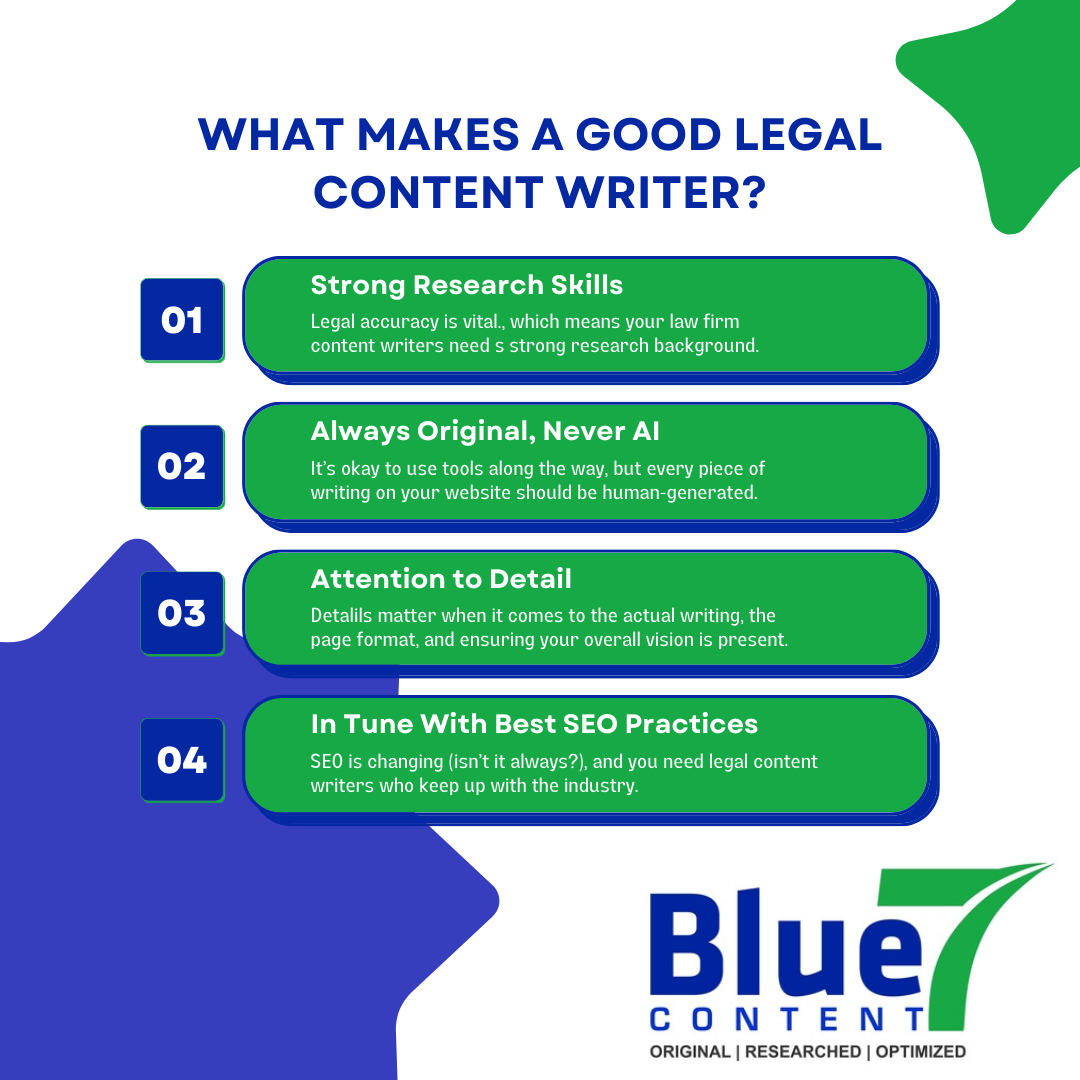
  3. What Makes a Good Legal Content Writer?
  4. Why High-Quality Legal Content Matters More Than Ever in 2025
  5. Do I Need an In-House Law Firm Content Team? 
  6. Reach Out for the Top Legal Content Writers Today 

From the first day in business, our motto has been “Original, Researched, Optimized,” and we’ve doubled down on being a human-first company.

Attorney Driven

From the top down, we’re just a legal crew. Co-founder Victoria Lozano is a practicing attorney in Chicago, and there are many talented current and retired attorneys onboard ready to help write and review content.

Human Crafted

Human connections are everything. We believe humans communicate with other humans better than AI can, which is especially important for the type of content you need. Your potential clients have real-life issues, and they want help from a real person.

Immediately Scalable Solutions

We work directly with marketing agencies. We can handle some of your content needs or all of them. Overflow issues? We can help. Tired of wrangling a writing team. We got you. We’re a fractional SEO content team with the experience to help you scale immediately without a quality decline. 

Communication Like We’re Your Team

You can reach us at any time. We’re not going to leave you hanging like many other content companies. If you have a question or need revisions, a member of our team (a real person) will help you nearly instantaneously. We believe in unreasonable hospitality. 

When building out a law firm website, you need more than a homepage that describes your firm, some pictures, and a contact form. You need content that shows your clients what they can expect if they choose to work with your law firm. 

This content can vary and may cover a range of topics, including pages specific to the practice areas you cover, from family law to personal injury to criminal law. Below is a sample of the types of legal content you may need and what we can provide: 

Note that not all of these types of content are necessarily focused exclusively on the law. We provide not just legal content for the clients but also content that highlights your team of attorneys and showcases what makes your firm different. We also certainly provide content for sources other than your website. We’re adaptable. Great writing and research skills are transferable.

You may have worked with content writers before who provided clean, readable content that served its purpose, but may not have provided the impact you expected. So, what makes a good legal content writer? 

Writing good legal content is not just about grammar and spelling. The right spell-check tools can make this part of the process easy. What makes a great writer is making the content as relevant, useful, and easy to read as possible for the client. Making sure that readers are able to understand the content without feeling confused or frustrated is also vital to converting them from readers to clients. 

To achieve this, our legal content writers have a number of resources and steps they take to ensure your legal content is as good as it can be. That includes the steps below, which our content writers strive to provide for each of our clients.

The best legal content writers are humans, not machines.

Strong Research Skills

State and federal laws are constantly changing and developing, meaning that staying on top of these changes can mean extra research. You may even want content that covers specific laws that are actively in development. That includes bills that are in the process of being passed, especially ones that may have a significant short-term impact on your potential clients. 

The best legal content writers are also some of the best researchers. They have the tools to access information that is accurate, up-to-date, and provided to the client in a way that is easy to understand.

Always Original, Never AI 

AI has come a long way. It can summarize articles, draft outlines, and assist with research, but when it comes to producing accurate, reliable, and truly effective legal content, it still falls short. Especially in 2026, when Google’s AI Mode is reshaping how search results appear, law firms can’t afford to publish content that’s generic, outdated, or wrong.

At Blue Seven Content, we don’t reject AI entirely. We use it thoughtfully to support efficiency, not replace human expertise, and it doesn’t even draft our work. We understand that legal content needs more than keywords and formatting. It needs nuance, compliance awareness, and trust-building language that only a human writer can deliver.

Here’s why AI can’t carry the weight alone:

  • Fact reliability is inconsistent. AI systems can hallucinate facts, cite non-existent laws, or pull outdated information.
  • Tone and empathy matter. Legal content isn’t just informative. It’s persuasive and sensitive. AI struggles with that human touch.
  • Originality is essential. Much of what AI produces is derivative. Google’s systems are trained to detect and devalue unoriginal content.

When it’s your reputation on the line, there’s no substitute for well-researched, custom-written content. That’s what we deliver to you, every time. At Blue Seven Content, we think we’re the best option for your legal content writing because we have a strict policy around our AI usage.

Attention to Detail 

If you have a house style, you want your content to follow those guidelines. That includes everything from specific phrases and practice areas you avoid to the way you format your law firm name. These little details go a long way toward creating a first impression of your law firm. 

Because putting your best foot forward is so important, having a legal content writer who understands this and pays attention to these details is vital. While any legal content writer can produce pages for your website, a good legal content writer will ensure that the specifics that make your firm stand out are present. 

That includes knowing details about your firm’s achievements. For example, you may have specific awards from your community that you want to highlight. A good law firm content writer will ensure those things are included on your site.

In Tune With Current Best SEO/GEO Practices 

While presenting an accurate picture of your firm is key to helping your audience grow, the best legal content writer will also keep the algorithm in mind as well. To get the attention and traffic you need for your website, your legal content writer will also need to be aware of search engine optimization (SEO) best practices. Consequently, good SEO content focused on the reader also does well in generative engine search.

These best practices include proper headings, keyword optimization, and localization that can help Google understand what your page is about and what locations you serve. Legal content writing is a balancing act between writing for your clients and for the search engine, and the best content writers find a balance between both.

As legal marketing continues to evolve, so does the way potential clients find and evaluate law firms. While traditional advertising, like billboards and radio spots, still has its place, most legal consumers today start or end their search online. With Google now integrating AI-generated summaries into search results, standing out requires more than just having a website. Your content needs to be clear, credible, and persuasive.

Low-quality content, whether generated by AI or written without care, can damage your firm’s reputation. If your site is confusing, vague, or inaccurate, potential clients may leave without taking action. Some may even question your professionalism based on the content they find.

This shift is especially important for law firms that want to improve their visibility in search results or gain traction in competitive markets. Having a website is no longer enough. Your content should:

  • Answer real client questions in a clear and accurate way
  • Reflect your firm’s values and strengths
  • Show both clients and search engines that you are a trusted authority

At Blue Seven Content, our legal content writers are best positioned to focus on creating work that does more than fill space. We produce content that earns trust, improves visibility, and helps law firms grow their online presence in 2025 and beyond.

Do I Need an In-House Law Firm Content Team? 

Having a law firm content writer who understands your firm’s needs can be useful and can provide you with ongoing legal content for your website. However, you may be concerned about having an in-house content team, and you may even be concerned that you do not have the budget for so much content. Fortunately, you do not have to worry about hiring new sources of writing when you work with our team. 

Our team of legal content writers can provide content for your team at varying tiers of quantity. For example, you may want to simply expand your number of landing pages as a one-time effort. In other cases, you may want regular blog posts that help support your current layout. In other cases, you may have no content at all and need to fully build your site’s content. 

Even without an in-house content team, this is an achievable goal with the right law firm content writers. The right team can provide needed pages in various forms and can produce more as the need arises.

If you’re a marketing agency, whether you focus specifically on legal marketing or not, you may need help with your content needs. Many agencies have wonderful internal writing teams, but they can get overwhelmed quickly when there’s an influx of content needs.

At Blue Seven, we can partner directly with marketing agencies. We do it all the time and know that scaling law firm SEO content, whether as a law firm yourself or as a marketing agency, isn’t an easy task. But when you have a team of the best legal content writers ready to go, it’s not as hard as you think.

Building a strong online presence is not just about social media posts and the technical side of your website. Much of what Google looks at, and all of what your potential clients look at, is the content that is actually on the page of your website. Building out this content, from your homepage to your monthly blogs, is key to painting a picture of what your law firm can offer. 

At Blue Seven Content, we offer a broad range of content writing packages for law firms of many sizes. But what you can expect from all of those packages is high-quality legal content from some of the top content writers today. You can expect our team to provide the detail, focus, and quality you expect from us. 

Ready to discuss your options for building out your content? Our team is ready to talk about what our writers can provide for your law firm’s website and how we can help your law firm grow. To learn more about our services, connect with us by calling, emailing, or filling out our online contact form.

Updated by Allen Watson – CEO of Blue Seven Content

AI Legal Content Marketing – Where Do Human Writers Stand?

Let’s face it. Law firm content marketing is a lot of work. The prospect of having to manually create quality legal content on a consistent basis can seem daunting. So, what a welcomed relief to discover AI content writing – right? When ChatGPT first came on the scene last fall, AI legal content marketing seemed like the perfect solution to the need for humans to write legal content.

But what at first seemed like a revolution in the way legal content could be written has a year later given way to a more realistic evaluation of how generative AI (GenAI) can be used in creating content for law firm websites. 

AI law firm writing is not bad. In fact, some of it is pretty darn good. However, as time goes on, GenAI content can become like copies of copies, producing content that is duller, more diluted, and less accurate. And to think AI-generated content can take the place of human-written content is to deny the natural ability humans have to connect with other humans by offering unique perspectives and relatable stories. 

  1. AI Law Firm Marketing with ChatGPT
  2. Legal and Ethical Considerations with AI Legal Content Marketing
  3. How AI Law Firm Marketing Could Get Ugly
  4. AI Content Writing and Google’s Helpful Content Guidelines
  5. Why There is Still a Place for Human Writers in AI Legal Content Marketing
  6. Connect with Your Clients with Blue Seven’s 100% Human Written Law Firm Content

AI Law Firm Marketing with ChatGPT

ChatGPT is an AI model that is able to interact with users in a conversational way and produce human-like text responses, often in seconds. ChatGPT was initially trained on massive amounts of internet-sourced data current only up to September 2021. As of September 2023, ChatGPT has the ability to browse the internet for up-to-date information. For law firms, ChatGPT and other GenAI platforms offer ways to improve efficiency, reduce costs, and create a better client experience. 

In its current iteration, ChatGPT is already a useful assistant for lawyers and law firms when used appropriately. It is able to quickly and accurately summarize large documents into desired formats. It is a great starting point for drafting forms and templates. It can generate useful ideas to help attorneys with legal strategies. AI can create emails, social media posts, and copy for use on websites. The technology will become even more useful to the profession as legal technology providers incorporate it into their specifically tailored products.  

Good as it is for some uses right now, GenAI cannot replace the need for significant human involvement to guarantee, at a minimum, content accuracy and originality. As some attorneys have found out, legal content written by ChatGPT is not a finished product and should always undergo final revision and editing by human writers. 

The legal marketing realm looks different now than it did a year ago because of artificial intelligence models like ChatGPT.

In many instances, GenAI can create adequate content that provides accurate information. ChatGPT also uses a type of natural language processing, allowing it to understand context and maintain conversation flow to provide more natural responses and build on previous conversations. However, it is not able to create better or beyond the data it learns from. 

ChatGPT can’t write with personality. It can’t write from experience. It can’t express an opinion or formulate original ideas. There is a generic quality about AI legal writing that can make it land flat with readers and make it hard for search engines to distinguish from other AI generated content on the same topic. Only human writers can add the flavor that engages readers and connects with them on a personal level. 

Law firms that incorporate AI into their practices should have a basic understanding of the potential legal and ethical issues that could arise. The American Bar Association (ABA) reminds lawyers the use of AI in a legal practice can raise ethical issues with regard to:

  • Confidentiality
  • Competence  
  • Practice Management
  • Honesty

At this point, there are still more questions than answers, but practitioners should be aware and educate themselves on how the use of AI as a legal practice assistant has been addressed within the jurisdictions they practice. 

Using AI-generated content may also raise legal issues regarding copyright infringement. The way ChatGPT and other GenAI programs learn and create content has the potential to violate copyright laws. The AI training process involves making digital copies of existing works on the internet. 

The works are copied without the permission of the copyright owner, who is guaranteed exclusive use. AI companies are arguing that the copying constitutes an allowable ‘fair use’ of the creator’s work. Copyright infringement may also occur if the AI-generated content is too similar to the work it copied.

There have been no legal determinations as copyright infringement cases are just starting to make their way through the courts. A report by the Congressional Research Service (CRS) addresses the questions about how AI content writing might infringe on copyrights and suggests Congress may wait for some guidance from the judicial system before deciding if additional legislation will be required. 

How AI Law Firm Marketing Could Get Ugly

How would you feel if you had spent 10 years building your law firm website with quality human-written content and someone downloaded your sitemap to use GenAI to mass produce content based on all your page titles, hijacking your website traffic in the process?

A recent Hubspot blog article discusses how AI was used to generate content from copied page URLs that was just different enough from the original content to pass Google’s duplicate content filters. One of the reasons this type of unscrupulous content marketing strategy was successful (for a while, anyway) was that the content being written was largely instructional and didn’t lend itself to much insight or variation.

Hubspot’s director of Global Growth, Aja Frost, says AI would have a much harder time duplicating content that communicated tone, interpretation, perspective, or experience – all contributions humans bring to content writing. 

AI Content Writing and Google’s Helpful Content Guidelines

It remains to be seen how human-written content will fair against GenAI content in search engine results. Google has made it clear that how content is created will not be its focus going forward. The quality of the content itself will determine how it is indexed and ranked. 

Google’s Helpful Content System was introduced in an update in August 2022 as a guide to help content creators produce better content. The algorithm rewards content that is helpful and focused on people rather than search engines. There have been a couple of updates to the original guidelines – the most recent coming in September 2023. 

A noted change in the recent update was the preference for ‘content created by people, for people’. The language of the guidelines now reads ‘content created for people’, indicating Google will not reward or penalize content for the source of its creation. 

Though Google may no longer explicitly favor content produced by humans, its guidance for creating helpful, reliable, people-first content suggests that well-written, human-created content might still be more favorable. When talking about page quality, Google is looking for content that is original, provides insightful analysis or interesting information, and adds substantial value as opposed to merely rewriting sourced information. In other words, Google is looking for something unique as a way to distinguish similar content. 

In pointing out indications of the kind of search engine-first content to avoid, the guidelines provide content creators with some questions that can be used to evaluate their content, including the following two:

  • Are you using extensive automation to produce content on many topics?
  • Are you mainly summarizing what others have to say without adding much value?

Bland, dull, mass-produced content that doesn’t offer anything new is not going to perform well in search engines and is just not a good way to stand out from the crowd.  

Although as content writers we hate to admit it, AI is going to replace the need for human writers to produce some types of simplistic, repetitive content. But, AI does not have the capability to generate more complex writing projects requiring analysis, creativity, perspective, or opinion. For distinctive writing and fresh ideas, skilled human writers will continue to be in demand. 

In most cases, AI will just assist human writers with time-saving functions such as generating ideas, creating outlines, and doing research. Human writers will still need to make sure the content is helpful, reliable, and people-first. 

With legal content, there will always be the need for significant human involvement to make sure the content provides up-to-date information gathered from reputable sources without plagiarizing other content. By the time AI-generated legal content is checked and appropriately edited to ensure accuracy and search engine receptivity, a human writer might as well have done it right the first time. 

Human-written content may also be more appealing to potential clients who are considering hiring the legal services of a law firm. A major purpose of legal content marketing is to establish authority and build trust. When contemplating AI legal content marketing lawyers need to consider reader expectations. 

  • Do people reading content on a law firm website have the right to know how the content was created?
  • Do readers of law firm website content want to know how it was created?  
  • If readers found out the content was created by GenAI would that increase their confidence in a law firm or its attorneys?  

Google’s position is that how content is created should be revealed to users when users would have a reasonable expectation of knowing how the content was produced. 

AI models can create content that sounds good but is not factually accurate. This is known as ‘hallucinating’ and has gotten a few lawyers in hot water for relying on GenAI content without verifying the information. 

As the result of some lawyers’ misplaced reliance on legal authority made up by ChatGPT, several courts are now requiring attorneys to disclose the use of GenAI in documents submitted to the court. As the use of GenAI continues to grow and develop, it is likely that standardized rules will be established regarding the use of AI to generate legal documents to ensure integrity is maintained in the practice of law. 

Human Created Data is Necessary to Avoid AI Model Collapse

There is another good reason human writers won’t be going anywhere anytime soon. As more and more AI-generated data gets dumped onto the internet the AI models begin training on other AI-generated data, which affects the quality and reliability of AI-generated content. 

With each new AI iteration, AI content becomes more distorted, leading to a degeneration of content over time. AI model collapse occurs as AI trained on AI gets further and further from the original source of data becoming more homogenous and losing complexity and diversity. 

What can be done to mitigate the potential for AI model collapse and maintain the accuracy and reliability of AI-generated content? One proposed solution is to consistently introduce new, human-created data into the training process.

Connect with Your Clients with Blue Seven’s 100% Human Written Law Firm Content

At the end of the day, you want the content you put on your website to connect with the people you are trying to reach and to persuade them you can give them what they need. Law firm content has to do more than merely inform. It has to reach out to people who may be very vulnerable because they have a legal problem and aren’t sure who to trust for the solution. Only human writers can understand how to write content targeted to affect the way people feel. 

The writers at Blue Seven Content aren’t just any human writers. They are hand-picked professionals who receive thorough training and must meet high-performance standards. Content produced by Blue Seven writers is always well-researched, authentic, optimized, and people-first. Our multi-level editing process assures you receive quality content that is ready to go on your website. If you want the content on your website to stand out to search engines and potential clients, contact Blue Seven Content

Written by Mari Gaines, JD – Legal Content Writer