10 Tips for Writing Personal Injury SEO Content That Converts to Clicks and Clients

Writing personal injury content may be easier said than done. You want your content to drive your readers to choose your law firm over others. Yet, you may need help figuring out where to start. And the longer you wait to create high-quality SEO content, the more likely it becomes that prospects will find the legal services they need elsewhere. 

You spend your money getting readers to your website. Now what? If your content is less than stellar, your potential client becomes someone else’s potential client with the click of a back button.

When it comes to personal injury lawyer SEO content, do not leave anything to chance. Learn the ins and outs of content that will help you engage, inform, and inspire your readers. Once you do, you can create content that turns your readers into clients.

  1. Why Does SEO for Personal Injury Lawyers Matter?
  2. Personal Injury SEO Content Tips
  3. Get Help Writing Personal Injury SEO Content For Your Law Firm or Legal Marketing Agency
personal injury SEO content converts to clicks and clients

Why Does SEO for Personal Injury Lawyers Matter?

According to research, Google processes more than 40,000 search queries every second. This works out to about 3.5 billion searches every day and 1.2 trillion searches annually around the world. With search engine optimization, you can make it easy for readers to find your content since it may appear at or near the top of Google searches. 

Google has a formula for how its search works. Based on this, it considers the meaning, relevance, quality, usability, and context of all content. If your personal injury SEO content hits the mark in these five areas, Google may see it as credible. At this point, when readers search Google for pertinent terms and phrases included in your content, it may be one of the top results they see. This means readers are more prone to click on and read your content over your rivals’. When they read your content, they may discover the value your law firm offers. This may lead readers to search other areas of your site for content and reach out to your firm for more information about your legal services.

Writing personal injury content that ranks highly on Google can impact your firm long into the future. If readers continuously return to your site, it may be easy for others to find you on Google. This increases the likelihood that readers will choose your firm over its competitors. On top of that, you may boost your conversions and sales.

Personal Injury SEO Content Tips

Producing top-notch SEO content for personal injury law firms may seem difficult at first. Fortunately, we are here to help you get the best results out of your content. Here are five tips you can use to create content that transforms your readers into clients:

1. Identify Your Audience

To make content your readers need, you have to figure out who you want to read it in the first place. Consider who will read your content and why they should look at it. From here, you can figure out what terms and phrases to include in your content. This can help you produce content that resonates with your target reader. 

2. Avoid Jargon

Even though SEO content for personal injury law firms is evolving, there is at least one constant: Jargon will do you no favors. You may understand legal terms and phrases, but your readers might not. As you produce your content, keep the reader’s point of view front and center. If there are terms and phrases that a reader may not understand, define or rephrase them. Otherwise, if a reader does not understand what you are saying, they may be confused about your content. This may drive them to look elsewhere for legal services. 

3. Avoid Fluff

Just because you want to craft meaningful content for your lawyer website does not mean you need to be long-winded about it. In terms of SEO, short and direct content is typically better than long and descriptive. Your content should make it clear what your law firm offers and what you are all about. When someone reads your content, they should not have to search far and wide for the information they need. If you are worried your content is loaded with fluff, help is available. For example, you can partner with a legal content marketing agency that can produce SEO-friendly content that is concise and digestible. This agency may help you revamp your existing content and produce new content that is free of fluff and delivers outstanding results. 

4. Be Intentional

You may be tempted to use AI legal content marketing, but doing so may hurt your law firm now and in the future. Artificial intelligence gives you a quick solution to produce content. Alternatively, the content is not personalized. In the big picture, it may not differentiate your law firm from others. If you produce SEO content on your own, you can tailor it to your firm. You can create content that is well-structured and easy to understand. Plus, you can write about any legal topics that are relevant to your readers. This flexibility creates endless possibilities. It allows you to deliver content that your readers can enjoy and helps your firm rise above its rivals. 

5. Update Your Content

If you are not careful, bad law firm website content may damage your brand reputation. For instance, you may have published a law firm blog post that includes statistics and research that are now out of date. Even worse, the post may contain information about statutes and laws that are no longer in effect. Prioritize your website content and make sure it is up to date. Generally, it may be a good idea to audit your site’s content every few months. Some pages may need to be updated more frequently than others. A legal content marketing agency can work with you to make a plan to keep your content up to date. 

6. Convey Empathy

A person who has suffered a personal injury has experienced a significant negative event in their life. Their normal has been turned upside down. They may be going through a wide range of emotions. They may be overwhelmed and need some reassurance that everything is going to be okay. 

Personal injury SEO content has to let the reader know that their plight is understood, their welfare is important, and there is help to get them through this ordeal. Law firms can draw on past experiences with personal injury clients for examples of what people may be going through following a personal injury accident. 

Content that conveys to the reader that someone cares about them and what they have been through makes them feel valued and increases their trust in the information (and the law firm providing it).

7. Incorporate References that Demonstrate Familiarity with the Local Area

Including references to local culture and other points of common interest or experience will demonstrate similarities and help establish common ground with the reader. People are more likely to trust other people that they have things in common with. Let the reader know you are a part of and care about the local community. 

Incorporating local references into writing personal injury SEO content also helps search engines identify content that is highly relevant in terms of proximity to the searcher. For law firms with localized practices, this means the people reading the content are more likely to live or work in the same local area.

8. Make Sure Your Writing is Unique

When creating content, don’t just reiterate what every other personal injury law firm is writing about ‘distracted driving accidents’ or whatever else. Beware of using common phraseology too often. There can be a lot of similar language used when writing about laws and legal concepts. 

Plagiarism can often occur unintentionally due to limited ways to describe similar topics and the sheer volume of content being produced. There is mixed authority on how much plagiarism is acceptable or should be tolerated. Generally, a plagiarism percentage under 10% is considered safe, but the goal should be as low as possible. An online plagiarism-checking tool such as Grammarly can be of assistance. 

Plagiarism is a big problem when AI is used for generating content. Text analysis expert Copyleaks conducted a recent study of AI-generated content produced on a number of different topics and found that 60% of the content, overall, contained some form of plagiarism. Almost 43% of the legal content contained plagiarism, with close to 12% having identical text. 

Writing personal injury SEO content that is unique and original may take a little more time and attention. However, the rewards will be worth the extra effort. Not only do search engines prefer something new and different, but readers will find the content more engaging and be more likely to reach out. 

9. Be Realistic About the Outcomes Clients Can Expect

Law firms trying to generate personal injury leads need to be careful when expressing what they may be able to do for a client. It is an ethical violation for attorneys to promise or guarantee they can obtain a particular result. 

Rules of professional conduct prohibit lawyers from making claims about their services that could be misleading to potential clients. Particularly problematic are statements claiming to be better than other attorneys, such as ‘we are the experts’ or ‘work with the best law firm in town’.  

Even a representation such as ‘our firm can get you all the money you deserve’ could be misleading in that a person may believe an attorney can do more than is actually possible. 

Content may contain factual statements about qualifications, prior case results, and testimonials from clients about actual experiences. Readers are then left to draw their own conclusions without being inappropriately influenced about the outcome of the legal services a personal injury law firm can provide. 

Make sure your choice for writing personal injury SEO content understands what’s needed to get the job done right and up to your state bar’s standards.

10. Incorporate Personal Experience 

If appropriate, sharing personal experiences can enhance the authenticity of content and make it more relatable for readers. Readers are more likely to connect with information describing actual experience – especially if it is similar to their own. 

When someone else has experienced something similar to what we are looking for information about we tend to give more credibility to what they have to say. Google has realized the value to users of content describing personal experience, which is why ‘experience’ was added as one of its content quality ranking factors in 2022. 

Google is especially concerned about experience when it comes to personal injury legal content because it could influence a person’s financial and individual well-being. Content quality ratings undergo additional scrutiny when the topic contains information that could affect ‘your money, your life’ (YMYL).

Law firms that can ethically incorporate personal experience into their content are more likely to connect with readers on a personal level and get more personal injury clicks.

There really is no easy way around it. Law firms wanting to convert more personal injury leads into clicks and clients must commit to producing content that is reader-focused, relatable, unique, and trustworthy.   

Get Help Writing Personal Injury SEO Content For Your Law Firm or Legal Marketing Agency

Search engine optimization can make or break your law firm’s website, and these 10 tips should be considered when writing personal injury SEO content. If done correctly, the content can help lay the foundation that begins an attorney-client relationship. Regardless, you do not have to tackle SEO on your own. At Blue Seven Content, we have a wealth of experience with legal content marketing. Our team includes law firm writers who can help you craft content that drives traffic and helps your web pages rank high on Google. To learn more about our SEO content services, contact us today. 

Written By Dan Kobialka and Mari Gaines – Legal Content Writers

It’s Always Been a Long-Term Game, Calm Down

“Instant results! Law firm SEO for immediate client acquisition!”

It’s obnoxious, sometimes, reading through your LinkedIn, Facebook, Instagram, or TwiX feeds.

The now-AI bros (it’s always the bros) are exactly who they’ve always been – the guarantors of instant results that leave you feeling cheap, used, and taken advantage of.

It’s always the bros.

You want long-term law firm website growth?

Then, you need a long-term law firm SEO content plan.

And you need law firm content that’s well-written by a person or team who does this regularly. Find your long-term team, make your long-term plan, and secure long-term growth.

Long-term FTW.

Stick with a long-term content strategy for your law firm.

A Long-Term Plan Means Long-Term: Don’t Get Scared After Two Months

No SEO professional will be able to give you an exact time frame for how long it’ll take for your SEO plan to start working. However, any reputable SEO professional should tell you it’ll likely take some time.

Even if you are barely scraping the surface of your SEO knowledge, then you’ve likely seen that you need a long-term strategy. It’s the truth. Despite what you may see on LinkedIn or on other social media platforms, insert results really aren’t a thing, but long-term organic growth through a strategic content plan is absolutely doable.

Not one month or two.

Make a plan that spans a year (to start with).

Make a plan that has quarter-specific goals that you and your team review.

Make a plan that gives you a solid year of STICKING TO THE PLAN.

On the flip side, you wouldn’t believe how many times we’ve seen law firms get great results from their SEO content after a year or so and then decide to stop producing content altogether once they get the results. It doesn’t take long to neglect a website before negative results happen. It doesn’t necessarily mean that you did anything wrong with your website in the meantime. It just means that others are continually adjusting and adapting their own websites, adding new content, and adjusting existing content.

Don’t stop once you get results. Keep going, even if you adjust your strategy.

Long-term content strategies should be the game plan regardless of practice area type. Blue Seven Content regularly helps develop strong, well-written, and researched:

Our team certainly handles more than just the “big” practice areas. We regularly write content for insurance defense firms, patent and trademark lawyers, employment lawyers, and more.

What Types of Content Make a Good Long-Term Law Firm Content Plan?

Your content strategy should be multifaceted. As far as marketing goes, you should tackle brand building from every avenue possible. This is much more than just SEO. However, since we just do content, we want to focus on the types of pages that can come together to create a healthy long-term SEO content strategy.

At the heart of your law firm’s website are the practice area pages. You might see these referred to as service area pages, but these are essentially your firm’s product descriptions. Your practice area pages tell your audience what you do. They give you a chance to convince a reader that you are the law firm best suited for their needs.

Practice area pages can encompass more than just one page for every area you practice. The reality is that you will likely need geographic-specific practice area pages focused on every location where you practice law. At least, pages for every location you want to get clients from.

For example, if you practice personal injury law in San Diego, your main target city for each page will be San Diego. However, as you grow your practice and expand your long-term law firm SEO plan, you may want to secure more clients from the surrounding areas. So, instead of having only a car accident page tuned towards your San Diego audience, you may also want to have a car accident page for Coronado, Chula Vista, La Mesa, and other nearby cities.

This applies to most law firms. It’s very rare for a firm to only take clients from one specific area.

There are likely some questions that you get over and over again. There are also some questions that individuals who need your services ask often, if not in person, then online, as they go through their journey of finding an attorney. Your law firm frequently asked question (FAQ) pages can help address these commonly asked questions, not only for the convenience of your audience but also for the happiness of Google and other search engines.

Blogging isn’t dead. Well, smart blogging isn’t dead. We’re no longer blogging just to blog in the SEO world. At least, most of us aren’t. However, law firm blogs can still provide more than just a source of Evergreen content for your website. They can help you address more granular issues related to your practice areas. The blog space on your law firm can help contribute to your overall SEO plan while also allowing you to reach out to the community, discuss current events, address local or national news, and more.

Your law firm content plan should include beefing up your “About Us” pages and any individual attorney biographical pages. Some of the most popular pages on any website are the pages that show the personal side of your firm. Looking for legal experience is scary, and people want to work with attorneys they can trust. Building out these sections of your website helps establish that trust with someone who is close to making their decision.

How Do You Develop Your Law Firm’s Long-Term Content Plan?

When developing your long-term law firm content strategy, think big picture.

Is your firm entering a new market?

Are you aiming to increase revenue by 50%?

Are you just starting out?

While creating content on a campaign-to-campaign basis or jumping into PPC may help achieve smaller short-term goals, a comprehensive long-term plan is crucial for reaching significant organic, long-term objectives.

Consider these key questions as you plan:

  • What are the firm’s long-term SMART goals? (Specific, Measurable, Achievable, Realistic, Timely)
  • Who are the law firm’s target potential clients? (e.g., car accident victims, slip and fall cases, violent crime defense)
  • Is there old content that needs refreshing? (e.g., outdated statistics, broken links)
  • Are there upcoming opportunities for blog posts or press releases? (e.g., recognition by Super Lawyers, relevant news events)
  • What makes this law firm unique?
  • Who will manage the content?
  • How often should content be published?

For example, suppose a small to mid-size personal injury firm wants to attract more car accident cases and reduce medical malpractice claims. A focused content plan might involve:

  • Targeting local car accident victims
  • Posting well-researched blogs about car accidents twice a week, including topics such as:
    • Recent car accidents
    • What to do in a car accident
    • What to expect from car insurance companies
    • Types of car accidents
  • Updating the website’s homepage to emphasize car accident claims by:
    • Adding relevant images of car accidents
    • Revising content to minimize focus on medical malpractice
    • Including statistics about local car accidents
    • Adding a “What to Do After an Automobile Accident” page
  • Posting and sharing the blogs across various social media platforms

Every long-term content strategy requires careful planning, and it’ll look different for each law firm. Once implemented, your law firm can expect several advantages, including increased visibility, improved client trust, and sustained growth – OVER TIME.

Law Firm Spanish Content and Translations – Bolster Your Long-Term Plans Based on Demographics

Serve your audience.

That means serving ALL of the people in your area. For areas with a heavy Spanish-speaking population, you NEED Spanish content on your website.

No, not just a cursory line or two on the homepage or a “We Habla Spanish” on the bottom left-hand corner of your page.

You need to SHOW your Spanish-speaking audience that they can trust you. Your existing law firm SEO web pages can be translated into Spanish by a professional. No, using Google Translate or ChatGPT is not your golden ticket.

That’s insulting to your audience.

Treat your Spanish-speaking readers with the respect they deserve. Translate your website pages and create brand-new Spanish content that reaches them directly.

It’s not rocket science – it’s knowing how to respect people.

Blue Seven Content – We Don’t Let Clients Down

It’s a long-term game, and we’re in it for the long haul. Our team has been doing this for a while now, and we’re continually refining our processes to improve. We communicate. We’ll never leave you in the dark, and we have a content guarantee.

When you’re ready to get your long-term law firm content strategy going (or if you want to bolster what you’re already doing), give us a call or fill out our form here. We’re ready to help.

Written By Allen Watson – CEO and Co-Founder of Blue Seven Content

March 2024 Google Updates – What It Means For The Blue Seven Approach

In early March 2024, Google began rolling out the latest updates in its ongoing mission to provide searchers with the most useful information and not the self-serving clickbait created primarily to achieve higher search result rankings. 

The updates focus on two main areas. Changes are being made to the core ranking systems to better distinguish and filter out unoriginal content. Spam policies are being improved in order to keep the lowest quality content out of Search.

For human content creators, the update is somewhat encouraging. It means human input and oversight are still highly valued contributions to content creation. And though Google does not have a problem with AI-generated content per se, it does have a problem with people trying to manipulate its systems with crappy content. 

March 2024 Google updates could affect law firm content.
Should you keep calm and stay the course if your content is genuinely helpful? Or panic and switch gears?

Google Search March 5, 2024 Updates

Generative AI has provided some new opportunities for spammers and some new challenges for Google to respond to. In 2022, Google began refining its ranking systems to better identify helpful content and provided guidance about the kind of content it was looking to reward. 

The March 2024 core update and new spam policies are just a continued refinement of Google’s systems in the attempt to deliver useful, high-quality content to searchers. 

1. Filtering Out Low Quality, Unoriginal Content from Search Results

Several times a year, Google makes fairly major changes to its algorithm and other systems used to identify and rank content. These changes are called core updates. Google has advised the March core update will involve several core systems and will be more complex than previous updates. 

At this point, Google will only say that the innovative signals and approaches that are being used to enhance the core systems mark an evolution in how the search engine will identify helpful content going forward.

A new FAQ page has been put together to help explain the changes. It doesn’t contain a lot of new information, but it does indicate Google will be focusing on content originality and trying to make sure users are left with the feeling they’ve had a satisfying experience

Because of the complexities involved, the rollout of the March core update is anticipated to take about a month. Google says to expect fluctuations in ranking during the integration process, but no action is required by those who have been producing helpful, reliable, people-first content. 

2. Identifying and Penalizing Websites Hosting Spammy Content

Google’s spam policies detail some of the types of content and practices that can result in lower rankings or in having content completely removed from Search. Google fights spam with both automated systems and manual human review and has indicated it will be using manual review to target sites violating the new policies. 

The March update added three new spam policies in response to growing trends Google was observing. 

  • Expired domain abuse
  • Scaled content abuse
  • Site reputation abuse

Expired Domain Abuse

Expired domain abuse is the practice of purchasing expired domains and leveraging their optimization advantage to promote content that may have nothing to do with the content produced by the previous owner. The practice can mislead users into thinking the new content is affiliated with the expired site. 

Scaled Content Abuse

Scaled content abuse occurs when large amounts of content are created with the intention of manipulating search results rather than providing useful information to searchers. Such content may but need not necessarily be created by AI. Of particular interest to Google is content that lures a searcher to click by promising an answer to a popular question and then fails to deliver the relevant information. 

Site Reputation Abuse

Site reputation abuse involves the publication of third-party content with little or no oversight by the hosting website, allowing the third-party content to piggyback on the host site’s better ranking signals. The third-party content may have little to do with the host site’s main purpose and offer minimal value to users. 

Google provides a few non-exclusive examples of what it will consider site reputation abuse as well as some examples of the type of third-party content that will not be considered spam. The more valuable the content is to site users and the more involvement by the hosting site, the less likely third-party content will be found to violate spam policies.   

Possibly because the practice of hosting third-party content is fairly widespread, Google will not begin enforcing the new policy until May 5, 2024, to give site owners an opportunity to make any necessary changes in order to comply. 

Google’s Stand on AI-Generated Content

Back in February of 2023, Google offered guidance about AI-generated content. The search engine clarified that it is looking for quality content no matter how the content is created. Original, people-first content demonstrating experience, expertise, authoritativeness, and trustworthiness (EEAT) will be rewarded by Google’s ranking system, whether written by people or machines. 

However, Google is well aware that machine-made content without human oversight can be unreliable and unoriginal. Updates continue to emphasize the need for significant human involvement to ensure AI-generated content is written to Google’s standards and does not violate any of the spam policies. 

What the Google Updates Mean for Low-Quality or Spammy Content

So, what is a website owner to do? Regarding the core update, acclaimed SEO expert Lily Ray recommends not overreacting to any early fluctuations in traffic as Google begins implementing the changes. Try to wait until everything has been rolled out because Google may need to course-correct mid-way through in order to initiate the changes it wants to make. 

For sites that may be or already have been penalized for violating the new spam policies, the best thing to do to try and save the site is to own the violation, figure out a new plan to try and get on Google’s good side again, and then apply for reconsideration. Second chances aren’t guaranteed so it’s best to be thoughtful and sincere in the reconsideration request. 

What the Google Updates Mean for High-Quality, Useful Content

The good news is that owners with helpful, reliable, people-first content on their sites should not have to do much of anything to make sure they are in compliance with Google’s updates. If the content on your site has always been high quality and useful, then you aren’t likely at risk of lower rankings or a spam violation. 

At Blue Seven Content, we aren’t worried about the content we produce for our clients. All of our content is generated by humans who are intimately familiar with producing the kind of content Google wants to reward. Because Blue Seven focuses on content quality, originality, and engagement, our approach never has to vary much, no matter what changes Google decides to make. 

Written by Mari Gaines, JD – Legal Content Writer

How SEO for Personal Injury Lawyers is Evolving

Personal injury lawyers are working to be seen in a market with over 425,000 law firms nationwide. A well-optimized online presence is needed to ensure your law firm stays competitive in its field. Search engine optimization SEO for personal injury law firms can help place your firm as a top point of contact for people needing legal help.

The online marketing and SEO world changes all the time, so it is crucial you work with a company that focuses on the full picture and keeps up with changes and trends. At Blue Seven Content, our legal writers are constantly shifting to keep up with Google search updates, including their latest roll-out of SGE: Search Generative Experience. Read on to learn more about how SGE can change how prospective clients could see your law firm’s personal injury lawyer content and how our writers can maximize this experimental search experience.

  1. What Is Personal Injury SEO Content?
  2. Why Does SEO For Personal Injury Practice Area Pages Matter?
  3. What is SGE?
  4. How Does SGE Affect Personal Injury SEO?
  5. Optimizing SEO for Personal Injury Content
  6. Some Final Questions About Personal Injury SEO Changes
  7. Keep Your Personal Injury SEO Updated in This Evolving World
Personal injury lawyer SEO remains in a constant state of change.
SEO always changes, but don’t get stuck at 2023 changes when 2024 changes come knocking.

What Is Personal Injury SEO Content?

Personal injury SEO content involves effective search engine optimization strategies to make personal injury law firm websites appear at the top of search engines like Google. This is accomplished by incorporating relevant personal injury keywords into your personal injury SEO content pages, such as law firm social media posts, landing pages, personal injury blogs, and service pages. Together, these strategies can help your law firm website be visible on search engine results pages (SERPs) when a query is made by prospective leads using the specific phrases you ranked for.

Personal injury SEO is the process of improving your website ranking in search engines to increase the organic search traffic to your firm’s website. Blue Seven Content writers provide not only relevant keywords but high-quality content for the needs of your prospective leads. With the personal injury market being flooded and technology evolving continually, you need law firm content writers who are shifting equally with these changes.

Why Does SEO For Personal Injury Practice Area Pages Matter?

Due to the sensitive and urgent nature of personal injury cases it is vital that personal injury lawyers be easily accessible online. When your website appears on the first page of Google’s search results, your law firm is in the top 90% of web traffic. On the other hand, if your website does not appear on the first page, your law firm may be invisible to the majority of your potential leads. Read on to learn how Blue Seven Content can help you achieve this goal.

Begin With a Strong Foundation

Before focusing on how personal injury lawyer SEO is evolving, it is crucial to evaluate your online presence to best understand your audience. Blue Seven Content will thoroughly evaluate the design of your website, the content quality, mobile friendliness, current user experience, and how you currently rank in searches. This paves the way for changing your SEO strategy, tailoring personal injury lawyer SEO techniques to meet the unique needs of your prospective leads and the goals of your law firm.

Understand Your Target Audience 

It is important to understand who your target audience is. Knowing who your potential clients may be, the language they are using for searching, and what specifically they are searching for is a critical strategy for SEO success. Understanding these key points will shape how you create your content and which keywords you will select to ensure your online presence resonates with the very people you are aiming to serve.

Determining your target client means you must consider factors such as the specific circumstances leading to the need for personal injury services, location, gender, and age. Blue Seven Content will analyze the data from your social media platforms and web pages to evaluate the behaviors and interests of your audience. Remaining up-to-date on common personal injury cases and current trends can greatly refine your target audience.

Analyze Your Competitors 

While it is crucial to know your audience and how your own law firm page is performing, it is equally important to look at your local competition. Personal injury lawyer content SEO is highly competitive and worth the investment to utilize top-talent writers who specialize in SGE and SERP optimization for creating content that attracts personal injury clients to your website rather than the competitors.

Blue Seven Content will evaluate:

  • Blog content and articles
  • Practice area pages
  • FAQ pages
  • Social media
  • Lawyer profile pages
  • Videos 
  • On-site client testimonials
  • Off-site client reviews
  • Backlinks

Keyword Targeting and Research

With the rollout of SGE, keyword search relevance is even more important for personal injury SEO content. Identifying the phrases and words that potential leads use when they search Google is a priority for keyword research. “Car accident lawyer” or “Personal injury attorney” are traditional keywords that tend to be broad yet highly competitive. These keywords are critical since they align with the most commonly searched terms, but they are also incredibly competitive.

Our team of writers carefully crafts the keywords that match your practice area using specific words and phrases that will enhance your personal injury SEO content. These phrases are targeted towards specific locations and queries and are generally less competitive. By capturing a more niche audience, these search terms result in higher conversion rates and engagement.

What is SGE?

SGE, search generative experience, is a program that uses AI-based technologies, including machine learning, deep learning, and natural language processing. Search engines utilize these technologies to understand how a user searches queries, processes relevant content, and formulates an appropriate response.

Google provides users with a quick overview of a user’s query without getting too complicated or detailed. This can easily alter what the user sees when searching for specific topics.

Additionally, as an experimental program, Google’s new search options are not perfect and can easily generate misinformation for users. Disclaimers are posted saying, “Generative AI is experimental. Info quality may vary” or “This information does not constitute medical advice or diagnosis.”

How Does SGE Affect Personal Injury SEO?

Generative AI can have pros and cons on SEO for personal injury law firms. Here are both the benefits and disadvantages of SGE:

Organic Traffic of SEO

Organic traffic could be reduced through the use of search generative experience. However, it could also generate leads with a more likely chance of converting.

The cons of SGE on traffic can come when users seek most of their needed information from AI-created summaries, which prevents them from clicking through to pertinent websites such as yours. For instance, if the response created by SGE is overly detailed, the user may choose not to click on the webpage that created the original information the AI was referencing. Though Google still cites them as the original sources, the high ranking value may decrease for “what is” queries.

SGE may not be all that bad, though. The leads driven to your website by SGE could be of higher quality. While traffic may decrease for basic queries, many people still require research that is more in-depth than what is generated by AI. This means that users who do visit your page will be well-informed and prepared to convert or engage in some way. Fortunately, traditional search results will remain available underneath these results to users who have opted-in to SGE responses.

Optimizing SEO for Personal Injury Content

In-depth research by Blue Seven Content has found many ways to optimize for SERP and SGE queries. The first result of our research is that the most common and simple phrases used in SEO writing may not be the way to go for ranking in search engines. Using more detailed keywords will result in users more easily finding the pages they need rather than a plethora of unrelated content.

We have also found that SGE, like traditional searches, is focused on providing users with helpful and relevant content while making the experience easier and faster overall. 

Natural language is best recognized by SGE and SERP pages, which can only be done through the use of high-quality SEO writers. Blue Seven Content writers excel in their research and writing skills to provide personal injury law firms with the ultimate SEO pages. Without high-quality content that provides users with vital information, your firm will not be viewed as an authority in your field, causing potential leads to look to competitors.

Some Final Questions About Personal Injury SEO Changes

What are the specific challenges of using SGE for personal injury law content, and how can they be overcome?

The specific challenges of using SGE for personal injury law content include ensuring the content is detailed enough to meet the new search technologies’ requirements for depth and relevance while also being accessible to the average person. Overcoming these challenges involves creating high-quality, informative content that addresses the specific queries and needs of potential clients, using clear and concise language, and optimizing for both traditional SEO factors and the capabilities of SGE to recognize and rank valuable content. Now, do we know which factors SGE will use to “rank” pages? Not really. Nobody does yet, and as with traditional SEO, it will continuously change.

Will SGE become the main way people find law firms in the future?

While it’s not definitively stated that SGE will become the main way people find law firms in the future, the adoption of advanced search technologies like SGE indicates a significant shift in how search engines operate and how users interact with them. Given this trend, it’s reasonable to anticipate that search experiences utilizing SGE or similar technologies could play a major role in how potential clients discover law firms, emphasizing the importance of adapting SEO strategies to these evolving technologies.

Keep Your Personal Injury SEO Updated in This Evolving World

Staying ahead of the SEO curve is the only way to keep your law firm seen when the market is flooded with personal injury lawyers who are fighting to make it to the top of search engine rankings. Personal injury lawyers need to use a company that is an expert in SEO writing if they want to stand out in an overly crowded digital landscape. Our team of writers aims to establish your law firm as a personal injury law authority, attract more leads, and greatly enhance your visibility online.

If you want to take your personal injury website content to the next level, Blue Seven Content is ready to help. Our writers utilize comprehensive SEO tools that will be tailored to the unique needs of your personal injury law firm. Discover what our team can do for your personal injury lawyer content by visiting our website today and filling out our quick contact form.

Written By Dianna Mason – Legal Content Writer

AI Legal Content Marketing – Where Do Human Writers Stand?

Let’s face it. Law firm content marketing is a lot of work. The prospect of having to manually create quality legal content on a consistent basis can seem daunting. So, what a welcomed relief to discover AI content writing – right? When ChatGPT first came on the scene last fall, AI legal content marketing seemed like the perfect solution to the need for humans to write legal content.

But what at first seemed like a revolution in the way legal content could be written has a year later given way to a more realistic evaluation of how generative AI (GenAI) can be used in creating content for law firm websites. 

AI law firm writing is not bad. In fact, some of it is pretty darn good. However, as time goes on, GenAI content can become like copies of copies, producing content that is duller, more diluted, and less accurate. And to think AI-generated content can take the place of human-written content is to deny the natural ability humans have to connect with other humans by offering unique perspectives and relatable stories. 

  1. AI Law Firm Marketing with ChatGPT
  2. Legal and Ethical Considerations with AI Legal Content Marketing
  3. How AI Law Firm Marketing Could Get Ugly
  4. AI Content Writing and Google’s Helpful Content Guidelines
  5. Why There is Still a Place for Human Writers in AI Legal Content Marketing
  6. Connect with Your Clients with Blue Seven’s 100% Human Written Law Firm Content

AI Law Firm Marketing with ChatGPT

ChatGPT is an AI model that is able to interact with users in a conversational way and produce human-like text responses, often in seconds. ChatGPT was initially trained on massive amounts of internet-sourced data current only up to September 2021. As of September 2023, ChatGPT has the ability to browse the internet for up-to-date information. For law firms, ChatGPT and other GenAI platforms offer ways to improve efficiency, reduce costs, and create a better client experience. 

In its current iteration, ChatGPT is already a useful assistant for lawyers and law firms when used appropriately. It is able to quickly and accurately summarize large documents into desired formats. It is a great starting point for drafting forms and templates. It can generate useful ideas to help attorneys with legal strategies. AI can create emails, social media posts, and copy for use on websites. The technology will become even more useful to the profession as legal technology providers incorporate it into their specifically tailored products.  

Good as it is for some uses right now, GenAI cannot replace the need for significant human involvement to guarantee, at a minimum, content accuracy and originality. As some attorneys have found out, legal content written by ChatGPT is not a finished product and should always undergo final revision and editing by human writers. 

The legal marketing realm looks different now than it did a year ago because of artificial intelligence models like ChatGPT.

In many instances, GenAI can create adequate content that provides accurate information. ChatGPT also uses a type of natural language processing, allowing it to understand context and maintain conversation flow to provide more natural responses and build on previous conversations. However, it is not able to create better or beyond the data it learns from. 

ChatGPT can’t write with personality. It can’t write from experience. It can’t express an opinion or formulate original ideas. There is a generic quality about AI legal writing that can make it land flat with readers and make it hard for search engines to distinguish from other AI generated content on the same topic. Only human writers can add the flavor that engages readers and connects with them on a personal level. 

Law firms that incorporate AI into their practices should have a basic understanding of the potential legal and ethical issues that could arise. The American Bar Association (ABA) reminds lawyers the use of AI in a legal practice can raise ethical issues with regard to:

  • Confidentiality
  • Competence  
  • Practice Management
  • Honesty

At this point, there are still more questions than answers, but practitioners should be aware and educate themselves on how the use of AI as a legal practice assistant has been addressed within the jurisdictions they practice. 

Using AI-generated content may also raise legal issues regarding copyright infringement. The way ChatGPT and other GenAI programs learn and create content has the potential to violate copyright laws. The AI training process involves making digital copies of existing works on the internet. 

The works are copied without the permission of the copyright owner, who is guaranteed exclusive use. AI companies are arguing that the copying constitutes an allowable ‘fair use’ of the creator’s work. Copyright infringement may also occur if the AI-generated content is too similar to the work it copied.

There have been no legal determinations as copyright infringement cases are just starting to make their way through the courts. A report by the Congressional Research Service (CRS) addresses the questions about how AI content writing might infringe on copyrights and suggests Congress may wait for some guidance from the judicial system before deciding if additional legislation will be required. 

How AI Law Firm Marketing Could Get Ugly

How would you feel if you had spent 10 years building your law firm website with quality human-written content and someone downloaded your sitemap to use GenAI to mass produce content based on all your page titles, hijacking your website traffic in the process?

A recent Hubspot blog article discusses how AI was used to generate content from copied page URLs that was just different enough from the original content to pass Google’s duplicate content filters. One of the reasons this type of unscrupulous content marketing strategy was successful (for a while, anyway) was that the content being written was largely instructional and didn’t lend itself to much insight or variation.

Hubspot’s director of Global Growth, Aja Frost, says AI would have a much harder time duplicating content that communicated tone, interpretation, perspective, or experience – all contributions humans bring to content writing. 

AI Content Writing and Google’s Helpful Content Guidelines

It remains to be seen how human-written content will fair against GenAI content in search engine results. Google has made it clear that how content is created will not be its focus going forward. The quality of the content itself will determine how it is indexed and ranked. 

Google’s Helpful Content System was introduced in an update in August 2022 as a guide to help content creators produce better content. The algorithm rewards content that is helpful and focused on people rather than search engines. There have been a couple of updates to the original guidelines – the most recent coming in September 2023. 

A noted change in the recent update was the preference for ‘content created by people, for people’. The language of the guidelines now reads ‘content created for people’, indicating Google will not reward or penalize content for the source of its creation. 

Though Google may no longer explicitly favor content produced by humans, its guidance for creating helpful, reliable, people-first content suggests that well-written, human-created content might still be more favorable. When talking about page quality, Google is looking for content that is original, provides insightful analysis or interesting information, and adds substantial value as opposed to merely rewriting sourced information. In other words, Google is looking for something unique as a way to distinguish similar content. 

In pointing out indications of the kind of search engine-first content to avoid, the guidelines provide content creators with some questions that can be used to evaluate their content, including the following two:

  • Are you using extensive automation to produce content on many topics?
  • Are you mainly summarizing what others have to say without adding much value?

Bland, dull, mass-produced content that doesn’t offer anything new is not going to perform well in search engines and is just not a good way to stand out from the crowd.  

Although as content writers we hate to admit it, AI is going to replace the need for human writers to produce some types of simplistic, repetitive content. But, AI does not have the capability to generate more complex writing projects requiring analysis, creativity, perspective, or opinion. For distinctive writing and fresh ideas, skilled human writers will continue to be in demand. 

In most cases, AI will just assist human writers with time-saving functions such as generating ideas, creating outlines, and doing research. Human writers will still need to make sure the content is helpful, reliable, and people-first. 

With legal content, there will always be the need for significant human involvement to make sure the content provides up-to-date information gathered from reputable sources without plagiarizing other content. By the time AI-generated legal content is checked and appropriately edited to ensure accuracy and search engine receptivity, a human writer might as well have done it right the first time. 

Human-written content may also be more appealing to potential clients who are considering hiring the legal services of a law firm. A major purpose of legal content marketing is to establish authority and build trust. When contemplating AI legal content marketing lawyers need to consider reader expectations. 

  • Do people reading content on a law firm website have the right to know how the content was created?
  • Do readers of law firm website content want to know how it was created?  
  • If readers found out the content was created by GenAI would that increase their confidence in a law firm or its attorneys?  

Google’s position is that how content is created should be revealed to users when users would have a reasonable expectation of knowing how the content was produced. 

AI models can create content that sounds good but is not factually accurate. This is known as ‘hallucinating’ and has gotten a few lawyers in hot water for relying on GenAI content without verifying the information. 

As the result of some lawyers’ misplaced reliance on legal authority made up by ChatGPT, several courts are now requiring attorneys to disclose the use of GenAI in documents submitted to the court. As the use of GenAI continues to grow and develop, it is likely that standardized rules will be established regarding the use of AI to generate legal documents to ensure integrity is maintained in the practice of law. 

Human Created Data is Necessary to Avoid AI Model Collapse

There is another good reason human writers won’t be going anywhere anytime soon. As more and more AI-generated data gets dumped onto the internet the AI models begin training on other AI-generated data, which affects the quality and reliability of AI-generated content. 

With each new AI iteration, AI content becomes more distorted, leading to a degeneration of content over time. AI model collapse occurs as AI trained on AI gets further and further from the original source of data becoming more homogenous and losing complexity and diversity. 

What can be done to mitigate the potential for AI model collapse and maintain the accuracy and reliability of AI-generated content? One proposed solution is to consistently introduce new, human-created data into the training process.

Connect with Your Clients with Blue Seven’s 100% Human Written Law Firm Content

At the end of the day, you want the content you put on your website to connect with the people you are trying to reach and to persuade them you can give them what they need. Law firm content has to do more than merely inform. It has to reach out to people who may be very vulnerable because they have a legal problem and aren’t sure who to trust for the solution. Only human writers can understand how to write content targeted to affect the way people feel. 

The writers at Blue Seven Content aren’t just any human writers. They are hand-picked professionals who receive thorough training and must meet high-performance standards. Content produced by Blue Seven writers is always well-researched, authentic, optimized, and people-first. Our multi-level editing process assures you receive quality content that is ready to go on your website. If you want the content on your website to stand out to search engines and potential clients, contact Blue Seven Content

Written by Mari Gaines, JD – Legal Content Writer

EEAT and YMYL For Lawyers – These Terms Are More Important Than Ever (2024 Edition)

SEO involves using various strategies when creating content so search engines will make the content available to persons looking for particular information. The type of information a user is searching for determines how carefully Google evaluates it before showing it in search results. Some content has the potential to deliver information that could be harmful to individuals, groups of people, or society in general. 

EEAT and YMYL for lawyers refer to acronyms describing content subject matter that has the potential to be harmful and content characteristics Google considers important for determining the quality of the content for search ranking purposes. When someone is looking for information, Google wants to identify the search results that best satisfy their needs. Google never wants to display search results that are misleading, offensive, harmful, or disturbing to a user. 

Because law firms often deal with YMYL topics, infusing content with EEAT helps Google understand that law firm content is the reliable, trusted information a user should see. 

  1. What is YMYL content?
  2. How Does EEAT affect YMYL content?
  3. Why YMYL and EEAT are Important Considerations When Creating Law Firm Content
  4. Optimizing YMYL Law Firm Content for EEAT
  5. Remember SEO Only Succeeds on a Healthy Website
  6. Find a White Label Content Services Provider to Write Your Content
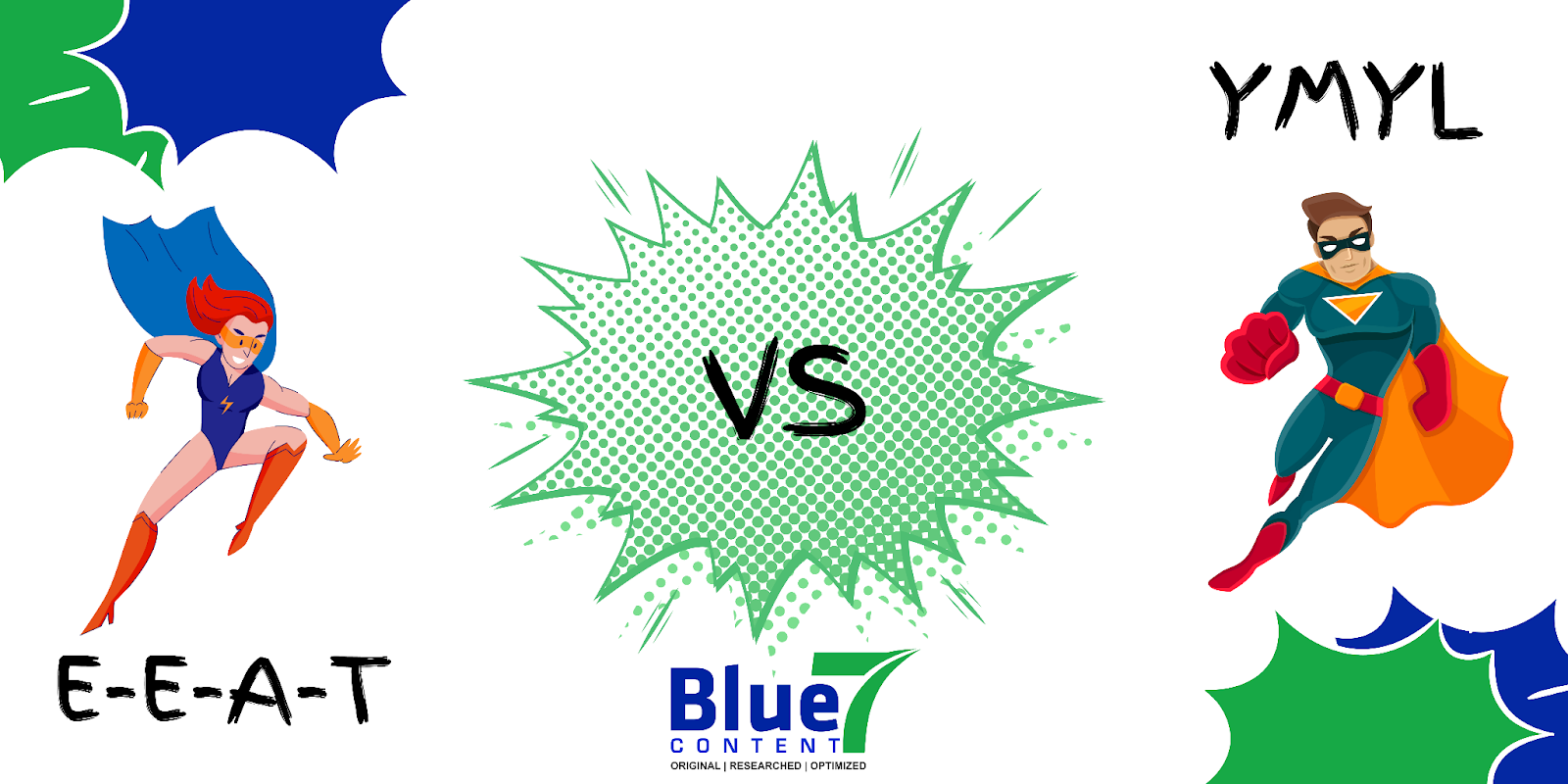
Superwoman EEAT battles Superman YMYL.
Do you know what EEAT and YMYL mean for your law firm?

What is YMYL content?

YMYL stands for ‘Your Money, Your Life’. Google’s latest Search Quality Raters Guidelines defines YMYL content as content containing information that could significantly affect someone’s health, financial stability, safety, or the general welfare and well-being of society.  Because reliance on YMYL content could critically impact a user’s life, search engines scrutinize YMYL content more carefully to ensure the data can be trusted. 

Law firm website content is often YMYL because law firms provide information about laws and legal procedures. Some may provide medical information related to injuries or recommend a course of action based on certain circumstances. Users looking for legal information are likely trying to find answers to life-impacting problems. 

The harm from YMYL content can come from the content subject matter itself or from misrepresentations or inaccuracies contained within the content. The greater the potential for harm, the more likely content will be identified as YMYL.

Topics that provide information or advice are YMYL for lawyers if significant harm could result from inaccuracies or poor guidance. Many users who land on law firm websites are searching for legal information because they are trying to decide what they should do. Inaccurate information or bad direction could cause someone to jeopardize their legal rights and, quite possibly, their health, safety, and financial well-being. 

Once a search engine determines content is YMYL, it has to decide if the content is reliable and can be trusted by users. 

How Does EEAT affect YMYL content?

EEAT (previously EAT) are factors a search engine uses to evaluate YMYL content to determine its quality. Prior to the most recent update, EAT (expertise, authoritativeness, trustworthiness) were the key indicators of page credibility according to Google’s page rating guidelines. Google added the second E for experience, deciding actual experience with the topic subject matter was relevant to the quality of the content.  

EEAT are not ranking factors, but rather they help Google determine the reliability of the content. Reliability improves content quality, and quality is a significant ranking factor. EEAT for lawyers means including the following kinds of information in law firm website content where appropriate:

  • Experience – Google considers personal experience a credible source of information about a topic. Writing from experience can also make content more personal and relatable. AI-generated content can never produce a unique experience, so writing from personal experience distinguishes human-generated content from AI-generated content. Content that describes actual experience may also appeal to Google’s upcoming AI-generated Search Engine Experience (SGE), which will be able to access more data and provide users with a more diverse mixture of search results. 
  • Expertise – Search engines want to know that the content’s author has the necessary skills, training, or other qualifications to provide competent information about a topic. Factual accuracy and credible sources of information help demonstrate expertise.
  • Authoritativeness – Authoritativeness is based on Google’s assessment of the content as being a go-to source for the requested information. Authoritative content goes deep and provides comprehensive information on a topic. Establishing topical authority on a particular subject shows Google the content is authoritative. Topical authority is built by creating content pillar pages and internally linking to subtopic content pages that discuss relevant keywords. Content with strong authority is more likely to be linked to by other credible websites, which further increases its authoritativeness.
  • Trustworthiness – Evaluating experience, expertise, and authoritativeness are indicators that Google uses to get to the most important determination, which is the trustworthiness of the content. Is the content accurate and reliable? If content is deemed untrustworthy, it will get a lower quality ranking, which will not help the overall ranking position. 

Having other authoritative and reputable websites link to a law firm website is a big indicator of content reliability to Google. Credible backlinks continue to be a top 3 search results ranking factor.

The best way to attract backlinks is to create good content that is considered reliable by other credible authorities. Generally speaking, longer and more thorough content attracts more backlinks than shorter, more abbreviated content. Regularly posted, well-written blog content can help law firms generate backlinks. 

Other ways attorneys can get started with link building involve taking advantage of opportunities to link back to their websites from other online platforms.

  • Guest posting to law-related or other relevant websites 
  • Posting on social media
  • Getting listed in reputable legal and business directories

Why YMYL and EEAT are Important Considerations When Creating Law Firm Content

In many cases, when someone has a legal question, they are searching because they have a problem that affects their money or their life. It is safe to assume law firm website content will receive the more rigorous examination of YMYL pages. This makes it imperative law firms create content Google can distinguish for its quality.

EEAT is about telling search engines content can be relied on to provide helpful information to a user. Attorneys and law firms need their content to communicate credibility to Google if it is to be seen by prospective clients. Making sure content is optimized for EEAT is an ongoing strategy that benefits from periodic reviews for accuracy and updating for freshness. 

Optimizing YMYL Law Firm Content for EEAT

Although there are over 200 ranking factors that Google takes into consideration, according to SEO strategist Backlinko, content quality is still the most important ranking factor. EEAT is a primary means Google uses to determine if YMYL content is trustworthy and, thus, a quality source of information.  

The following content creation tips will support EEAT optimization and better search engine rank results:

  • Create content that is original, helpful, people-first, accurate, and unique.
  • Establish topical authority with in-depth content addressing all keyword variations.
  • Boost the experience factor with user-generated content such as testimonials and reviews.
  • Build strong internal links between pages to ensure your website is well-organized and easy for search engines to navigate.
  • Update and add new content regularly to demonstrate expertise and build authority. 

People-First, Not Search Engine-First

Google wants content created primarily to help people. Content created primarily to attract search engines will not be rewarded. Google has created guidelines for assessing whether your content is people-first or search engine-first

In a recent update, Google clarified that existing content would need to be substantially edited (people-first) in order to boost a page’s freshness factor. Google will not recognize any value in merely changing publication dates (search engine-first) when the content remains basically the same. 

Remember SEO Only Succeeds on a Healthy Website

When discussing optimizing YMYL content for EEAT, the importance of website health cannot be overlooked. Website health is how well the technical aspects of a website function. Problems with internal or external broken links, security issues, pages without links (orphan pages), slow loading speeds, and duplicate content can all affect how Google accesses website content and what it does once it finds it. 

Google discovers data by crawling the web in search of pages. If website navigation by web crawlers is thwarted, content may not be indexed to show in the SERPs. Even when content is discoverable, there is no guarantee that it will be crawled. Having a sitemap helps Google crawl a website more efficiently by telling the program which files to crawl and why they are important. 

Find a White Label Content Services Provider to Write Your Content

Assuming the navigability of your website, it is the quality of your content that will ultimately determine your marketing success. Creating quality content for law firm websites involves a lot more than good legal writing. It is a technical skill to incorporate all of the SEO components into content and make it authentic, engaging, people-first, and written from a law firm’s brand perspective. 

The legal services industry is highly competitive, and there is less room all the time in the crowded field of top search results. If you need help producing a consistent flow of well-researched, strategically optimized, original law firm content that is written by people for people, give Blue Seven Content a call.  

Written by Mari Gaines, JD – Legal Content Writer

Crafting Meaningful Content For Lawyer Websites – What It Means In 2024

When it comes to digital marketing, it seems the only constant is how fast things change. In 2023, it seemed generative AI might revolutionize writing content for lawyer websites, but it turns out that AI cannot replace the need for significant human involvement in content creation to ensure accuracy, originality, and voice.

And there may also be legal ramifications associated with AI-generated content. Laws regulating the use of AI in content creation have not kept pace with the technology, and there are several issues – such as copyright infringement – that are just beginning to come under legal scrutiny. 

While generative AI may not be the best idea for creating content for law firm websites, Google has been testing its use to enhance the search experience of its users. Known as Search Generative Experience (SGE), the SGE feature is able to create personalized responses to detailed search inquiries, thereby reducing a user’s need to evaluate search results. 

The SGE feature is scheduled to go mainstream in 2024 and has many marketing professionals concerned about the potential affects the new feature could have on current SEO marketing strategies. This article talks about the upcoming changes, what they mean for law firm marketing, and how law firms can create content that will continue to rank well and generate website traffic in the coming year.

  1. Why AI Still Doesn’t Work (Well) for Creating Content for Lawyer Websites
  2. How SGE Will Affect Search Results
  3. Does SGE Spell the End of SEO?
  4. SEO Content Best Practices for Law Firms That Will Continue in 2024
  5. What Law Firms Can Do to Succeed with Content Marketing Efforts in 2024
  6. Get More Bang for Your Legal Marketing Buck in 2024 with Blue Seven Content
Content for lawyer websites in 2024.
Content for lawyer websites is going to have to look a bit different in 2024.

Why AI Still Doesn’t Work (Well) for Creating Content for Lawyer Websites

As generative AI continues to evolve and become even more refined, it might be tempting to see how well it can create website content for your law firm. Although we don’t use AI to assist with content creation at Blue Seven Content, we do acknowledge its usefulness for generating ideas and structuring outlines. 

But AI-generated law firm website content is far from ready to go without being reviewed and edited by a human. Information still needs to be verified and accurately sourced. The tone and focus of the writing may need to be adjusted if it is not consistent with how a law firm wants to brand itself. 

The following issues are some of the pitfalls that lawyers need to be aware of when using AI to generate content:

  • The information presented is not always accurate or up-to-date and must be fact-checked.
  • The output may be very similar to other content and hard for search engines to distinguish for ranking purposes.
  • The output is limited by the quality of data used to train the AI.
  • Strategic human prompting is necessary to get the intended results.

In 2024, search users will be looking for anything but generic when it comes to content. Users almost expect content to be specifically tailored as though responding only to their inquiry. In fact, SGE will be rewarding content that is more targeted and personalized by placing the best results right at the fingertips of users. 

While incorporating AI to help streamline operations and improve client experience is almost essential in the competitive legal services market, it cannot be trusted to produce authentic, original, accurate, targeted content with your law firm, your legal practice, and your desired clients firmly in mind. 

How SGE Will Affect Search Results

SGE takes Google searches to the next level using AI. Generative AI accesses deep learning algorithms called large language models (LLM) that enable it to understand more of the context of a given search and provide results that are more personalized and interactive. SGE is an attempt to make a computer seem more human. 

According to Google, SGE will enable users to:

  • Enter search queries that are more complex and specific
  • Read an AI-generated overview of the search results and click on links to the relevant sources
  • Access needed information right from the search results
  • Ask follow-up questions to refine a search without starting over

The SGE feature is currently available to Google Chrome users in the US who are at least 13 years old, visit the Search Labs tab, and enable the feature. Not all inquiries will generate SGE responses. SGE will not generate a response for explicit or dangerous topics or queries that indicate a vulnerable situation. SGE is currently intended to help users engage more deeply with longer-form informational content. For inquiries where an SGE response is appropriate, it will appear at the top of the search results. 

Does SGE Spell the End of SEO?

Well, no, but SGE may spell the end of SEO as we now know it. When a search query is entered, two search engines will provide results. The traditional search engine results pages (SERP) still appear, but they will appear below the AI-generated search results. What this means is a lot of organic search results that would have ranked well as the result of traditional SEO may now not be seen or be seen less often. 

The SGE results will display an AI-generated summary of information (snapshot) intended to answer a user’s search query. The information included in the snapshot is pulled from organic sources AI determines will be most helpful to the user. The user is able to click on links to the organic sources for further reference. Also featured is a carousel of three clickable cards where a user can link to additional sources that might be of interest. 

So, how can your law firm website content get selected as a source for the SGE snapshot or appear in the SGE card carousel? 

Those details are not yet precisely known, but an overview of SGE released by Google indicated that the AI search would be integrated with the ranking and quality systems developed and used by the core search function so content that ranks well in the traditional search results may have a strong possibility of also appearing in the SGE results. 

According to the SEO tool platform Semrush, the content displayed in SGE results does tend to share the following similar characteristics, which may shed some light on what kinds of content Google’s AI considers to be reliable, trusted sources.

  • Expert opinion or analysis
  • Full sections and blocks of text suggesting an affinity for lists, bullet points, or other structured text
  • Content displaying topical authority
  • New or novel information

An additional marketing challenge law firms may face as SGE becomes widely integrated is getting prospective clients to click through to their websites. If the SGE snapshot answers a user’s question completely, there may be no incentive to go further than the search results page. This type of zero-click search experience has been increasing as Google has added more search enhancements to the SERP, such as knowledge panels and local packs. It is anticipated that SGE will contribute to declining click-through rates.  

SEO Content Best Practices for Law Firms That Will Continue in 2024

Despite the growing influence of AI on the digital marketing landscape, certain optimization strategies will remain among the best ways for law firms to achieve higher search rankings in 2024 and are certainly consistent with what is now known about SGE.   

Establish Topical Authority

Content that has topical authority provides comprehensive information on a particular topic. Google algorithms prioritize content that demonstrates authority. Indications of authority are expertise, experience, authoritativeness, and trustworthiness (E-E-A-T).  

An SEO strategy that helps content for lawyer websites establish authority is called a topic cluster. A topic cluster begins with a core pillar page and links to related sub-topic pages. A pillar page provides a broad general overview of the topic, and the sub-topic pages go into greater detail on the related topics. 

Topic clusters provide a structure that makes it easier for search engines to navigate the content and improve internal linking so users can find relevant information faster. A well-written pillar page may also be seen as an authoritative resource, making it more likely to generate backlinks and improve link authority. 

Update or Refresh Old Content

Google still loves fresh content. SEO expert Neil Patel recommends evaluating older content for accuracy and relevancy at least once a year. Updating content can provide the following benefits that impact SEO and user experience:

  • Gives content an updated publication date, letting Google know it is current 
  • Newer content is more likely to rank and motivate user click-through
  • Provides an opportunity to correct grammatical and spelling errors 
  • Improves content accuracy and relevancy
  • Can replace broken links or add links to higher-quality resources
  • Re-optimize keywords or phrases for better performance

Refreshing older content for lawyer websites benefits not only the updated content but also gives a rankings boost to the website publishing the content. The more frequently content is updated, the more often Google will crawl the website for new information.

Focus on User Experience

All of Google’s changes are made with the objective of improving the experience of its users. User experience involves how quickly content can be accessed, its visual appeal, the accuracy and depth of the information presented, and its readability. 

Google is looking for content created to help people rather than produce marketing results. The trick is to create content that is foremost valuable to users and also attractive to search engines.

Content that is well-organized provides comprehensive, up-to-date information, is well-researched using credible sources, and is written in a friendly, relatable manner is the kind of content Google is looking to present to users. 

Tailor Content to Match Search Intent

Search intent is what actually motivates a user’s search. Google can evaluate how well content matches a user’s intent based on how a user interacts with the content. Does a user get the information they are looking for from the content, or do they quickly leave and click on other search results? Content that is relevant to a user’s search will rank higher than content that misses the mark. 

A way to gain a better understanding of user intent is to do a search on keywords before writing and then reviewing the content that is ranking well. The information in content ranking well for particular keywords can be used as a guide for creating content that provides the answers a user is actually looking for. 

What Law Firms Can Do to Succeed with Content Marketing Efforts in 2024

As more becomes known about how SGE prioritizes information, marketing strategies will continue to adapt in order to optimize the opportunities for recognition in SGE results. Law firm website content writing may need to evolve from a focus on anticipated keywords to addressing more comprehensive and detailed search queries as more information is learned about AI preferences. 

Content marketing may be evolving, but some practices remain effective even with the addition of AI-generated search results. The following content marketing strategies are still recommended and will continue to be productive in 2024:

  • Update old content
  • Post content frequently and consistently
  • Use multiple content distribution channels
  • Make content more engaging/interesting by sharing success stories, new or little-known information, and unique viewpoints
  • Optimize for local SEO
  • Post only authentic, original content that is well-optimized, researched, and sourced

When it comes to writing content for lawyer websites, Blue Seven Content has you covered. We may not yet know exactly what AI will be looking for, but we’ve got a pretty good idea of what will always work. It is our business to create quality content that answers the questions your new clients are asking. We aim to position the law firms we work with as trusted authorities and thought leaders serving their communities with integrity and compassion.

Our authentic, original content is written entirely by a team of human writing professionals and thoroughly edited for composition and accuracy. If you are looking to make 2024 a great year for your law firm, Blue Seven Content can help get more of the right clients walking through your doors. Call us at 843-580-3158 or visit our website to learn more about our content creation services. 

Written by Mari Gaines, JD – Legal Content Writer

White Label Law Firm SEO Content – What It Means

Law firm marketing in the digital age is all about getting the attention of potential clients. How a law firm is able to distinguish itself and its services from other law firms with similar practices is the difference between receiving a steady stream of prospective clients and wondering where the next client will come from.

Well-written SEO content is a vital component in any law firm marketing strategy. Good content is what helps a law firm attract and maintain quality clients. Bad content causes potential clients to click away – if they even see the content in the first place. 

The content that goes on a law firm website can’t be an afterthought. Writing quality law firm SEO content is a skill. It has to be thoughtfully tailored to achieve a specific purpose. Content must be interesting, informative, accurate, persuasive, and written with search results in mind. It should be created so it performs consistently over time and produces measurable results.

Pursuing white-label law firm SEO content is a way for law firms and legal marketing agencies to obtain the consistent production of expertly crafted original content written to client-specific preferences. 

  1. What White Labeling Means
  2. Is SEO Content Still That Important for Law Firm Marketing?
  3. Law Firm Content Must Rank High in SERP to Get Results
  4. Why White Label Law Firm SEO Content?
  5. How To Choose a White Label Content Provider
  6. Why Blue Seven Content for Your Law Firm White Label Services?
  7. Grow Your Legal Practice with Blue Seven Law Firm SEO Content
Blue Seven Content provides white label law firm SEO content reviewed by practicing attorneys.
Blue Seven Content provides quality, well-researched law firm content.

What White Labeling Means

White-labeling is a type of business outsourcing. Outsourcing is a way for businesses to save time and money and still be able to offer high-quality products or services. White-label providers create products or services that other companies can purchase and then brand as their own. 

White-label legal content writers are ghostwriters for hire. They have a working knowledge of the subject matter and the research capabilities to create accurate and authoritative content.

The writers receive information about what to write and often who it is to be written for and then produce content that will be owned by and branded as the law firm client. 

White Labeling Does Not Mean Generic Reproduced Content

White labeling can describe a generic product that is branded and sold by different companies. However, it cannot describe law firm content because duplicate or very similar content found on different sites is not SEO-friendly. Therefore, each piece of white-label law firm SEO content must be distinctly crafted to the specifications and business practices of individual law firms. 

Is SEO Content Still That Important for Law Firm Marketing?

Well-written SEO content is as critical as ever for successful law firm marketing. Content that is easy to read, informative, accurate, and optimized to reach the right type of client is still a key component in a law firm’s overall marketing strategy. 

Most people with legal issues are going to begin to search for answers online. According to a recent survey conducted by legal marketing services provider Attorney Sluice, 70% of the persons surveyed said if they needed to find an answer to a legal question, they would first search for the answer online. 

About 45% of those surveyed said they would start their search to hire an attorney online either by using a search engine or visiting a social media platform. When asked about the significance of placement in search results, 34% believed the best lawyers were those ranking the highest. Another 12% believed higher search result rankings meant more legal experience. 

Law firms wanting to have their content appear before persons with legal questions or needing legal services have to publish content that is going to rank as high as possible in response to targeted search queries. Content that is poorly written or not optimized properly will likely not be seen by those it’s trying to reach, thus wasting a law firm’s valuable time and marketing dollars. 

Law Firm Content Must Rank High in SERP to Get Results

Being highly ranked on page one of the relevant search results is the desired position for any law firm content targeting a specific search inquiry. The content must compete with and outrank a lot of similar content in order to achieve a top position. Consequently, close attention must be paid to the specific details that can affect ranking when creating content. 

According to the SEO tool suite platform Semrush, the page landing in the number one spot in Google search results has an almost 28% chance of a click-through. The click-through rate drops by about half for the number 2 spot and falls all the way to 2% for content in the number 10 spot. Content that appears on page 2 of the search results or beyond has very little chance of ever being read. 

Well-optimized content lets a search engine know that it best meets the needs of a search inquiry by including quality factors that set it apart from competing content. Following are some content creation tips that indicate content quality and can boost search engine placement.

  • Content should thoroughly cover a topic so it doesn’t leave a reader needing to look elsewhere for additional information.
  • Tell Google the content is reliable by demonstrating E-E-A-T (experience, expertise, authoritativeness, and trustworthiness).
  • Make the content unique by incorporating original ideas or examples.
  • Make sure time-sensitive content is updated to keep it relevant to current searches. 
  • Try to write content at about an 8th-grade reading level so it is easy to understand.

SEO marketing expert Backlinko recently analyzed close to 12 million Google search results to identify factors that correlate with first-page search result rankings. The key findings included the following factors relating to content:

  • Better link authority (the measure of how many other websites link to your content) means higher ranking.
  • Content that covers a topic in-depth ‘significantly outperforms’ superficial or incomplete content.
  • The average Google first page search result contains just under 1,500 words.
  • Websites that people stay on longer (because of great content!) tend to rank higher.

Why White Label Law Firm SEO Content?

If law firms want to achieve their marketing goals, they need to publish a lot of quality content on a consistent basis. Trying to produce a large volume of content can be time-consuming, costly, and detract from core law firm business operations. 

In addition to lots of it, the content needs to have all the pieces so that it ranks well, engages readers, builds trust, enhances brand awareness, drives traffic to a website, and ultimately results in law firm clients. That means the content must incorporate current SEO best practices and be written in such a way that it pulls the reader in and convinces them they have found the solution to their legal problem. 

Whether a law firm does its own marketing or uses a legal marketing agency, white-label law firm SEO content writers are specialists who can produce engaging, well-researched, original content in high quantities while maintaining consistent quality.  

Law Firms  

Digital marketing has become very specialized. To be good at it takes consistent practice and staying on top of an ever-changing digital landscape. It can be a full-time job all on its own. Yet, in addition to practicing law, lawyers also handle marketing in the majority of US law firms. Only about 33% pay internal staff or an outside agency to handle legal marketing. 

So, what is the problem with lawyers creating their own content? Well, there can be several problems for the lawyer looking to improve a law firm’s ROI. 

  • Content creation takes time away from practicing law
  • Content may not be promoting the law firm brand
  • Content may not be adequately optimized for search engines
  • Content may not be written to prompt readers into action
  • Content may not connect with the right readers
  • Content may not be produced consistently

The bottom line is that it is typically more cost-effective and gets a law firm better marketing results to purchase tailor-made content from writers who regularly create SEO content for law firms.

Legal marketing agencies offer a suite of services to help law firms with marketing. Content marketing is often among them. Initially, marketing agencies may produce content in-house, but as a business grows and demands for content increase, it may make sense to cut agency overhead and use a reliable white-label provider for content creation. 

Legal marketing agencies may have the technical prowess to produce fabulous content, but they may be able to scale their businesses more efficiently to meet the demands of clients by outsourcing content production to white-label writers. 

How To Choose a White Label Content Provider

A white-label content provider is going to create content that a law firm will be using to represent its business to potential clients. There has to be a fit between provider and client so the content is consistent with how a law firm desires to brand itself. 

Some basic criteria that can help determine the best fit when selecting a white-label content service include:

  • Qualifications/Experience – Visit the website and social media platforms of a white-label content provider. Do you like the content posted by the provider? Are you confident in the abilities of the writers? Do they offer the services you need?
  • Customization – A good white-label service provider will create content to meet specific client preferences, whether they be stylistic, brand specific, or in order to optimize the content for a particular purpose. 
  • Quality Control – Content is intended to build trust between a law firm and potential clients. Readers expect it to be factually and legally accurate without grammatical errors. How is the content edited? What assurances exist confirming the quality of the product?
  • Accessibility – How available is someone to answer questions, respond to feedback, and address concerns? What is the level of commitment to client satisfaction?
  • Transparency – Does the white-label service provider say what they do and do what they say? Are they clear about services and pricing?  Are you confident the company operates with the utmost integrity? Will your privacy be respected?

Just as a law firm’s content needs to build trust between the firm and its clients, there needs to be trust between a law firm and its white-label service provider to achieve the best marketing results. 

Law Firm White-Label FAQs

How does white-label SEO content specifically address the unique ethical considerations in legal marketing?

White-label SEO content for law firms should be designed with an understanding of legal marketing’s ethical considerations, ensuring content complies with regulations and standards specific to the legal industry. This approach includes creating content that is accurate, informative, and respectful of confidentiality and advertising rules, addressing the unique ethical concerns that law firms face in their marketing efforts.

What are the specific steps a law firm should take to integrate white-label SEO content into their existing marketing strategy?

To integrate white-label SEO content into their marketing strategy, law firms should first identify their target audience and key practice areas, then select a reputable white-label content provider for law firms

that understands legal industry nuances. The next steps involve collaborating with the provider to create a content plan that aligns with the firm’s marketing goals, ensuring the content reflects the firm’s brand voice and ethics, and finally, integrating this content across their digital platforms for a cohesive online presence.

Can white-label content be customized to reflect a law firm’s specific brand voice, and if so, how is this achieved?

Yes, white-label content can be customized to reflect a law firm’s specific brand voice. This is typically achieved through a collaborative process where the law firm communicates its branding guidelines, tone, and target audience to the content provider. The provider then tailors the content to align with these specifications, ensuring it resonates with the firm’s brand identity and appeals to its desired clientele.

Why Blue Seven Content for Your Law Firm White Label Services?

Blue Seven Content writers are a dedicated group of professionals who love creating quality content. Our writers are carefully selected and receive ongoing training to keep their skills on the cutting edge of SEO content creation. The content we produce is well-researched, original, accurate, and designed to engage targeted readers. 

All Blue Seven writers have secondary education. Some have legal experience and education. They all have diverse backgrounds and life experiences, giving them the ability to meet the expectations of even the most discriminating clients.  

Providing a quality product that gets results for a client is the goal of Blue Seven Content. We are a very detail-conscious bunch and hold ourselves to high standards of performance. Each of our creations must pass through a multi-layered editing process before ever reaching a client’s inbox. 

We are discreet about the law firms and legal marketing agencies we provide white-label services for. Our clients appreciate our discretion, and we are happy to respect their privacy.

We value our clients. On those rare occasions when a problem does arise, Blue Seven Founders Allen Watson and Victoria Lozano are quick to respond and work to resolve any differences to the satisfaction of the client. 

Law firms need to publish a steady stream of great content to attract new clients and retain existing ones. At Blue Seven Content, we can provide law firms and legal marketing agencies with amazing content guaranteed to be authentic and 100% written by human wordsmiths. 

Whether it’s practice area pages, niche landing pages, FAQs, or blogs, you can expect high-quality, fairly priced content customized to suit your business needs. Your law firm SEO content solution is only a message away. Reach out. We will be glad to show you what we can do. 

Written By Mari Gaines, JD – Legal Content Writer

Blogs for Law Firms – How to Start Your Legal Blog in 2024

A substantial number of people dealing with legal issues turn to the Internet to look for the right attorney to take on their case. This means your law firm’s popularity, credibility, and visibility online have a substantial impact on how successful your law firm may be. 

Although blogs for law firms may seem like something you do not have time for, the truth is that having a comprehensive blog with valuable information for prospective clients can not only help generate business but also improve your law firm’s website search engine rankings and help build authority online. 

  1. Search Engine Ranking Factors for Law Firm Blogs
  2. What High-Quality Legal Blogs Cover
  3. The Buzz Around ChatGPT and Why You Should NEVER Use AI to Write Lawyer Blog Content
  4. Connect With Our Wordsmiths at Blue Seven Content Today 

Search Engine Ranking Factors for Law Firm Blogs

If you hope to get your lawyer blogs and law firm practice area or landing page ranking, it is important to understand the essential ranking factors. Some of these can be handled by your digital marketing company. For example, having high-quality backlinks, fast page loading speed, and core web vitals are crucial. However, none of these ranking factors will matter if your web content leaves much to be desired. In December 2022, Google released an algorithm update that focused on ranking content that more adequately meets user’s needs. The most notable include E-E-A-T and YMYL.

What Is E-E-A-T?

E-E-A-T is an acronym that stands for experience, expertise, authoritativeness, and trustworthiness. Although E-E-A-T is not technically a Google ranking factor, Google and other search engines are more likely to rank pages with strong E-E-A-T. Here is a rundown of how you can utilize these factors to improve user trust, build authority, and create content that converts traffic into leads:

Experience

The content on your law firm blogs should always be high-quality and provide users with the information and subject matter they are looking for. Your blogs should be written in a way that users understand your law firm has first-hand experience in this area of law. One way you can do this is by highlighting your law firm’s case results, awards, and accolades in handling legal issues similar to what your potential clients have experienced.

Expertise 

Google is more likely to boost your lawyer blogs in the rankings if users can see that you have the credentials and qualifications to provide the knowledgeable and reliable information they are looking for. Lawyers providing valuable information about their practice areas through blogging is a prime example of topical expertise in action online. 

Authoritativeness

Authoritativeness describes your online reputation in the legal community. If your law firm or attorneys are widely recognized as being respected and knowledgeable in their subject matter, the pages accredited to them are more likely to perform well in search engine rankings. 

Having a reputable SEO content provider that devotes their efforts toward legal content writing may be the best way to put your law firm on the map. Then, your competitors will help boost your website’s authority by linking back to your content because it provides value to web users. This will help set your law practice up as a leader in the legal marketing industry. 

Trustworthiness

Your blogs and web pages absolutely will not rank if they are not deemed trustworthy. Google Quality Raters will consider the factual accuracy of a page and whether trusted sources have been cited, such as legal statutes and government (.gov) pages when determining whether a blog, landing page, or practice area page is trustworthy enough to rank in the top three search results. 

What Is YMYL?

YMYL refers to “Your Money or Your Life.” These are topics that could have a significant impact on the reader in some way. For example, information about local car accidents in the news may not be useful to most readers. However, a blog post about how to report a car accident or obtain copies of a crash report would be. The more YMYL content on your site, the better your rankings will be.

Blogs for law firms in 2024 - Start planning today.
Blogs for law firms in 2024 – Start planning today.

Most lawyers do not have time to create their own blogs. You are likely not a professional writer – you are a legal representative who needs to devote as much of your attention as possible to your client’s cases. Having a legal content writer craft compelling blogs on your behalf is the answer. Legal writers and content consultants can not only write content that ranks but also offer suggestions on what topics you should cover on your law firm blog. 

What to Do’s and How To’s

When you are trying to decide what to blog about, consider what your target audience is searching for. Most often, they are searching for long-tail phrases and keywords that focus on What to Do’s and How To’s. Some examples could include:

  • How to Deal With the Insurance Company After a Car Accident
  • What to Do if Police Try to Question You Without a Lawyer
  • How to Avoid Probate
  • What to Do if A Client Breaches a Contract
  • How to Appeal a Denied Social Security Disability Claim

Why Potential Clients Need an Attorney

People dealing with legal issues almost always think about trying to navigate their case without a lawyer. They envision lawyers as being expensive, greedy, and maybe even conceited. Writing blogs about why your readers can benefit from a lawyer will challenge these preconceived notions while boosting traffic and leads to your site. 

What to Expect Articles 

Many people who truly need a lawyer are hesitant to reach out for help. When you write what you expect articles on your law firm blog, you can help prepare potential clients for what’s to come. 

This can give them the confidence boost they need to fill out your contact form or contact your law office directly to schedule a free or confidential consultation and discuss their specific needs. You can even write blogs that focus on what to expect from your attorney fees when costs are holding would-be clients back from contacting your office for help. 

Comprehensive Guides

Writing comprehensive guides is another way to build authoritativeness and trustworthiness online. Even someone dealing with a legal issue likely has little to no understanding of the intricacies of the laws and which statutes are going to impact their case. Although these guides should be comprehensive, they should also be written in a way that helps readers easily understand the laws and feel confident that you truly understand what they are going through.

Updates to State and Federal Laws

One of the best ways to blog on your law firm’s website is by writing content that describes updates to state and federal laws affecting your potential clients. For example, in 2023, Florida made major changes to its personal injury statute of limitations and contributory negligence laws. When you notify your readers of these changes, it can help set you apart from your competitors and ensure your readers understand that law changes could have a profound impact on their case.

Thorough FAQs

Frequently asked questions blogs are some of the most untapped and underutilized resources you can offer to your readers. Not only do FAQs give web users answers to questions they may be too intimidated to ask, but Google has an entire section on Page 1 of the SERPs devoted to “People Also Ask,” where your law firm blog could rank as a featured snippet.

The Buzz Around ChatGPT and Why You Should NEVER Use AI to Write Lawyer Blog Content

When you do not have time to write compelling law firm blogs for your website, it may be tempting to turn to AI and ChatGPT to generate these blogs for you. However, we strongly discourage any law firm from utilizing AI products in any way, shape, or form. While many in the digital marketing community have embraced ChatGPT, our team at Blue Seven Content has no preconceived notions about how ChatGPT and other AI programs work or how AI content will impact your law firm’s rankings.

When you use these programs to ask specific queries or write content for a specific target keyword or longtail phrase, it will generate nearly the same response every time it is asked. This is problematic when other law firms across the country are also asking ChatGPT to write the same types of content. Not only will your content be unoriginal, but in many cases, it will plagiarize existing content online, which will have a devastating impact on your rankings.

Furthermore, ChatGPT and other AI models are not always accurate. In fact, at this point in time, they are not updated regularly enough to give accurate information or answers to your readers. For example, when laws are changed, if the AI model has not been updated to reflect these changes, you run the risk of creating content that is factually inaccurate, which would seriously harm your authoritativeness and trustworthiness. 

When you do not have time to write content for your law firm website, do not turn to these artificial intelligence programs. Instead, work with a professional legal content writer who will do thorough research and already has an in-depth understanding of the information users are looking for to craft compelling and original content for your lawyer blog.

Connect With Our Wordsmiths at Blue Seven Content Today 

Our expert legal content writers at Blue Seven have extensive knowledge and experience writing high-quality SEO content for law firms and law firm websites. Whether you need to build out your practice area pages, are interested in focusing on niche landing pages, or are ready to focus on your law firm’s blog, our wordsmiths know how to write content that is sure to rank. 

When you are ready to improve your existing web pages or craft evergreen blog content, connect with our digital content marketing professionals at Blue Seven Content. Complete our confidential contact form or call us to get started as soon as today.

Written by Dianna Mason – Legal and Construction Content Writer

The Nuts and Bolts of Law Firm SEO Writing – It’s More Than Just the Writing

Law firm SEO writing is evolving at a rapid pace, with artificial intelligence, ChatGPT, and Google all throwing major curve balls over the last year. But it doesn’t change the fact that your law firm needs content and that content should serve a purpose. Yes, you want to be on page one of Google’s SERP, and you want to pop up in featured answers and SGE results. 

A skilled legal SEO writer needs a combination of skills, of which quality writing is certainly the most important. However, there is so much more that goes into a law firm page than just research and writing. There are what we call the “nuts and bolts” of the page that really complete it and have it ready for the client and the intended readers.

  1. Make it an Easy Read 
  2. Get Those Headings Formatted Properly
  3. Choosing the Right External Links
  4. Internal Links Back to Your Page
  5. Anchor Text for Links
  6. The Right Tone for Your Call to Action (CTA)
  7. Get the Law Firm SEO Writing Nuts and Bolts Done Right 
Help ensure your great law firm SEO writing also looks great on the page.

Make it an Easy Read 

Your page should be easy on the eyes, but this means a few things. A law firm practice area page, blog post, or any other page on the website should, first and foremost, be written in a way that’s easily understandable. The reading level needs to be appropriate for your intended audience, and this could look different depending on many factors, including the types of practice areas targeted and the education level of the website’s usual reader.

Seventh and eighth-grade reading levels are typically appropriate, but you can occasionally bump that up toward the college level. For example, you probably don’t need overly complex language or sentences if you’re a personal injury firm. However, if you handle, say, license defense for professionals such as doctors, financial advisors, or insurance agents, then you can get away with more elevated language. 

Moving Beyond the Reading Level

Aside from the reading level of your law firm website content, there are various other ways to help make the reading process more enjoyable for the reader. This includes some easy formatting techniques. 

  • Enough headings. Headings lay out a roadmap for the reader. They break up the page and give the reader a heads up about what’s next, allowing them to skim for the info they really need. You need the right amount of H2s and H3s, and this will vary depending on page length and the requirements of the page. 
  • Shorter sentences. Long and complex sentences aren’t helping anyone. The rule of thumb is to keep your sentences shorter, but you can occasionally mix it up with a compound sentence. 
  • Shorter paragraphs. Keep your paragraphs short for the most part. I know those high school English classes stressed five sentences a paragraph, but three is generally okay. Again, shorter means a person is more likely to read the information.
  • Bullet points. When the opportunity presents itself for a good bullet list, take it. Think about what your eyes do when they read a webpage. They probably skim, and they probably stop and read the bullets. 

Between having the appropriate reading level and properly formatting a page using the suggestions above, you’ll be well on your way to crafting good content for a law firm website. 

Get Those Headings Formatted Properly

We previously mentioned headings, and here we are again. Headings get their own heading in this article (SEO dad jokes?). 

Your headings need to look right, and that’s not always as easy as it sounds. There are two main types of capitalization styles for headings on a website page: sentence case and title case. 

  • Sentence case. In sentence case, only the first word of the heading and any proper nouns in the heading get capitalized. The following are examples of sentence case used:
    • Types of compensation available for a medical malpractice claim
    • How long do You have to file a slip and fall claim?
    • Choose Blue Seven Content for Your law firm SEO needs
  • Title case. In title case, all words except for articles, conjunctions, and shorter prepositions are capitalized (the last word of the heading is capitalized no matter what). One way to understand this without thinking too much about it is that words with four letters or more are capitalized, while most shorter words aren’t. Proper nouns will get capitalized, as will verbs, no matter their length, so “You,” “They,” “We,” “Do,” “Is,” etc. will get capped. The following are examples of title case properly used:
    • Types of Compensation Available for a Medical Malpractice Claim
    • How Long Do You Have to File a Slip and Fall Claim?
    • Choose Blue Seven Content for Your Law Firm SEO Needs

Which Style is Best for You?

The capitalization style you use for your legal SEO content will depend entirely on the preferences of your client. Over the years, I’ve seen the pendulum swing from using sentence case to title case multiple times, and I have clients who prefer each style. Right now, most clients prefer title case for headings. Still, others may prefer that every word in a heading be capitalized. This is something that is easy to get right when you work with a client regularly. 

One of the main issues here is to keep it uniform. If you use title case for your headings with a client, always use title case for them. And you certainly don’t want to switch it up mid-page – that just looks sloppy. Before you start working with a client or handling content for your law firm, go ahead and decide how you want your headings formatted. Keep them uniform throughout the website as much as possible.

External links are a good way to bolster your law firm website content. An external link to a quality source can help establish the facts of your page in the mind of the reader, adding credibility to your content. External links can also help increase the authority of your website. 

However, you can really screw things up if you don’t use good links. Your law firm content writer should focus on reputable sources. We’re talking about looking for good .gov, .edu, or other sources from reputable entities. What you don’t want to do is link to other law firms or places like NOLO or FindLaw. While you can certainly peruse these places for information, don’t link to them on your firm’s website. 

For blogs, depending on the topic, you can search for reputable news sources, but that can be tricky. Even though we’re legal marketers, we have to keep current political issues in mind. Half the country hates half of the news sources available, and the other half of the country hates the other half of the news sources. Don’t get mad at me. I just want peace. 

Internal links have to be a part of your strategy. Listen, we’re the content people. That’s all we do, so we don’t know your exact internal SEO strategy. But you’re going to need some internal links on each practice area page, FAQ page, or blog post

Internal links help bolster your website in the eyes of search engines. They create an ever-evolving map for Google and others to use so they can understand the intent of your website. However, you don’t need to go linking to just any page. Be strategic about it. When you work with a skilled SEO team and content writers who “get it,” you’ll have the right internal linking happening to lead your readers and the search engines on the right journey.

This may not seem like a big deal for law firm SEO writing, but remember, we’re talking the nuts and bolts. The way a page looks and is formatted matters, and that includes the text used to incorporate internal and external links – the anchor text. 

Anchor text has always been a pet peeve of mine. It’s not something you’d ever even notice on a page when it’s done correctly, but you definitely notice if it’s not. 

Anchor text refers to the words you use to hyperlink your source into the law firm content page. I think some examples will help best illustrate this (ignore the actual sentence because I go in to look for data). In these examples (not actually linking out, but I’ve made it clear what the anchor text should be), we can see how the anchor text for a hyperlink should be a few words and centered on an area that would seem natural to click. We’ve all seen hyperlinks in just about everything we’ve read online.

Not so Good

  1. When we examine data available from the Pennsylvania Department of Transportation, we can see that there were 40 billion motorcycle accidents last year across the Commonwealth. 
  2. When we examine data available from the Pennsylvania Department of Transportation, we can see that there were 40 billion motorcycle accidents last year across the Commonwealth. 
  3. When we examine data available from the Pennsylvania Department of Transportation, we can see that there were 40 billion motorcycle accidents last year across the Commonwealth. 

Good Example

  1. When we examine data available from the Pennsylvania Department of Transportation (PennDOT), we can see that there were 40 billion motorcycle accidents last year across the Commonwealth. 

When you write your page, you don’t need to actually “bold” the anchor text. I only did that so you could more easily see which words were used. Some key rules we try to stick to are:

  • Don’t link the first word of the sentence (first example above).
  • Don’t link just a single word. 
  • Link the whole name of an agency or entity if you link some of it (including acronyms at the end).
  • Don’t link more words than necessary (like example three).
  • Link relevant words (not like example two).

If you take a minute to read some reputable sources, you’ll quickly see that hyperlink anchor text should look seamless. Check out Investopedia, Forbes, Wired, and others for some good examples. 

The Right Tone for Your Call to Action (CTA)

Your call to action can be fairly obvious or more subtle. This depends on your brand personality, the type of firm, and even the type of page. For a practice or service area page, you may want a more clear CTA since, in theory, your reader is there because they need your help for some pressing issue. You should make it clear why you’re the help they need and that they can call you now for a consultation.

However, for a blog or FAQ, you may want a more subtle CTA. You may not even want one at all. Again, it depends on several factors that you need to know before crafting the page. A good call to action is nuanced and examines all of the parameters you and your client lay down. 

Get the Law Firm SEO Writing Nuts and Bolts Done Right 

Having a good writer is everything. A quality legal SEO writer is worth their weight in gold, but they can turn to silver or bronze if they mess up the page basics. When you work with a content writing team, you want the whole package. Otherwise, you’ll just end up spending valuable time editing an otherwise well-written page. 

At Blue Seven Content, we have regular meetings to review all of this and more. All of this is included in the guides our writers receive and in the initial training we provide. Not only that, but each piece passes through an editing phase to double-check all of this before a client gets anything.

We’re ready to help, and we don’t need a long adjustment period to hit the ground running with your law firm or legal marketing agency. Give us a call or send a message today, and we’d be happy to discuss these aspects of law firm SEO writing with you and your team.

Written by Allen Watson – Founder and CEO of Blue Seven Content