AI Website Content and Copyright Laws

Updated October 27, 2026. This article covers U.S. copyright law and practical publishing considerations for law firms and marketing agencies. It provides general information, not legal advice about a particular work or dispute.

An AI tool can produce a practice area page in seconds. Before that page goes on your website, someone still has to answer a few important questions. What did a person actually create? Who owns the rights to that work? Does the finished page reproduce someone else’s protected material?

Those questions deserve separate answers. A decision about an AI company’s training data does not clear every page its product generates. And a provider’s permission to use an output does not establish that you own an enforceable copyright in all of it.

At Blue Seven, our work starts with research and human judgment. We care about this issue because law firms and agencies are investing in content they expect to use, maintain, and stand behind for years. Here is where the law stands and what we recommend checking before publication.

In this article

Artificial intelligence and the copyright infringement debate, with AI and copyright symbols.
Copyright ownership, AI training, and publication of outputs raise separate questions.

Separate authorship from infringement

There are three issues to keep straight:

  1. Copyrightability and ownership. Is there protectable human expression in the page, and who owns it?
  2. Acquisition and training. Did the AI developer have a lawful basis to obtain and use the material involved in training?
  3. The published output. Does the text, image, or other material you plan to publish infringe someone else’s rights?

The Copyright Office addresses the first and second issues in separate parts of its AI report. Its training report also discusses the possibility of infringing outputs. A page can lack protection for its machine-generated passages and still contain protected material copied from someone else. Treating an output as uncopyrightable is not a clearance process.

What human authorship means for AI website content

U.S. copyright law protects qualifying original expression fixed in a tangible medium. It does not protect ideas, systems, or methods simply because someone describes them on a website. Section 102 of the Copyright Act supplies that starting point.

The Thaler decision now includes an appeal and a denial of review

Stephen Thaler sought registration for A Recent Entrance to Paradise, naming his Creativity Machine as the sole author. On March 18, 2025, the D.C. Circuit affirmed the refusal to register the work, holding that the Copyright Act requires human authorship.

The Supreme Court declined to review the case on March 2, 2026. That left the appellate ruling in place. A denial of review is not a Supreme Court decision on the merits.

Thaler involved a work submitted as entirely machine-authored. The D.C. Circuit did not decide how much human involvement would be sufficient in a different case, and it recognized that using AI does not categorically disqualify a work from protection.

Human contributions still matter

The Copyright Office’s January 2025 copyrightability report explains that protection may cover original human expression that remains perceptible in a work, creative modifications, or sufficiently creative selection and arrangement. Protection does not automatically extend to the underlying machine-generated material.

The report also distinguishes assistance from authorship. Using AI to brainstorm before independently writing an article need not prevent protection. Under the technology the Office examined, prompts alone generally did not provide enough control over the resulting expression to make the user its author. The assessment is specific to the work and the person’s actual contribution.

For a law firm practice area page, our recommendation is straightforward: have a writer develop the explanation from verified sources, add relevant examples, and make substantive editorial decisions. Keep the drafts that show that work. Adding a byline or changing a few words should never be your team’s basis for promising ownership of an entire AI draft.

Be accurate if you apply for registration

The Office’s registration guidance directs applicants to identify their human contributions and disclose and exclude AI-generated material that exceeds a minimal, or de minimis, amount. An assistive use of AI does not automatically require a disclaimer. If an application or registration omitted relevant AI-generated material, the guidance explains how to correct the record.

Who owns the content your firm commissions

Copyright ownership generally begins with the author or authors, subject to rules such as work made for hire. Copyright ownership can also be transferred. Sections 201 and 204 explain those rules, including the signed-writing requirement for transfers other than those occurring by operation of law.

Paying for a freelance article does not, by itself, answer every ownership question. The work-made-for-hire rules distinguish employees working within the scope of employment from certain specially commissioned works that meet additional requirements.

We recommend that a firm and its agency settle the following in their written agreement:

  • Which rights the client receives and when they transfer.
  • Whether the work includes licensed images, stock material, or other third-party assets.
  • Whether generative AI may be used, for which tasks, and what the writer must disclose.
  • Who checks sources, confirms permissions, and approves publication.

Review the AI provider’s applicable terms as well. A contractual allocation of rights cannot supply missing human authorship or grant rights in someone else’s protected material without the necessary authority. Any promise about output ownership should be read alongside the copyright rules and the actual work delivered.

What AI training cases do and do not resolve

Fair use is a fact-specific analysis. Section 107 directs courts to consider the purpose and character of the use, the nature of the copyrighted work, the amount and significance used, and the effect on the work’s potential market or value. Commercial use matters, but it does not resolve the analysis by itself.

The Copyright Office’s Part 3 report on generative AI training considers how those factors may apply. As of October 27, 2026, the Office still labels it a pre-publication report, first released May 9, 2025. It is policy analysis, not a new statute or a court ruling that clears every training use.

Two developments help explain why the details matter:

  • Bartz v. Anthropic. In June 2025, the Northern District of California found the training use before it to be fair use, while treating the acquisition and retention of pirated central-library copies separately. The June 23 order did not approve all copying associated with AI. On July 20, 2026, the court approved the parties’ settlement. That settlement does not establish that every AI training practice or output is lawful.
  • Thomson Reuters v. ROSS Intelligence. On September 29, 2026, the Third Circuit affirmed partial summary judgment concerning Westlaw headnotes, including the rejection of ROSS’s fair-use defense. The case involved a competing, non-generative legal-search tool. The court expressly distinguished generative systems, so this decision should not be presented as a blanket ruling about AI-written websites.

For your publishing team, the practical lesson is to review the material you actually intend to use. A favorable training decision for one provider is not a substitute for checking your page.

Check the actual content before publishing

A prompt asking a tool to rewrite a competitor’s article deserves a different review from a writer explaining a legal issue from primary sources. Look for copied passages, distinctive examples, images, and other material that may belong to someone else. The Copyright Office’s training report recognizes that outputs can reproduce protected expression.

Similarity alone does not answer every infringement question. Copyright protects expression rather than the underlying idea, and the analysis can depend on what was copied and whether a license or legal exception applies. A topic shared by two law firms is different from one firm reproducing the other’s original explanation.

There is no universal safe percentage or word count for borrowing. The Copyright Office’s fair-use FAQ emphasizes that the circumstances matter. We recommend using similarity checks to flag passages for human review, rather than treating a clean score as legal clearance.

The same care applies to visuals. Confirm the source and permitted use of an image instead of assuming that an AI label, search result, or vendor download gives your firm every right it needs.

Professional responsibilities still apply

ABA Formal Opinion 512, issued July 29, 2024, addresses lawyers’ use of generative AI. It discusses competence, confidentiality, independent verification, and supervision. It also explains why lawyers need to assess a tool’s terms and data practices before entering information related to a representation.

The opinion interprets the ABA Model Rules. Firms must check the rules and guidance that apply in their own jurisdictions. The ABA is not a single nationwide disciplinary authority for every lawyer.

For website content, check the accuracy of legal statements and claims about the firm. ABA Model Rule 7.1 addresses false or misleading communications about a lawyer’s services. Your jurisdiction’s advertising rules should guide the review of results, credentials, testimonials, and other marketing claims.

Search guidance does not replace a rights review

Google’s guidance on generative AI content recognizes that AI can assist research and structure. It calls for accuracy, quality, relevance, and manual verification, including metadata. Its scaled-content abuse policy addresses large-scale content created primarily to manipulate rankings rather than help people, regardless of how it is produced.

Google does not promise rankings because a human wrote a page. Its people-first content guidance emphasizes useful, trustworthy work and clear authorship. Our recommendation is to meet those editorial expectations while separately checking copyright and professional responsibilities.

A practical publishing workflow for firms and agencies

Here is the process we recommend for a new page or a substantial refresh. These are editorial safeguards, not a guarantee against a claim.

  1. Start with the brief and the sources. Identify the reader, relevant jurisdiction, purpose of the page, and questions it needs to answer. Use current statutes, court opinions, and official guidance for legal claims.
  2. Set the boundaries for AI use. Agree on approved tools and tasks before work begins. Keep confidential client or matter information out of unapproved systems. Escalate questions about consent or data handling to the responsible lawyer.
  3. Document the human work. Retain research notes, drafts, and substantive revisions. Be able to explain who wrote the final passages, developed the examples, and organized the page.
  4. Review borrowed material. Check quotations, close paraphrases, images, and licenses. Investigate suspicious matches. If the team cannot establish a sound basis for using material, replace it or obtain appropriate advice or permission.
  5. Verify the law and the firm’s claims. Open every cited source. Check dates, jurisdiction, case posture, and whether a statement describes an allegation, a ruling, or an appeal. Have the responsible lawyer review legal accuracy and applicable advertising requirements.
  6. Approve the complete page. Review the title, headings, author information, links, image descriptions, and metadata along with the body. Record who approved publication. Do not label a page attorney-reviewed unless that review occurred.
  7. Keep the record and maintain the page. Save the approved version, source list, rights documentation, and review date. Revisit time-sensitive claims when the law or the firm’s services change.

If you already have AI-assisted pages online, start with the ones containing substantial borrowed text, uncertain image rights, unsupported legal statements, or confidential information. An organized review is more useful than assuming that every page is safe or that every page has to go.

Build website content you can stand behind
The legal questions will continue to develop. Your publishing standards can be clear today. Know who created the content, verify the sources, understand the rights you receive, and give a qualified person responsibility for the final review.

That approach fits the work we do with law firms and marketing agencies. If your website needs original writing or a careful content refresh, talk with Blue Seven about the pages, audience, and review process your team needs.

Written by Allen Watson and Victoria Lozano, Esq., Founders of Blue Seven Content
Law Firms and Search Generative Experience (SGE)

Law firms are beginning to explore what the search generative experience (SGE) means for them. Surely, most law firm marketing directors or partners have spoken to their marketing agencies, and there may be some internal panic. 

At Blue Seven Content, we only generate written content for law firm websites, so SGE has the potential to significantly affect our business. In fact, if SGE and ChatGPT play out how many in the industry think, we won’t have a business at all. 

But I don’t think it’s as bad as people think. So far, as I’ve delved into SGE responses for law firms and law-related queries, I’ve been pleasantly surprised by how it’s working. 

Law firms and search generative experience, how will Google's search revolution change the legal marketing industry?

The Law Firm Short-Tail Keywords

When thinking about where to begin my search generative experience journey, I figured the best place to start would be where it all started for me – typical keywords for crafting a law firm practice area page. 

You know what I’m talking about:

  • Los Angeles personal injury lawyer
  • Car accident lawyer in Denver
  • Palmdale slip and fall attorney

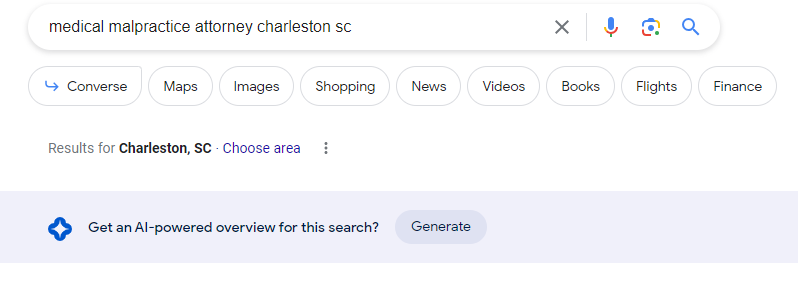
When it comes to the SGE results, it doesn’t currently seem like Google is trying to make waves. I typed in “medical malpractice attorney Charleston SC,” after I geocoded my location to Charleston. First, I got the usual SERP results, but there was also a “generate AI response” option for me to press:

Typing medical malpractice attorney charleston sc gives me the option to click an SGE button.

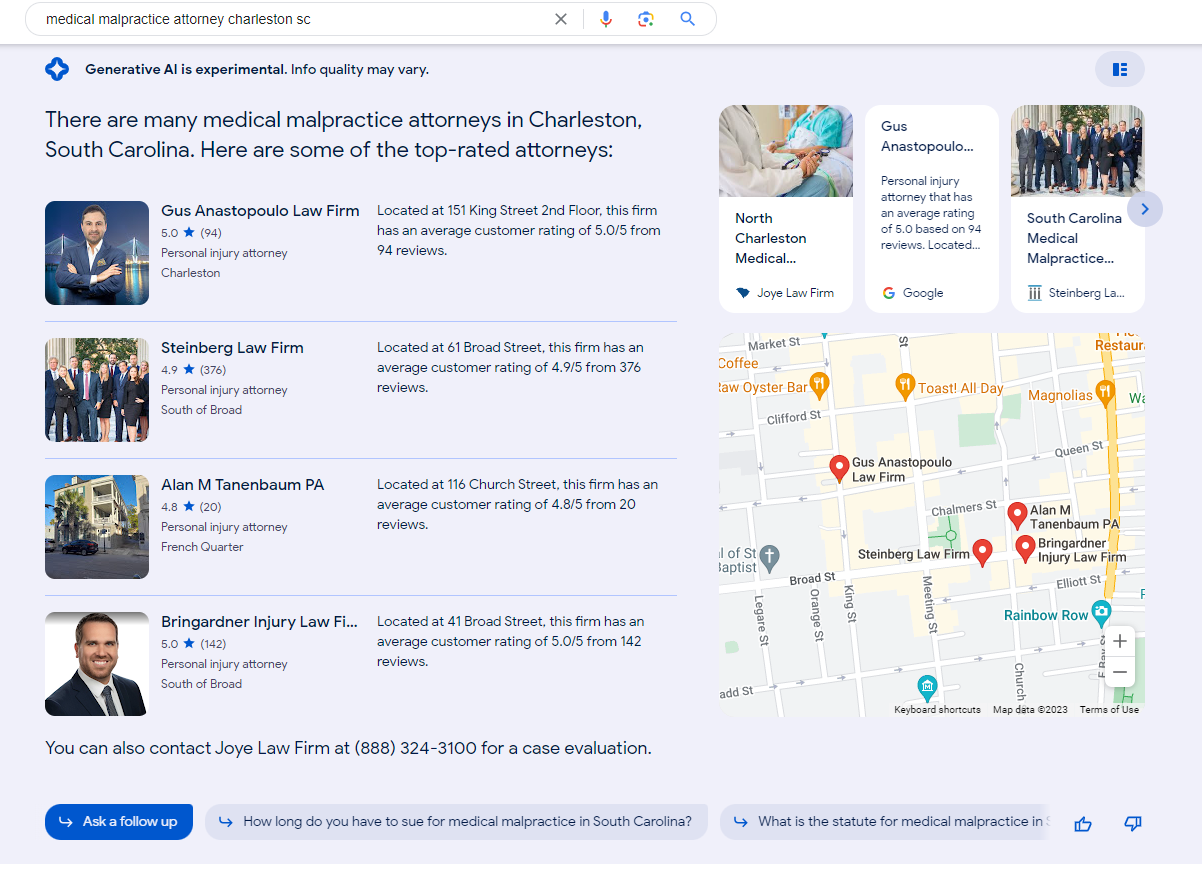
When I clicked the AI button, it seemed like it pulled a list of medical malpractice attorneys in the area, and it appeared to reward reviews from various sources (uh oh, back come the directories?). However, what doesn’t seem to play a role in this generative response (yet) are the PPC or organic results you’d usually find on the SERP. They give these as 4- or 5-pack for each search:

The SGE gave me a directory of sorts.

At the bottom of the SGE response, there were a few prompts for related follow-up questions, presumably what people typically ask around the same time they are looking for a medical malpractice lawyer:

  • How long do you have to sue for medical malpractice in South Carolina?
  • What is the statute for medical malpractice in South Carolina?
  • What are the limits for malpractice in SC

These types of responses are the norm for SGE when you type in the usual keywords that would bring you to a law firm practice area page. It does not yet give you an automatic generative response – you have to choose to click it. 

We should really pay attention to the follow-up queries on the bottom of these responses. These are the type of long-tail keywords that lead to responses we already write answers for, but this gives us an idea of what Google (and readers) want to see. 

These types of queries are harder for SGE to even make a coherent response for. What are they going to do – describe what a car accident or family law attorney is? No, I think these queries will remain relevant to the traditional SERP results. 

However, the long-tail keyword queries are a different story. 

The Law Firm Long-Tail Keywords

I’ve predicted that Google would keep legal queries YMYL, but that may not actually be the case. Of course, this is all still experimental, so I may be proven right. I could just as easily be proven wrong. 

So, I decided to delve into general queries such as “steps to take after a slip and fall accident” or “when should I call a lawyer after a car accident.”

I’ve found that these types of searches generate an automatic SGE response. For these queries, we’re getting a response you could expect to find on ChatGPT, except Google can draw from, well, Google. This AI can access the internet.

When you type in these types of searches, the SGE does give you a response, and it does show a 3-pack (4-pack if you scroll right) of pages where it draws its answer from. Usually, these are law firms, but there are other sources, depending on your question. 

My immediate questions, and ones that people smarter and with more experience than me are tackling, are:

  • What makes a page “good” for SGE to draw from?
  • How do we best optimize for SGE?

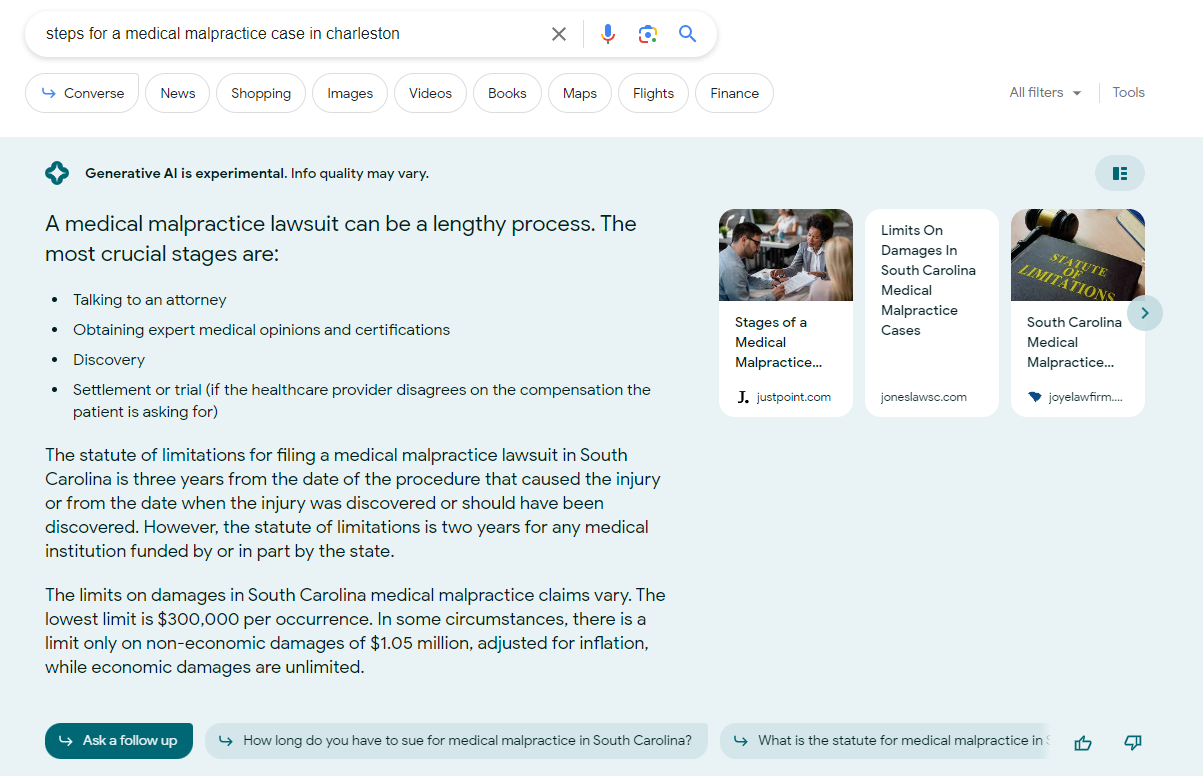
I geocoded myself to Charleston, SC, again and typed “steps for a medical malpractice case in Charleston.” I got the SGE answer straight away, above the fold:

Ask a long-tail keyword geared towards a legal question, and you get an automatic SGE response.

You can see a small photo of, supposedly, where the information used to generate the response comes from. Again, I want to know what makes these the “best” pages to use for an SGE response. 

Again, we get the same follow-up prompts on the bottom that we got when we looked up the “medical malpractice attorney Charleston SC.” 

Below the SGE, we go right into what we’re used to seeing on the SERP, but not sponsored ads. It goes right into the organic search results (my content writer’s heart sings when ads aren’t first), but I also know that so many searchers won’t go beyond the SGE response. 

Something funny happened when I typed, “when should you call a lawyer after a construction accident.” I got the sponsored results first, and THEN I got the SGE response in the middle of the page, finally followed by the organic results:

I’m sure these results will be replicated the more I play with SGE queries. Again, Google is experimenting with all of this, and they will try to figure out what works best for the average user AND for them. Google is not going to throw away revenue, so having the sponsored results show up first shouldn’t surprise anyone. 

Do We Already Know How to do This?

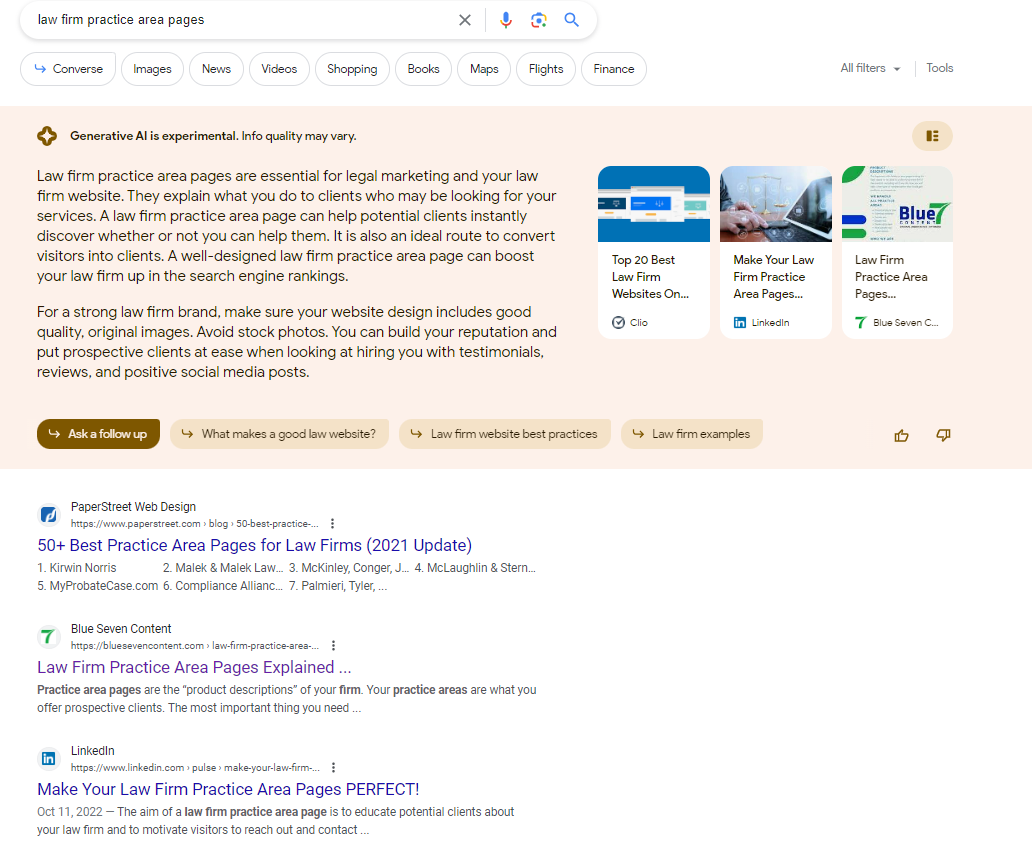
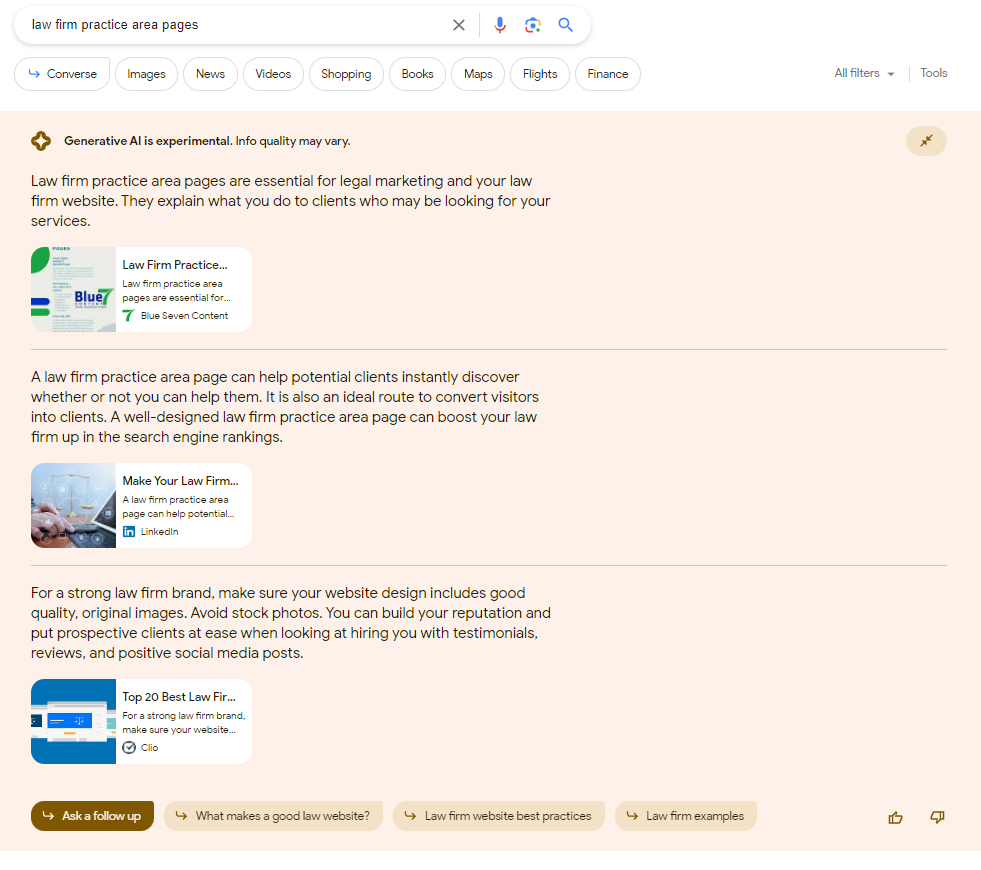
As I think about law firms and search generative experience exploration, I was curious as to how this would work when I entered the keywords that Blue Seven Content usually ranks well for anyway. First, I typed in “law firm practice area pages”:

We already ranked second in organic for this keyword (on most days), and we show up in the SGE as well. Look what happens when I expand the SGE result:

When I expand it out, Blue Seven ranks number one in the SGE response. Now, the results don’t show the meta description that we have for that page, but that’s not surprising. Google has a way of looking at your meta and ignoring it anyway, so there’s that. 

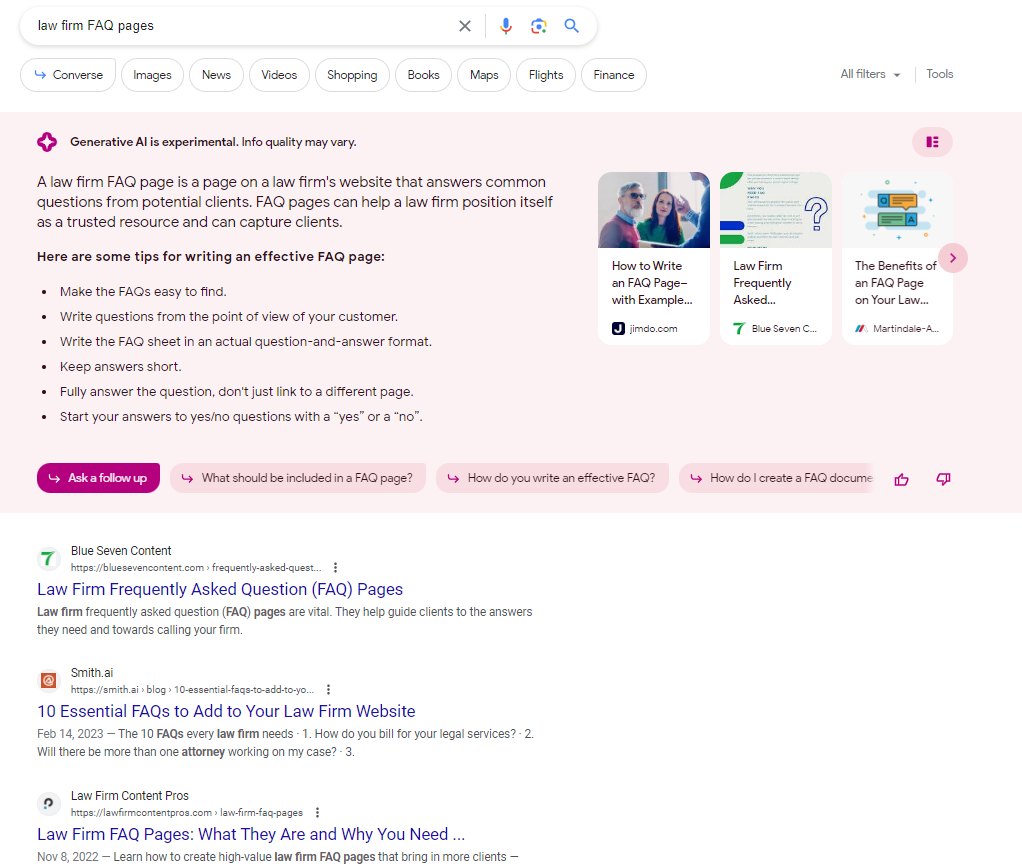
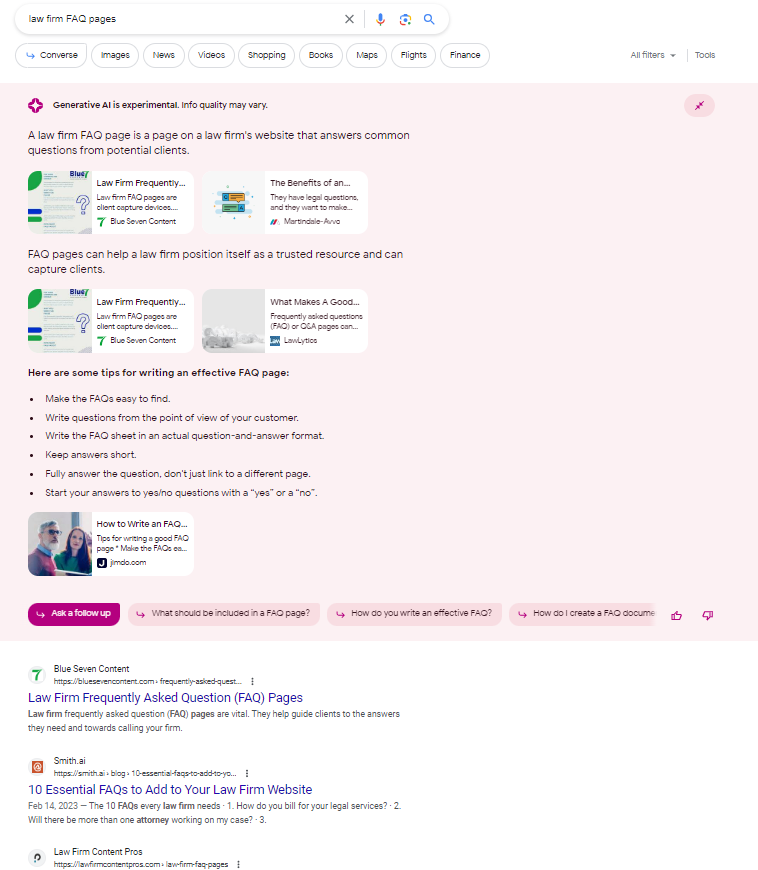
I did the same with “law firm FAQ pages” because we’re frequently number one with that search. Here’s the result:

Here, we show up number one in organic SERP and number one and two in the SGE response:

We Still Have ChatGPT to Deal With

As I’ve noted multiple times before, ChatGPT is a “threat” to us legal content writers. Not legal marketing agencies, though. Legal marketing agencies that handle all of a law firm’s online marketing will always be around, and they’ll adapt. No, it’s the content writers who have to worry.

But do we?

Okay, maybe some legal content writers have to worry. The ones who can’t produce content better than ChatGPT are certainly on the chopping block. But that was always going to be the case. What I think will happen, as I’ve said before, is that ChatGPT has had its sugar rush. It’s given the industry a high (or a bad trip, depending on what your role is). 

But as I’ve toyed around with Google’s SGE, I’ve seen that good content matters. Google is meeting AI in a way that (1) provides simple answers that users are looking for and (2) seeks to maintain the main revenue driver for the platform – ads. 

For now, SGE results are generally pulling answers from well-ranking organic content that already answers, or closely answers, the search query. Could SGE end up pulling content that someone generated with ChatGPT and published? Yes, of course. But not if that content isn’t better than what’s already out there. 

Currently, ChatGPT has many flaws. Phantom court cases and rulings. Massive plagiarism. Predictable writing that reeks of AI. Zero human touch. 

And, of course, there’s the issue of what happens to content online when ChatGPT gains access to the internet (it’ll happen eventually) and begins learning new stuff based on content people have generated using ChatGPT. It’s a self-feeding loop with little new input from actual humans. 

Content degradation is waiting to happen.  

Was there content degradation with human legal content writers consistently regurgitating each other? Of course there was. This is why I’ve said I’m grateful to ChatGPT for snapping us (at least Blue Seven) out of any comfort zone we may have fallen into. 

We have to constantly improve. We have to be better content creators, thinkers, researchers, and writers. Writers have to be better than the silver bullet LLMs that many (lazy) marketers think will be their golden ticket. 

With my intro research into SGE responses to legal queries, I’m positive that quality, human-written content will reign supreme. Humans can and should use the tools available at their disposal, much like SEOs use Ahrefs, Semrush, and Clearscope. They should use tools like editors use, including Copyscape, Grammarly, or Hemingway. These technological advancements didn’t kill the SEO or the editor, and those who are good at their craft don’t completely rely on the tools. Because they are tools used to build the larger product – a good piece of writing. 

Law Firms and Search Generative Experience (SGE) – My Take for Now

I think SGE will seek to answer basic queries with assistance from results that already rank. Perhaps this will go to paid results eventually, but Google is drawing from organic results for now. Ranking in SGE will be more competitive because it’s taking from 3 or 4 organic sources now, then the rest of the SERP responses appear. 

Who knows what this will look like in six months or a year, but I don’t think it’s the death of the legal content writer. I think it’s the beginning of a new search experience, and we have to adapt. What we’re adapting to is still up in the air. How will law firms respond to search generative experience? Stand by, we’ll be back for more.

Written by Allen Watson – Founder and CEO of Blue Seven Content

ChatGPT and Legal Marketing – Where do We go From Here?

(UPDATED FEB 2023) WRITTEN BY ALLEN WATSON: FOUNDER & CEO OF BLUE SEVEN CONTENT

ChatGPT and legal marketing – AI is about to completely upend the legal marketing field.

Okay, not really. But that’s what a bunch of people are about to tell you. Perhaps you’ve already heard that your law firm practice area pages and blog posts no longer need to be written by a human. Maybe someone has raved about how much money you’ll be able to save by not having to pay for content anymore. Since November, all people can talk about is ChatGPT.

Let me be clear – ChatGPT is far more advanced than any other AI that’s come out, at least publicly. In fact, it can create content that’s better than some of the drivel I’ve seen on law firm websites. But I don’t think it’s a legal marketing killer, and I think law firms and legal marketing agencies need to do their research before declaring victory over human writers. 

  1. What is ChatGPT?
  2. Responses to ChatGPT
  3. How Could ChatGPT Disrupt Legal Marketing?
  4. What I Found When Using ChatGPT (Legal Content Writer Explorations)
  5. The Issues With ChatGPT for Legal Content Writing
    1. Plagiarism is a problem
    2. Incorrect information
    3. It cannot can cite sources
    4. Very surface-level content
    5. No current information to pull from
    6. Where does new information come from if everyone stops posting new content?
    7. Possible legal or legislative issues
    8. None of the ChatGPT legal marketing issues are insurmountable
  6. Microsoft and Google – The Battle Brewing
  7. Embrace Technological Advances Instead of Dismissing Them

What is ChatGPT?

If you’ve been anywhere on social media recently, you’ve seen people raving (or ranting) about ChatGPT. 

But what the hell is it?

ChatGPT was created by OpenAI, which is a research lab focused on advancing artificial intelligence technologies. The organization was founded in 2015 by various individuals, including Elon Musk. However, Musk resigned from the board of OpenAI in 2018.

ChatGPT was released in beta version to the public on November 30, 2022, and amassed more than a million users less than a week after its launch. ChatGPT uses a large artificial intelligence model created by OpenAI, called GPT-3.5 language technology. This system has been trained by using a massive amount of text data from various sources.

ChatGPT is revolutionary, but we're not sure it can handle good legal content writing.
You need to understand ChatGPT and how it affects your field.

The current way to use ChatGPT is sort of like a chatbot, where a user will input a question or prompt into a search bar and watch as ChatGPT responds with what it believes to be the appropriate information for the prompt or question. Perhaps the best part of ChatGPT is that you can get it to respond in pretty much any form you want. You can have it craft a five-paragraph essay, or you can command it to give the answer or response as a poem.

Want to dig further? Tell ChatGPT to craft a response to a question or prompt in iambic pentameter or in the speaking style of William Shatner. It can do it.

I asked it to write me a love story between Luke Skywalker and Yoda. It did it, and it convinced me that was the true story behind the whole saga.

This AI system responds really well to the prompts imputed. You can get very specific and creative. I do strongly suggest you go try it out. It’s honestly great for entertainment. You’ll also see the potential for this tech to disrupt everything.

Responses to ChatGPT

To say the response to ChatGPT has been resounding and immediate is an understatement. Educators have proclaimed that the essay is dead because there will be no way to know what’s student-written and what’s generated by ChatGPT. Teachers say there is no way they’ll be able to assign take-home tests.

Some have questioned whether ChatGPT will make lawyers obsolete, as it may be able to create arguments and draft legal documents. Imagine a courtroom where all you do is wait for AI to tell you the outcome of the case because it’s already read every possible law and court case.

The Washington Post has said that Google (and other search engines) face a major threat because of ChatGPT. The argument is that ChatGPT could spell disaster for Google by providing better answers to the queries that we typically ask Google.

Google crawls and indexes billions of web pages. It then ranks this content in order of the most relevant answers (most of the time). When you perform a search, you get a list of links to click through, typically beginning with ads related to your search and then moving on to the organic links related to your search. This, my friends, is where SEO wizards have made their bones.

When individuals type in a question on ChatGPT, they are presented with a single answer based on the AI search and synthesis of the information already online. The idea is that now, instead of you having to click through the most relevant links to find the information you need, ChatGPT will handle the hard part for you and give you THE answer. The definitive answer. 

Of course, there have been significant discussions about what comes next for the internet. Web 3.0 is typically seen as the next phase, even though there is little consensus about what this means or what it looks like. We’ve discussed the metaverse as being the key component in a Web 3.0 world, and ChatGPT and other AI technologies could aid that shift.

Legal marketing SEO agencies make a living off of helping law firms rank toward the top of search engines for specific queries. The industry, quite frankly, isn’t ready to handle a world where SEO isn’t a thing. 

All I can do is approach ChatGPT from the angle of a content writer that understands and uses SEO but focuses on providing content that readers need/want to see.

I’ve been creating legal marketing content for years. I’ve written thousands of law firm practice area pages and blog posts, and I’ve supervised writers who have written tens of thousands. So, it was only natural for me to begin by prompting ChatGPT with topics that frequently crop up when crafting a page.

I asked, “What types of compensation are available for a car accident in California?” and it gave me a solid answer, one that you’d typically see on a law firm’s website.

I asked, “Is there a cap on damages available for a successful personal injury claim in Michigan?” and ChatGPT gave me a convincing answer.

I asked, “What are the most common injuries caused by a moped accident?” and the AI provided an indisputable list of injuries.

Finally, I asked, “What are the four elements of negligence for a personal injury claim?” and the AI gave me exactly what you’d expect to see on a law firm’s website.

Each one of these responses came back with data organized in a way that we would typically see on a law firm web page. There was a brief explanation, a bullet list or a number list of some sort, and often a little conclusion to wrap it up. I could certainly envision a legal content writer crafting a law firm practice area page or blog post, inputting their H2s into the ChatGPT prompt, and then copy and pasting the answer to their page.

After these basic queries, which would essentially be sections of a longer page for a law firm, I decided to get more specific with the requests. I asked ChatGPT to write a 500-word law firm practice area page targeting those who need a Chicago car accident attorney.

You know what?

The page wasn’t bad. It was surface-level, but it certainly provided enough information to maybe convince someone that they’d need an attorney if they’ve been injured in a crash.

But it was certainly not the type of page that I would create. I do see the value of using ChatGPT and other types of AI tools for coming up with ideas for a page. This is a tool, not a replacement. At least not yet.

Blue Seven Content founder Allen Watson discusses ChatGPT with Conrad Saam and John Reed.

Just because I said the responses given by ChatGPT were convincing and organized does not mean that they were without issues. In fact, everything that I put into the prompt would never pass muster at Blue Seven Content, and it certainly wouldn’t fly on a law firm’s website.

Plagiarism is a problem

The most glaring issue that cropped up was plagiarism. This is the biggest sin when it comes to writing website content, no matter the industry. If a law firm content writer plagiarizes content from either themselves or from other sources, this is going to hurt the web page. Google’s algorithms know how to spot copied content, and they can penalize a page or even an entire website for it.

  • The prompt on car accident compensation in California came back as 33% plagiarized.
  • The query about moped injuries came back as 23% plagiarized.
  • My question about the four elements of negligence came back 19% plagiarized.
  • A prompt asking how burn injuries are classified was returned as 17% plagiarized.

Not once did I ask it a “typical” legal question and get a response that was less than 15% plagiarized. This challenge is not insurmountable if you have the ability to detect plagiarism and have a competent editor (even then, all you’re doing is wordplay without originality). Right now, ChatGPT is not capable of original thought. It has to provide answers using information already available.

Also, remember that 500-word practice area page I told ChatGPT to write? Well, it came back 34% plagiarized. Sources it drew from ranged from other law firm websites to the Daily Mail. If you’re a veteran legal content writer, you already know to avoid citing competitive law firms and sources that lack credibility. 

Jan 2023 Update – I wanted to know how ChatGPT has evolved, if at all, since it’s release. I asked it to craft a law firm page for fairly simple prompts. I received answers that were less than 10% plagiarized and was fairly impressed. However, I then asked the AI to write a page that required a slightly more technical response, but still fairly basic for a law firm website. There was more than 20% plagiarism.

Bottom line so far – ChatGPT simply cannot help but provide plagiarized answers for anything more than a VERY basic prompt.

Incorrect information

Incorrect information is the last thing a law firm needs on its website.  One of the biggest problems with ChatGPT is the lack of sourcing, and the fact that you have to 100% know the material in order to detect incorrect responses.

I asked ChatGPT, “Is there a cap on damages available for a successful personal injury claim in Michigan?”

If you know anything about these caps, then you know they typically apply to non-economic damages for medical malpractice claims, which is the case in Michigan. However, ChatGPT responded that there was a cap for ALL non-economic damages in Michigan.

ChatGPT presents incorrect information as if it’s fact and in a pretty convincing way. With this tech, you can’t see that there may be other answers the same way you can when you perform a Google search. Nor does it provide room for nuance of the law or the geographic area of the law you are searching. 

The AI tech behind ChatGPT isn’t at a level where it can detect incorrect information, or at least where it can analyze and synthesize information correctly. Somewhere, the AI read that Michigan had a non-economic damage cap, and it had no clue that the information was incorrect. We can look directly at a tweet from Sam Altman, CEO of OpenAI:

I asked ChatGPT, “What are the exceptions to California’s medical malpractice statute of limitations?” The response I got was lacking in substance. 

The AI response failed to properly explain the exception for minors who sustain injuries due to a medical error. It didn’t highlight that there is a difference depending on the age of the minor when the injury occurred. ChatGPT failed to mention the exceptions to California’s medical malpractice statute of limitations for foreign objects left behind in a person’s body after a procedure. 

These are just a few of the mistakes I found during a cursory review. I can only imagine the issues that would arise for slightly more complex queries. 

It cannot can cite sources

I initially thought ChatGPT wasn’t able to cite sources, but it can. When you write your prompt, you can tell the AI to use and cite reputable sources and it will do so. However, I caution anyone doing this, because we don’t currently know how ChatGPT decides what is “reputable.” Conrad Saam, my friend and president of Mockingbird Marketing, has said that the program has given him Wikipedia as a “reputable” source. While Wikipedia is generally accurate, there’s a snowball’s chance in hell I’ll be citing it on a law firm practice area page, FAQ page, or blog post.

We also don’t want to pull information from John Doe’s hobby blog. Don’t get me wrong, we’ll use those sources as a starting point, but we have to verify the information and cite using trusted sources. 

I’m still of the opinion that, no matter what citations ChatGPT provides, there needs to be a human fact-checker. This is particularly true for those of us who write content that demands a certain degree of accuracy. This, in my opinion, would lead to the most time-consuming part of preparing a page for publishing. If you are going to cite data or statistics, then you need to be able to source the information through a hyperlink on the web page. Anyone relying on ChatGPT to craft legal content will have to have an editor go back and (1) go to the source provided by the AI (2) verify the information, and (3) hyperlink the external sources into the content.

All of this is beginning to sound like work writers already do when they create a new law firm website page from scratch, and it’s likely to take nearly as long. If not longer. Content writers often loathe having to go in and adjust or correct other people’s work. It’s typically easier to simply make a new page. 

Very surface-level content

The information returned through ChatGPT is fairly surface level, at least for the purposes of law firm website content. Even if we can get passed the plagiarism issue with good editing, the pages ChatGPT provides are equivalent to what I’d expect from someone who has never written this type of content before. It’s fluffy and lacks nuanced research.

No current information to pull from

Right now, ChatGPT relies on information only up to a certain point in 2021. The AI does not use current data or any real-time information. This will be a problem if you want to use current data and statistics or any new laws on your law firm’s website. Additionally, if you need to craft a blog post about current changes or updates to your particular field of law, ChatGPT will have no way to do this.

Ramping up ChatGPT and other artificial intelligence programs to allow for real-time updates will be a massive undertaking. This requires enormous computing power, something that will take some time to build. 

I recently read “The Metaverse: And How It Will Revolutionize Everything” by Matthew Ball, and one possible solution to this problem could be on our tables and in our pockets – our devices. Almost everyone has a computing device (or four or five of them), and the reality is that they remain dormant much of the time. 

If a larger system had the ability to tap into these devices for their computing power, this could allow for the systems needed to control a real-time AI program (as well as potentially power a metaverse immersive environment). It’s essentially crowd-sourcing computer power. 

This comes with a whole slew of privacy and legal questions that many of us are certainly not ready to think about, which highlights some of the issues that AI developers will have to overcome. 

Where does new information come from if everyone stops posting new content?

Maybe this is just my limitations on what I am able to understand about ChatGPT’s capabilities and AI in general, but if this type of technology is used to create new content, where will the AI be able to draw from and learn from in the future?

I envision a future where, if this type of artificial intelligence becomes common, we see AI copying other AI responses. Somewhere, AI systems need to intake new information from human sources in order to stay relevant. 

There will inevitably be legal issues that arise. The courts and lawmakers will step in to address these issues, but that could take a while. For example, will anyone face liability if ChatGPT or another AI gives incorrect information that then causes harm to others? Imagine a WebMD controlled by AI. Will people listen to the advice given by the AI, or will they find a way to verify what they’ve been told?

What if it’s determined that anything written with AI must be labeled as being “machine-generated,” much like the requirement on most platforms that certain posts have to be labeled as ads? Will your legal clients trust you if they see your website is created by AI?

ChatGPT is currently in beta form, and we’re all the test subjects. The more prompts we put into the system, the more it will learn. Developers will continue to tweak the code to determine what works best, and the AI will learn as it goes. 

The system will get better at understanding why incorrect information is, in fact, incorrect. It will learn that it needs to take existing information and craft it in a way that doesn’t plagiarize others. Coders can help the AI recognize what an authoritative source looks like, and they can show it how to use anchor text to hyperlink. Hell, the AI can probably teach itself how to do that.

Using AI for content writing - embrace the change, but be wary of the outcomes.
Will AI be a tool to use when crafting legal content, or is this going take over?

Microsoft and Google – The Battle Brewing

Microsoft recently announced they were investing $10 billion into OpenAI, and there is strong speculation they’ll integrate ChatGPT into their Office tools. This is the third, but largest, round of investment the tech giant has made into the AI company. Microsoft has clearly seen the value of artificial intelligence, and they’re always working to reinvent the company and stay ahead of the curve.

As of February 2023, it seems that Microsoft is beginning to use ChatGPT through their search engine Bing and browser Edge. This is still in limited testing, but it seems that users will be able to conduct a search but that half of the results page will incorporate the chatbot. This could be a huge push for the search engine that’s so long been eating Google’s dust for breakfast in the search world. It could be a paradigm shift for the world of search.

Google is nervous. Google called in the big dogs, founders Larry Page and Sergey Brin, to help guide them through this credible threat to the company’s main source of revenue (search engine results and ads). Unfortunately for Google, their first foray into the competition with Bard AI was a flop. The search engine giant’s demo of the AI and their search engine resulted in an inaccurate response, and this response led to Google losing more than $100 billion in valuation in one day.

Until we see how the battles between Google, Microsoft, and other major companies end, we’ll have to keep adjusting strategies. As a legal content writer or SEO company for legal marketing, this is something you’ll need to keep an eye on over the next few months and into 2024.

Legal marketing companies and law firms may actually need to start focusing on Bing much more than they’ve done in the past. Let’s be honest – Google has driven SEO over the last two decades. That supremacy is threatened right now.

Embrace Technological Advances Instead of Dismissing Them

It may seem like I’m against AI. I’m not. In fact, I want to embrace it. ChatGPT and legal marketing aren’t avoidable.

There’s never been a time when rejecting new technologies has worked out for anyone in the long run. Horse and carriage operators vehemently hated the concept of a motorized vehicle, and many people doubted whether cars would actually become mainstream. For years, people doubted that computers could ever revolutionize the way individuals went about their daily lives. Even the benefits of the internet weren’t fully understood for quite a while. In fact, many scoffed at the idea of online shopping and “social media.”

Here we are, looking at what could represent another major shift in the way we approach “knowledge.” We have a choice – both as a society and as individuals. We can reject the technology and deny its ability to shape our lives, or we can embrace this type of AI and figure out how to make it work best for us.

No matter what choice we make, the end result will be the same. There is no putting a genie back in the box. ChatGPT is already far more advanced than any other type of AI chat we’ve seen, and it’s still in a rudimentary form. For those of us in the legal marketing sphere, the idea of ChatGPT can be terrifying if we don’t understand what it means for us. 

Maybe ChatGPT or another AI program will eventually address the shortcomings I mentioned above. Why would any legal marketer want to be behind on the trend because they wanted to “protect” their industry? Protectionism only delays the inevitable. 

We don’t need protection from tech – we need to work with it. We have to embrace the possibility inevitability of change. We can use this to be better.